Neomerinthe
A genus of deep-water scorpionfishes found in Atlantic, Indian and Pacific Oceans.
Last updated
Neomerinthe is a genus of marine ray-finned fish in the scorpionfish family, Scorpaenidae. These fish inhabit the Atlantic, Indian, and Pacific Oceans.
The genus was established in 1935 by American ichthyologist Henry Weed Fowler, who designated Neomerinthe hemingwayi as the type species. The name combines "neo," meaning new, with Merinthe, a synonym for the genus Pontinus, which Fowler thought the new species resembled.
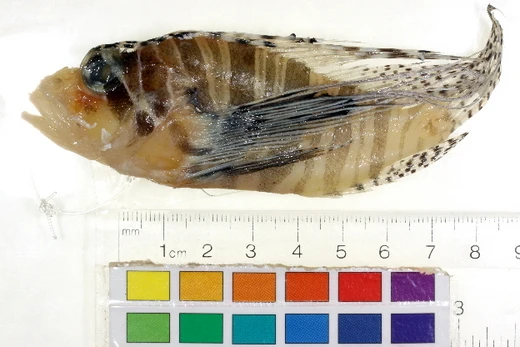
The genus contains 12 species. They have an elongate, robust body and lack an occipital pit behind the eyes. A bony suborbital ridge under the eye is armed with three spines, and the uppermost spine on the preoperculum is longer than the others. Teeth are present on the sides of the roof of the mouth.
The dorsal fin has 12 spines and 9–10 soft rays, with the rearmost ray split to its base. The wedge-shaped pectoral fin has 16–18 rays; the longest rays are in the center, and in adults, some upper rays are branched at the tips. The body scales are rough, and the lateral line extends to the base of the caudal fin. Sizes range from a standard length of 7.1 cm (2.8 in) in the curved-spine scorpionfish (N. procurva) to a total length of 59 cm (23 in) in Folger's scorpionfish (N. folgeri).
Neomerinthe scorpionfishes are found worldwide except in the eastern Pacific Ocean, and they live in deep water.
Scientific classification
- KingdomAnimalia
- PhylumChordata
- ClassActinopterygii
- DivisionTeleostei
- OrderPerciformes
- FamilyScorpaenidae
- GenusNeomerinthe
Named by Fowler, 1935
Sources: Wikipedia taxobox: Neomerinthe (CC BY-SA 4.0)
Quick Facts
- Type species
- Neomerinthe hemingwayi
Facts from the source article.
More in Lionfish and Scorpionfish
Sources
Compiled from Wikipedia and the sources listed below. Text from Wikipedia is available under CC BY-SA 4.0; this entry is adapted from it.
- Wikipedia: Neomerinthe (CC BY-SA 4.0).
- Word definitions: the , each quoted from its Wikipedia article.
Spotted an error? Know more?
Reader corrections go straight into our review queue. Suggest an edit · How this site is sourced