Taenianotus
A monotypic scorpionfish genus with a leaf-like appearance and wide Indo-Pacific range.
Last updated

Diego Delso · via Wikipedia: Taenianotus · CC BY-SA 4.0
Taenianotus is a monotypic genus, containing only the species Taenianotus triacanthus.[1] In 1802, the French naturalist Bernard Germain Étienne de La Ville-sur-Illon, comte de Lacépède established the genus Taenianotus when he described Taenianotus triacanthus.[2] Cuvier, in 1829, designated Taenianotus triacanthus as the type species for the genus.[2]
Scientific classification
- KingdomAnimalia
- PhylumChordata
- ClassActinopterygii
- DivisionTeleostei
- OrderPerciformes
- FamilyScorpaenidae
- GenusTaenianotus
- SpeciesTaenianotus triacanthus
Named by Lacepède, 1802
Sources: Wikipedia taxobox: Taenianotus (CC BY-SA 4.0) · order, family and genus agree with WoRMS AphiaID 218119 (CC BY 4.0)
Conservation status
Least Concern (LC)
- LC▲ this species
- NT
- VU
- EN
- CR
- EW
- EX
Source: IUCN Red List assessment · GBIF copy of the Red List category
How big is it?
Largest length in the source, 0.1 m, next to a 1.8 m person.
Diagram: drawn by Codexery, schematic shapes to scale (not a likeness). Length: Wikipedia: Taenianotus
Where the taenianotus has been recorded
Each dot is a place where the species has been observed and reported (2,405 records, half-degree grid) — not a modelled range. 32 inland records left out (institution coordinates).
Map: drawn by Codexery. Data: GBIF occurrence search (records CC0 / CC BY) · Natural Earth basemap (public domain) · place coordinates: Wikipedia (CC BY-SA 4.0)
Biology and range
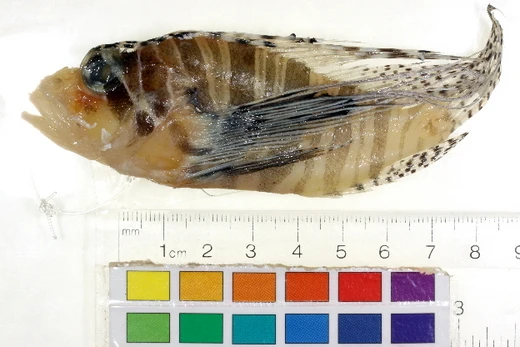
A dark line runs through its eyes.[3] The prey is sucked in by a sudden opening of the mouth when the fish is close enough.[3] At full maturity, Taenianotus triacanthus reaches a length of roughly 10 cm.[3] The body of this fish is extremely flattened, giving it a leaf-like appearance.[3]
Shedding its skin occurs every 10 to 14 days, and following this molt, the fish may alter its coloration.[4] This species hunts by ambush, lying in wait for small fish or shrimp to come near.[3] The geographic distribution of Taenianotus triacanthus extends from the east African coast and the Red Sea across the tropical Indo-Pacific, reaching as far north as the Galapagos Islands, the Ryukyu Islands, Hawaii, and the coast of New South Wales.[3]
What the specialist sources record
The GBIF Backbone Taxonomy lists Taenianotus triacanthus as an accepted species in the family Scorpaenidae.[5] GBIF holds 2,720 occurrence records for this taxon as of 8 October 2026.[5] The specific name triacanthus is derived from tri ("three") and acanthus ("thorn" or "spine"), though the fish actually possesses only two preopercular spines.[6] Around its mouth, the leaf scorpionfish has a variably developed 'beard' of fine appendages, and algae and hydroids may grow on its skin.[1]
References
- "Eight interesting facts about the Leaf Scorpionfish". facts only, no text reused. daveharasti.com
- Wikipedia, "Taenianotus" (CC BY-SA 4.0), which cites: ; ; "Fishes of the World", Wiley, 2016, p. 468–475 (we also read that source) en.wikipedia.org
- Wikipedia, "Taenianotus" (CC BY-SA 4.0) en.wikipedia.org
- Wikipedia, "Taenianotus" (CC BY-SA 4.0), which cites: "Eight interesting facts about the Leaf Scorpionfish" (we also read that source) en.wikipedia.org
- GBIF Backbone Taxonomy and occurrence index, Taenianotus triacanthus (taxon key 2334499). CC BY 4.0 (backbone); counts are facts. gbif.org
- Wikipedia, "Taenianotus" (CC BY-SA 4.0), which cites: "Order Perciformes (Part 9): Suborder Scorpaenoidei: Family Scorpaenidae", The ETYFish Project Fish Name Etymology Database, 2 October 2021 (original not read by us) en.wikipedia.org
Each numbered sentence above was checked against the source it cites before publication. Sentences citing Wikipedia adapt text from the English Wikipedia article Taenianotus (contributors), used under CC BY-SA 4.0; this entry is available under the same licence. Other sources were used for facts only; no text or images are copied from them.
More in Lionfish and Scorpionfish
Sources
Compiled from Wikipedia and the sources listed below. Text from Wikipedia is available under CC BY-SA 4.0; this entry is adapted from it.
- Wikipedia: Taenianotus (CC BY-SA 4.0).
- Classification: the source article's taxobox; order, family and genus checked against WoRMS, the World Register of Marine Species (CC BY 4.0).
- Conservation status: IUCN Red List assessment.
- Occurrence records: GBIF (CC0 / CC BY). Basemap: Natural Earth (public domain).
- Word definitions: the , each quoted from its Wikipedia article.
Spotted an error? Know more?
Reader corrections go straight into our review queue. Suggest an edit · How this site is sourced