Mistapew
A spirit-being across Cree-Montagnais-Naskapi cultures, known as 'big man'.
Last updated

Alarichall · CC0
Scholars have noted that reconstructing pre-colonial Mistapew beliefs is difficult because ethnographic fragments come from different sources and time periods, and traditional beliefs about this figure underwent change during the twentieth century.[1]
Life and work
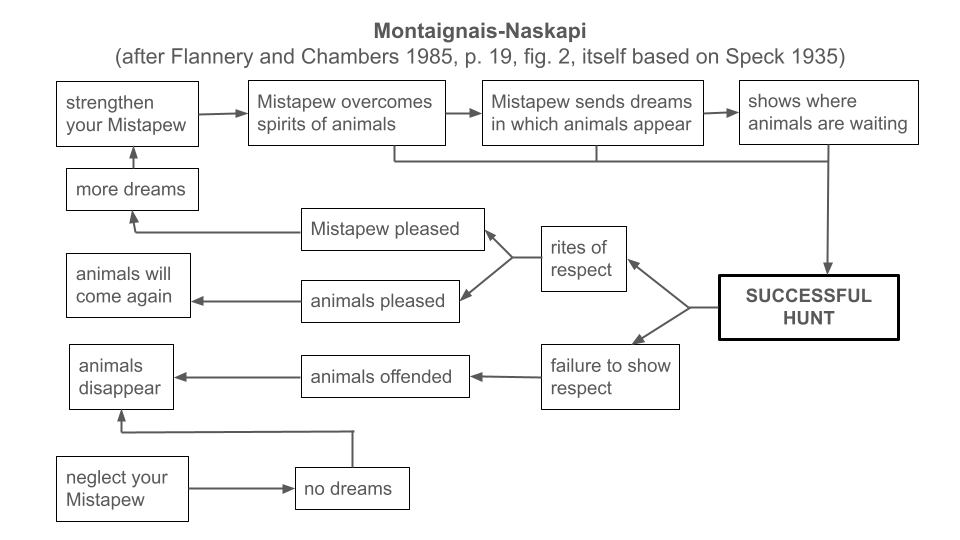
In Innu and Naskapi cultures, anthropologist Frank Speck reported in 1935 that Mistapew denoted "the human soul in its animate, active state"[2] Speck noted that a hunter's success depended on harmony with the "Great Man," and he perceived some similarity between Mistapew and the Witigo.[2] Regina Flannery's 1930s and 1940s fieldwork among East Cree communities at Waskaganish, Eastmain, Fort George, and Mistassini detailed what Mištapew meant there.[3] In the myth, Mištapew visits Čowa, prophesies he will kill a beaver, and instructs him not to feed it to his children. Čowa disobeys, suffers poor hunting, and later meets Čičimištapew, Mištapew, Mištapeš, and animal chiefs, who teach him hunting skills.[3]
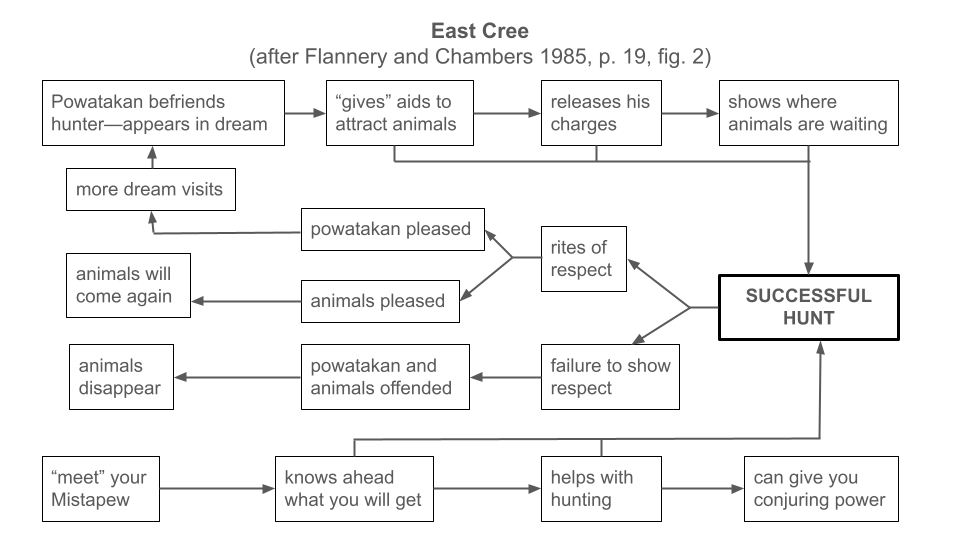
By the 1960s, James Bay Cree no longer relied on hunting for subsistence, but the idea of Mištapew lasted, extended to cover "spirits" believed in by the Cree.[3] Within the shaking tent ceremony, a ritual that provided divinatory guidance for hunting, Mištapew played a central role.[4] Flannery documented a narrative from multiple community members about a man named Čowa who performed the shaking tent ceremony for the very first time.[3]
What the cited sources add
Opaskwayak Cree elder Wilfred Buck reported in 2009 a story naming the constellation Orion as Mistapew, where a giant imprisons the souls of seven sleeping brothers.[5] Leona Makokis's late twentieth-century interviews with Saddle Lake elders report that the teacher of honesty is "Sabe" or "Mistapew," a kind, honest being that dwells in the unseen world.[6] According to Joachim Fromhold, in the Rocky Mountains Mistapew are giants, offspring of spirits and humanity, who were overseers of the earth and guardians of mankind.[7] Fromhold states that these giants withdrew from the living world and went to sleep, and their outlines can still be seen in natural features.[7]
References
- Wikipedia, "Mistapew" (CC BY-SA 4.0), which cites: John S. Long, Richard J. Preston, and Cath Oberholzer (2006). "Manitu Concepts of the Eastern James Bay Cree", in Papers of the 37th Algonquian Conference, pp. ; Flannery, "Each Man Has His Own Friends: The Role of Dream Visitors in Traditional East Cree Belief and Practice", Arctic Anthropology, 1985, p. 1–22 (original not read by us) en.wikipedia.org
- Wikipedia, "Mistapew" (CC BY-SA 4.0), which cites: Frank Gouldsmith Speck, Naskapi: The Savage Hunters of the Labrador Peninsula (University of Oklahoma Press, 1977 [first publ. 1935]), . (original not read by us) en.wikipedia.org
- Wikipedia, "Mistapew" (CC BY-SA 4.0), which cites: Flannery, "Each Man Has His Own Friends: The Role of Dream Visitors in Traditional East Cree Belief and Practice", Arctic Anthropology, 1985, p. 1–22 (original not read by us) en.wikipedia.org
- Wikipedia, "Mistapew" (CC BY-SA 4.0), which cites: Flannery, "Each Man Has His Own Friends: The Role of Dream Visitors in Traditional East Cree Belief and Practice", Arctic Anthropology, 1985, p. 1–22; John S. Long, Richard J. Preston, and Cath Oberholzer (2006). "Manitu Concepts of the Eastern James Bay Cree", in Papers of the 37th Algonquian Conference, pp. (original not read by us) en.wikipedia.org
- Wikipedia, "Mistapew" (CC BY-SA 4.0), which cites: Buck, "Atchakosuk: Ininewuk Stories of the Stars", First Nations Perspectives, 2009, p. 71–83 (original not read by us) en.wikipedia.org
- Wikipedia, "Mistapew" (CC BY-SA 4.0), which cites: Makokis, Leona Josephine. 2001. "Teachings from Cree Elders: A Grounded Theory Study of Indigenous Leadership." Unpublished Doctor of Education thesis, Universi (original not read by us) en.wikipedia.org
- Wikipedia, "Mistapew" (CC BY-SA 4.0), which cites: Joachim Fromhold, Alberta History. Jasper National Park: 10,000 Years of Indian History. Part 2 - 1750 to 1850 (Lulu, 2011). (original not read by us) en.wikipedia.org
Each numbered sentence above was checked against the source it cites before publication. Sentences citing Wikipedia adapt text from the English Wikipedia article Mistapew (contributors), used under CC BY-SA 4.0; this entry is available under the same licence. Other sources were used for facts only; no text or images are copied from them.
More in Legendary Creatures of the Indigenous Peoples of North America
Sources
Compiled from Wikipedia and the sources listed below. Text from Wikipedia is available under CC BY-SA 4.0; this entry is adapted from it.
- Wikipedia: Mistapew (CC BY-SA 4.0).
Spotted an error? Know more?
Reader corrections go straight into our review queue. Suggest an edit · How this site is sourced