Court
Institution with authority to adjudicate disputes and administer justice.

A court is a body, typically a government institution, that has the power to settle legal disagreements between people or groups and to deliver justice in civil, criminal, and administrative cases, all while following the rule of law. These bodies are made up of judges or other judicial officers, and they are generally created or abolished by laws passed by a legislature. However, a court can also be established by a constitution or a similar founding document. The specific authority a court holds is called its jurisdiction, which defines what kinds of legal questions or requests it has the power to decide.
The word "court" comes from the French *cour*, meaning an enclosed yard, which itself traces back to the Latin *cōrtem* and *cohors*, also referring to an enclosed space or its occupants. This Latin root is related to the word for "garden." The meaning of a judicial assembly emerged in the 12th century, evolving from the earlier use of the term for a ruler and their attendants, who would meet in such an enclosed yard to settle disputes. The verb "to court," meaning to seek favor, comes from the idea of traveling to a sovereign's court to gain their approval.
The term "the court" can also refer to the presiding judge or judges themselves. A judge or panel of judges may be called "the bench," while the lawyers are collectively known as "the bar." The system of all courts that interprets and applies the law is called the judiciary. The physical location where a court meets is its venue; the specific room is a courtroom, and the building is a courthouse. These facilities can range from very small and simple spaces in rural areas to large, complex buildings in cities.
Jurisdiction, from Latin meaning "to declare the law," is the court's practical authority to decide certain matters. According to William Blackstone, a court handling civil wrongs needs at least three parties: the plaintiff (who claims an injury), the defendant (who is asked to provide a remedy), and the judicial power (which examines the facts, applies the law, and orders a legal remedy). In higher courts, there are also barristers, attorneys, and other assistants, and sometimes a jury. Jurisdiction is the official power to make legal decisions over a person or thing within a specific territory. A key question in any legal case is whether a court has jurisdiction to hear it. The three basic parts of jurisdiction are: personal jurisdiction (over a person or thing), subject-matter jurisdiction (over the type of legal issue), and territorial jurisdiction (over people within a certain area).
- field
- Law and judiciary
- known_for
- Adjudicating legal disputes and administering justice
- types
- Trial courts, appellate courts, administrative courts, international courts, tribunals
- key_concept
- Jurisdiction (personal, subject-matter, territorial)
- legal_traditions
- Civil law courts and common law courts
Lore & Background
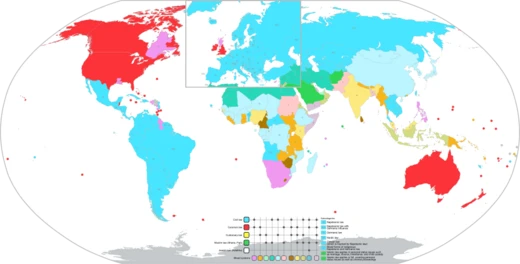
The word 'court' comes from the French 'cour', an enclosed yard, deriving from the Latin 'cōrtem' and ultimately from Ancient Greek 'χόρτος' (khórtos) meaning 'garden'. The meaning of a judicial assembly first appears in the 12th century, originating from the earlier usage designating a sovereign and his entourage who met to adjudicate disputes in such an enclosed yard. The verb 'to court', meaning to win favor, derives from the same source as people traveled to the sovereign's court to win his favor. According to William Blackstone's Commentaries on the Laws of England, a court (for civil wrongs) is constituted by a minimum of three parties: the āctor or plaintiff, who complains of an injury done; the reus or defendant, who is called upon to make satisfaction for it; and the jūdex or judicial power, who examines the truth of the fact, determines the law, and applies a legal remedy. It is also usual in superior courts to have barristers, attorneys, or counsel as assistants, and courts often consist of additional barristers, bailiffs, reporters, and perhaps a jury. The two major legal traditions of the western world are civil law courts and common law courts. Civil law courts are profoundly based upon Roman law, specifically the Corpus Juris Civilis, rediscovered around the end of the eleventh century. In most civil law jurisdictions, courts function under an inquisitorial system, while in the common law system, most courts follow the adversarial system.
Reader's Guide
Courts serve as the central means for dispute resolution in both common law and civil law legal systems, with the understanding that all people have an ability to bring their claims before a court. The system of courts that interprets and applies the law is collectively known as the judiciary. Courts may be organized into a hierarchy with specific jurisdiction, including specialized courts. Trial courts hold trials and have varying original jurisdiction, while appellate courts hear appeals of lower courts. Some courts, such as the Crown Court in England and Wales, may have both trial and appellate jurisdictions. International courts, such as the International Criminal Court based in The Hague, have been created to resolve matters not covered by the jurisdiction of national courts. The practical authority of a court—its jurisdiction—is defined as the official authority to make legal decisions and judgments over a person or material item within a territory, with three basic components: personal jurisdiction, subject-matter jurisdiction, and territorial jurisdiction. Opinion polls show citizens tend to value impartiality in courts.
Did You Know?
- The word 'court' comes from the French 'cour', an enclosed yard, deriving from the Latin 'cōrtem' and ultimately from Ancient Greek 'χόρτος' (khórtos) meaning 'garden'.
- According to William Blackstone, a court for civil wrongs requires a minimum of three parties: plaintiff, defendant, and judicial power.
- International courts like the International Criminal Court are based in The Hague, Netherlands.
Frequently Asked Questions
What is a court in the legal system?
A court is an institution—typically a government body—empowered to resolve legal disputes between parties and deliver justice across civil, criminal, and administrative matters under the rule of law. It is staffed by judges or other judicial officers who hear cases and issue binding decisions.
What are the main types of courts?
Courts are generally divided into trial courts, appellate courts, administrative courts, international courts, and tribunals. Each tier or category handles a distinct layer of proceedings, from first-instance hearings up to cross-border adjudication.
What does 'jurisdiction' mean for a court?
Jurisdiction is the practical scope of authority a court holds to decide particular kinds of cases, broken down into personal, subject-matter, and territorial dimensions. Without proper jurisdiction, a court lacks the legal power to issue a valid ruling on the matter before it.
How are courts created and dissolved?
Courts are most commonly established and disbanded through legislation passed by a legislature, though they can also be constituted directly by a constitution or an equivalent foundational instrument. This means their very existence depends on a higher legal act rather than on executive whim.
How do civil law courts differ from common law courts?
Civil law courts operate within a tradition where judges apply codified statutory frameworks, while common law courts rely more heavily on judicial precedent and case-by-case reasoning. Both traditions share the core function of adjudicating disputes, but they reach decisions through different interpretive methods.
More in Legal Systems & Courts 1-24
Spotted an error? Know more?
This is a living reference — every entry is fact-audited, and reader corrections feed straight into our audit queue. Suggest an edit · See this site's audit record