Civil procedure
Body of law governing civil court proceedings.

Louisiana · Public domain
Civil procedure is the set of laws that dictates how courts handle civil lawsuits, as distinct from criminal cases. It covers everything from starting a lawsuit, serving legal papers, and filing pleadings or motions, to conducting depositions and discovery, running trials, issuing judgments, and managing post-trial steps. It also outlines available remedies and the duties of courts and clerks. Civil procedure is generally classified into two main types: inquisitorial and adversarial.
In criminal cases, the state usually prosecutes to punish offenders, though some legal systems (like those in England and France) allow private prosecutions. Civil cases, on the other hand, are typically started by individuals, companies, or organizations for their own benefit, and government agencies can also be parties. Criminal and civil cases are often heard in separate courts. In common law systems, the party bringing a criminal charge is the prosecution; the party bringing a civil action is called the plaintiff or claimant. In both, the opposing party is the defendant.
In criminal proceedings, the government is named first in the case title. In the United States, this varies: federal cases are styled *United States v. Sanchez*; some states use *People v. Sanchez* (e.g., California and New York); others use *State v. Sanchez*; and the four commonwealths (Massachusetts, Pennsylvania, Virginia, and Kentucky) use *Commonwealth v. Sanchez*. In England and Wales, a criminal case is styled *R. v. Sanchez*, with "R." standing for Rex or Regina, pronounced "The Crown." Other Commonwealth jurisdictions follow similar forms. In civil proceedings, the party who files the case is listed first, so a suit between Ms. Sanchez and Mr. Smith would be *Sanchez v. Smith* if Sanchez sued, or *Smith v. Sanchez* if Smith did. The order may change on appeal.
Most countries clearly separate civil and criminal procedure. A criminal court can order a convicted defendant to pay a fine and legal costs, but the victim typically seeks compensation in a civil action. In France and England, however, a criminal court judge can also award compensation to the victim. Evidence from a criminal trial is generally admissible in a related civil case. For instance, a road accident victim does not automatically benefit if the driver is found guilty of careless driving; the victim must still prove their civil case, unless collateral estoppel applies (as in most U.S. jurisdictions). A victim may win a civil case even if the driver is acquitted in criminal court, because the criminal standard of proof is higher. Conversely, if a civil jury finds a driver not negligent, a prosecutor may be barred from bringing criminal charges.
If the plaintiff proves liability, the main civil remedy is money damages. Other remedies include restitution, property transfer, or an injunction to require or stop certain actions. The standard of proof is higher in criminal cases to avoid punishing an innocent person. In English law, the prosecution must prove guilt "beyond reasonable doubt," while a civil plaintiff must prove their case "on the balance of probabilities." So in a criminal case, doubt with a reason prevents a conviction; in a civil case, the court weighs all evidence and decides what is most likely.
- field
- Law
- known_for
- Rules governing civil lawsuits
- distinction
- Distinct from criminal procedure
- standard_of_proof
- Balance of probabilities
- typical_remedy
- Damages (money)
Lore & Background
Civil procedure differs from criminal procedure in several key ways. In most cases, criminal prosecutions are pursued by the state to punish offenders, while civil actions are initiated by private individuals, companies, or organizations for their own benefit. Government agencies may also be a party to civil actions. Civil and criminal cases are usually heard in different courts. In jurisdictions based on English common law, the party bringing a civil action is usually called the plaintiff or claimant, and the opposing party is the defendant. In civil proceedings, the party who initiates the action is listed first in the case title; for example, a lawsuit between Ms. Sanchez and Mr. Smith would appear as Sanchez v. Smith if Sanchez filed the claim, or Smith v. Sanchez if Smith did.
Reader's Guide
Civil procedure is significant because it provides the framework for resolving disputes between private parties, companies, and government agencies outside the criminal justice system. The standards of proof are higher in a criminal case than in a civil one: in English law the prosecution must prove guilt 'beyond reasonable doubt,' but the plaintiff in a civil action is required to prove his case 'on the balance of probabilities.' Evidence from a criminal trial is generally admissible as evidence in a civil action about the same matter. If the plaintiff has shown that the defendant is liable, the main remedy in a civil court is the amount of money, or 'damages,' which the defendant should pay to the plaintiff. Alternative civil remedies include restitution or transfer of property, or an injunction to restrain or order certain actions. The distinction between civil and criminal procedure is maintained in most countries, though in France and England a victim of a crime may incidentally be awarded compensation by a criminal court judge.
Did You Know?
- Civil procedure governs how a lawsuit may be commenced, including service of process, pleadings, motions, discovery, trial conduct, judgment, and post-trial procedures.
- In civil proceedings, the party who initiates the action is listed first in the case title.
- The standard of proof in a civil case is 'on the balance of probabilities,' lower than the criminal standard of 'beyond reasonable doubt.'
- Evidence from a criminal trial is generally admissible as evidence in a civil action about the same matter.
Scope and Architecture of Civil Procedure
Civil procedure constitutes the comprehensive regulatory framework that dictates how courts manage civil disputes from inception through resolution. Unlike criminal law procedures, this body of rules is designed to govern private disputes between individuals, companies, or organizations. The scope is remarkably broad: it prescribes how a case is formally commenced, what method of service of process must be employed, and which categories of pleadings, motions, applications, and court orders are permissible. It further regulates the scheduling and execution of depositions and discovery or disclosure processes, the conduct of the trial itself, the mechanics of entering judgment, and the array of post-trial procedures available to the parties. Beyond the courtroom, civil procedure also establishes how courts and their clerks must operate on a day-to-day basis. The framework ultimately determines what remedies are accessible to a successful party, making it the operational backbone of every civil dispute resolution system.
The Fundamental Divide Between Civil and Criminal Proceedings
The distinction between civil and criminal procedure rests on who initiates the action and for what purpose. Criminal prosecutions are typically brought by the state to punish offenders, though some systems like English and French law permit private citizens to file a prosecution. Civil actions, by contrast, are launched by private parties—individuals, corporations, or government agencies—seeking their own benefit. In common-law jurisdictions, the initiating party in a criminal matter is called the prosecution, while in civil cases they are the plaintiff or claimant; the opposing side is the defendant in both. Case styling reflects this divide: a federal U.S. criminal case reads "United States v. Sanchez," while a civil suit between two individuals appears as "Sanchez v. Smith." The four U.S. Commonwealth states use "Commonwealth v. Sanchez" for criminal matters, and England and Wales employ "R. v. Sanchez," with R. denoting Rex or Regina. Civil and criminal cases are ordinarily heard in separate courts, reinforcing the structural separation between the two systems.
Standards of Proof and the Landscape of Remedies
Because the stakes differ fundamentally, the burden of proof varies between the two systems. In criminal proceedings, the prosecution must establish guilt beyond reasonable doubt—a threshold that cannot be met if the fact-finders harbor a reasoned doubt about the suspect's culpability. Civil plaintiffs, however, need only demonstrate their case on the balance of probabilities, meaning the court weighs all evidence and determines what is most likely true. This lower threshold has practical consequences: a victim of a road accident may succeed in a civil claim even when the driver is acquitted of careless driving, since the criminal standard is stricter. Conversely, if a civil jury finds no negligence, a prosecutor may be barred from pursuing criminal charges under the doctrine of collateral estoppel, which applies in most American jurisdictions. When liability is established, the primary civil remedy is monetary damages. Alternative remedies include restitution, transfer of property, or injunctive relief compelling or restraining specific conduct.
Procedural Traditions Across the Globe
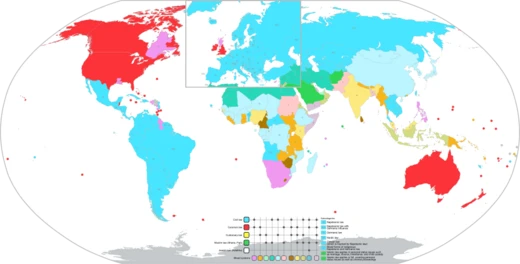
Civil procedure is not a monolithic system; it is traditionally classified into two broad families: the inquisitorial model and the adversarial model. The specific rules governing any given case depend heavily on the jurisdiction in which it is heard. A wide array of nations maintains distinct civil procedure frameworks, including Australia, Brazil, Canada, England and Wales, Germany, India, Italy, the Netherlands, Romania, Scotland, South Africa, the United States, and Bhutan. Even within a single country, procedural details can vary by court level or region. Notably, the treatment of victims' compensation differs across systems: while most countries require victims to pursue damages through a separate civil action, France and England permit a criminal court judge to award incidental compensation to a victim during the criminal proceeding itself. These national variations underscore that civil procedure is as much a product of local legal culture as it is a set of universal procedural necessities.
Gallery
Frequently Asked Questions
What is Civil procedure?
Civil procedure is the body of legal rules that tells courts how to manage disputes between private parties, as opposed to state prosecutions. It covers everything from how a claim is filed and served, through pleadings, discovery, and trial, to the final judgment and any post-trial steps.
How does Civil procedure differ from criminal procedure?
Where criminal procedure governs the government's case against an accused offender, civil procedure sets the framework for resolving disputes between individuals or organisations. The two tracks diverge in their standards of proof, the kinds of relief available, and the procedural timelines courts must follow.
What standard of proof applies in a Civil procedure case?
Civil matters are decided on the balance-of-probabilities standard, meaning the party bearing the burden must show their version is more likely true than not. This sits well below the beyond-reasonable-doubt threshold required in criminal trials.
What is the typical remedy under Civil procedure?
The most common outcome is a monetary damages award intended to compensate the successful party for losses actually suffered. Courts may also grant injunctions or declarations, but financial compensation remains the default form of redress.
What stages does a case pass through under Civil procedure?
A typical civil matter moves through commencement (filing and service of process), pleadings and motions, discovery or disclosure of evidence, trial, judgment, and any post-trial or appellate proceedings. Each stage is governed by specific rules on timing, format, and which filings are permissible.
More in Legal Systems & Courts 1-24
Spotted an error? Know more?
This is a living reference — every entry is fact-audited, and reader corrections feed straight into our audit queue. Suggest an edit · See this site's audit record