Common law
Judge-made law originating in medieval English King's courts.

The common law is a legal system built on rulings made by judges, tracing its roots to the royal courts of medieval England. It was later adopted by many territories that were once part of the British Empire. In the 1100s, King Henry II sent traveling judges across England to hear cases and apply a uniform set of rules. Over time, the decisions of these judges created precedents, forming a detailed body of common law that served as England’s primary method of lawmaking for centuries. Today, the term “common law” can refer both to this historically English system—where judges can create binding rules for future courts—and to the actual collection of laws that such systems produce.
Compared to the civil law tradition found in much of continental Europe, common law shows less influence from Roman law and is less likely to be written into comprehensive codes. This gives common law judges broader freedom when interpreting statutes, effectively allowing them to make law through their rulings. However, some countries, like South Africa and Scotland, have mixed systems that blend common law and civil law elements. Common law also differs from other types of valid law, such as statutes, equity, and religious laws like canon law or sharia.
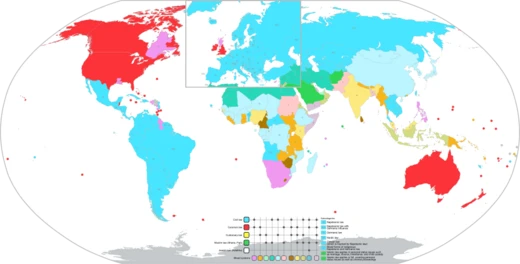
Roughly a third of the world’s population now lives under common law or mixed legal systems. Examples include Australia, Bangladesh, Canada, Hong Kong, India, Ireland, Nigeria, Pakistan, Singapore, and the United States.
The term “common law” carries several related meanings. First, after the Norman Conquest, it referred to the law shared by the king’s courts, as opposed to local courts. Second, it became synonymous with judge-made law, distinct from statutory law. Third, as the British Empire grew, colonies that adopted common law procedures were called common law systems, in contrast to civil law ones. Fourth, during the late medieval period, England developed a separate set of equitable rules administered by the Court of Chancery. Even in jurisdictions that later merged these two court systems, equity remains a distinct body of rules separate from the common law. Fifth, England still has ecclesiastical courts with authority over certain religious matters, and “common law” can describe the laws that are not part of those church courts.
Originally, common law meant the laws common to all of the king’s courts in England, stemming from the practices of those courts after the Norman Conquest in 1066. This sense of common law is distinct from the local folk courts of shires and hundreds, where most disputes were settled before the Conquest. Even after 1066, other courts continued to exist, such as those in boroughs, merchant fairs, and the manorial courts of large landowners.
During the 1100s and 1200s, continental European countries began adopting Roman law doctrines, including codified civil codes like the *Corpus Juris Civilis*. England, however, already had its common law system, so common law jurisdictions often differ significantly from civil law ones in judicial reasoning and sources of law. Still, some places, like Louisiana and parts of Canada, have fused systems combining both traditions. Despite their differences, the two systems have influenced each other over time. Early English judges and scholars like Glanvill and Bracton were familiar with Roman law—many were clerics trained in canon law. Bracton’s treatise *De Legibus et Consuetudinibus Angliae* was heavily shaped by canon law and the structure of Justinian’s *Institutes*, and later influenced Blackstone’s *Commentaries on the Laws of England*. Roman law ideas regained importance in common law scholarship with the rise of academic law schools in the 1800s. As a result, today the main divisions of law—property, contract, tort, and to some extent unjust enrichment—appear in both civil and common law systems. Common law countries are also increasingly adopting codes in areas like bankruptcy, intellectual property, antitrust, banking regulation, securities, and tax law. A major example is the Uniform Commercial Code (UCC) in the United States, created by the American Law Institute and Uniform Law Commission, which has been enacted, with local variations, in most U.S. states and territories, including the District of Columbia.
By the 1400s, litigants who felt wronged by the common law courts began petitioning the king for relief. This practice eventually led to the development of equity, administered by the Court of Chancery.
- key_developer
- Henry II (12th century)
- field
- Legal system
- known_for
- Judge-made law, precedent, and quasi-legislative judicial discretion
- influence
- Approximately one-third of the world's population lives in common law or mixed jurisdictions
- distinct_from
- Civil law, equity, canon law, sharia, and statutory law
Quick Facts
- Category
- Legal system
- Territory
- At least 40 countries, including the United Kingdom, United States, Australia, Canada, India, Ireland, and Hong Kong
- Start Date
- c. 1066 – 1166, Kingdom of England
Facts from the source article.
Lore & Background
Initially, the common law referred to the laws common to all the King's courts across England, distinct from local folk courts, urban borough courts, merchant courts, and manorial courts. This system originated in the 12th century when Henry II established travelling judges who decided cases and enforced a set of laws common to all England. Over centuries, the precedent set by these judges evolved into a sophisticated body of judge-made law, which became the primary form of lawmaking in England. Today, the term describes both the historically-English legal system that allows judges to create binding rules and the resulting body of laws. Compared to the civil law tradition of continental Europe, common law has markedly less influence from Roman law and is less likely to be codified, giving judges broader discretion in statutory interpretation and a quasi-legislative role. Early common law judges and scholars, including Glanvill and Bracton, were well accustomed with Roman law, and Bracton's treatise 'De Legibus et Consuetudinibus Angliae' was heavily influenced by canon law and Justinian's Institutes, later influencing Blackstone's Commentaries on the Laws of England. Despite these distinctions, common law and civil law systems have historically influenced one another, and some jurisdictions, such as South Africa and Scotland, maintain mixed systems incorporating both traditions. Approximately one-third of the world's population now lives in common law or mixed jurisdictions, including Australia, Canada, India, and the United States.
Reader's Guide
The common law tradition has markedly less influence from Roman law than the civil law tradition of much of Continental Europe, and has less tendency to be codified, leaving common law judges broader discretion in statutory interpretation and a quasi-legislative function in adjudication. Some jurisdictions, such as South Africa and Scotland, have mixed systems incorporating both common law and civil law elements. The common law can be distinguished from statutes, the law of equity, and religious laws such as canon law or sharia. In the late 19th century, the separate judicial systems of common law and equitable courts in England were fused, though the rules of equity were retained. Early legal theorists believed the common law reflected ancient Anglo-Saxon customs, but by the 20th century scholars such as A. V. Dicey, Oliver Wendell Holmes, and Roscoe Pound generally disavowed that historical theory, viewing the law in a positivistic or realist way as the binding ratio decidendi of case law.
Did You Know?
- The term 'common law' originally referred to the law common to the King of England's courts, as distinct from local courts.
- Henry II established a system of travelling judges in the 12th century that enforced a set of laws common to all England.
- In the 17th century, it was established that where the rules of equity and common law conflicted, equity would prevail.
- Jeremy Bentham introduced the term 'judge-made law' as a criticism of the pretense that judges merely discovered unwritten rules.
Frequently Asked Questions
Who is Common law and where did it originate?
Common law is a judge-made legal system that grew out of the King's courts in medieval England. It was shaped in the 12th century when Henry II sent travelling judges across the realm to apply a unified set of rules, and their accumulated decisions gradually crystallized into the precedent-based framework we recognize today.
What are Common law's core powers and role?
Its defining function is creating binding legal rules through judicial decisions rather than through a single codified statute. Judges exercise quasi-legislative discretion, and every ruling sets a precedent that later courts must follow, making the system continuously self-building.
How does Common law's story end?
It does not have a fixed ending; the system remains fully operative in the present day. Roughly one-third of the global population currently lives under common law or mixed legal systems, including nations such as Australia, Bangladesh, Canada, and Hong Kong, so its narrative is still unfolding.
Why is Common law important in the broader legal landscape?
Because it spread from England to the former colonies of the British Empire, it now underpins the legal frameworks of a vast number of countries. Its reliance on precedent and judicial reasoning offers a flexible, case-by-case approach that complements or replaces rigid statutory codes in those jurisdictions.
How is Common law distinct from other legal systems?
It is specifically a product of judicial interpretation and precedent, setting it apart from civil law's codified statutes, equity's fairness-based remedies, canon law's ecclesiastical rules, sharia's religious jurisprudence, and purely statutory law's legislative text. While these systems can coexist in mixed jurisdictions, common law's engine is the judge's evolving reasoning rather than a single authoritative code.
More in Legal Systems & Courts 1-24
Spotted an error? Know more?
This is a living reference — every entry is fact-audited, and reader corrections feed straight into our audit queue. Suggest an edit · See this site's audit record