Lake Urmia
Endorheic salt lake in Iran, once the largest in West Asia.
Last updated

NASA · Public domain
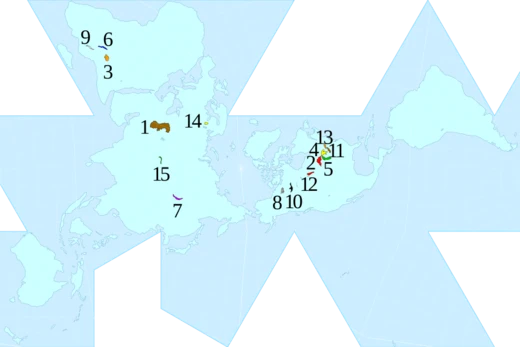
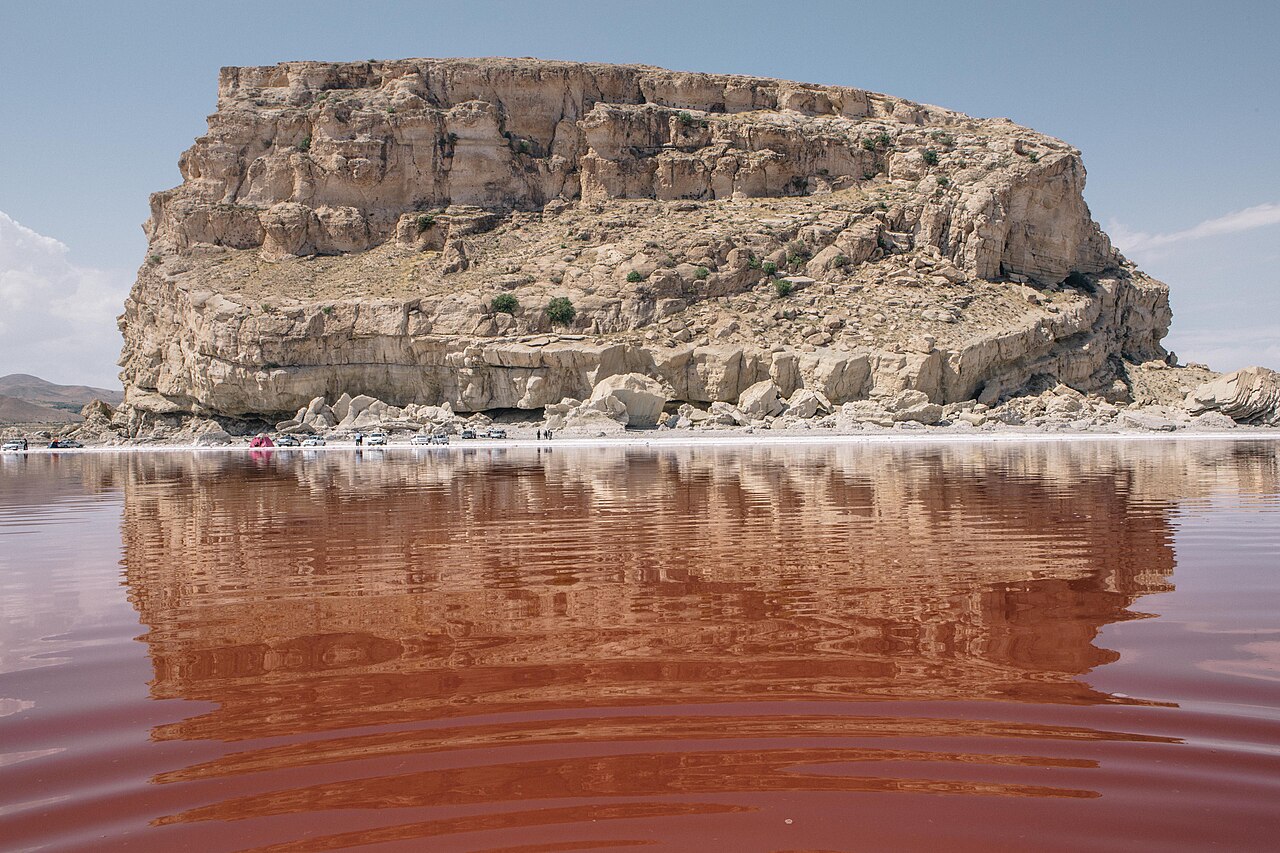
When it reached its maximum size, this lake was the largest in all of West Asia.[1] With a surface area of roughly 6000 km², it was formerly the sixth-biggest saltwater lake globally.[1]
Geography and history
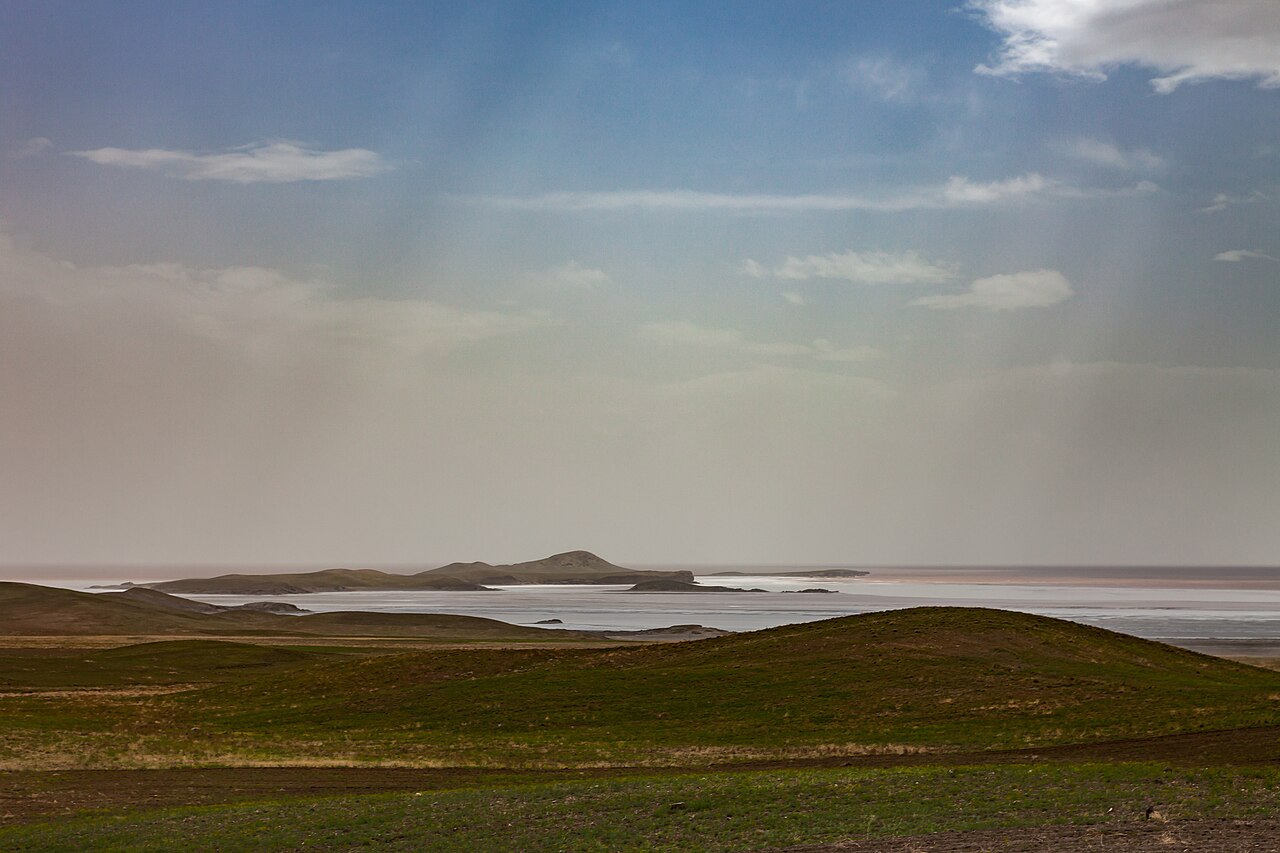
Assyrian records from the 9th century BCE mention Parsuwaš and Matai in the area of Lake Urmia.[2] The lake had approximately 102 islands, with Shahi Island historically the largest.[3] Because the lake has no outlet, evaporation is the sole mechanism for water loss.[4] On the eastern shore lies Yanik Tepe, a prehistoric settlement whose occupation dates back to 6000 BC.[5]
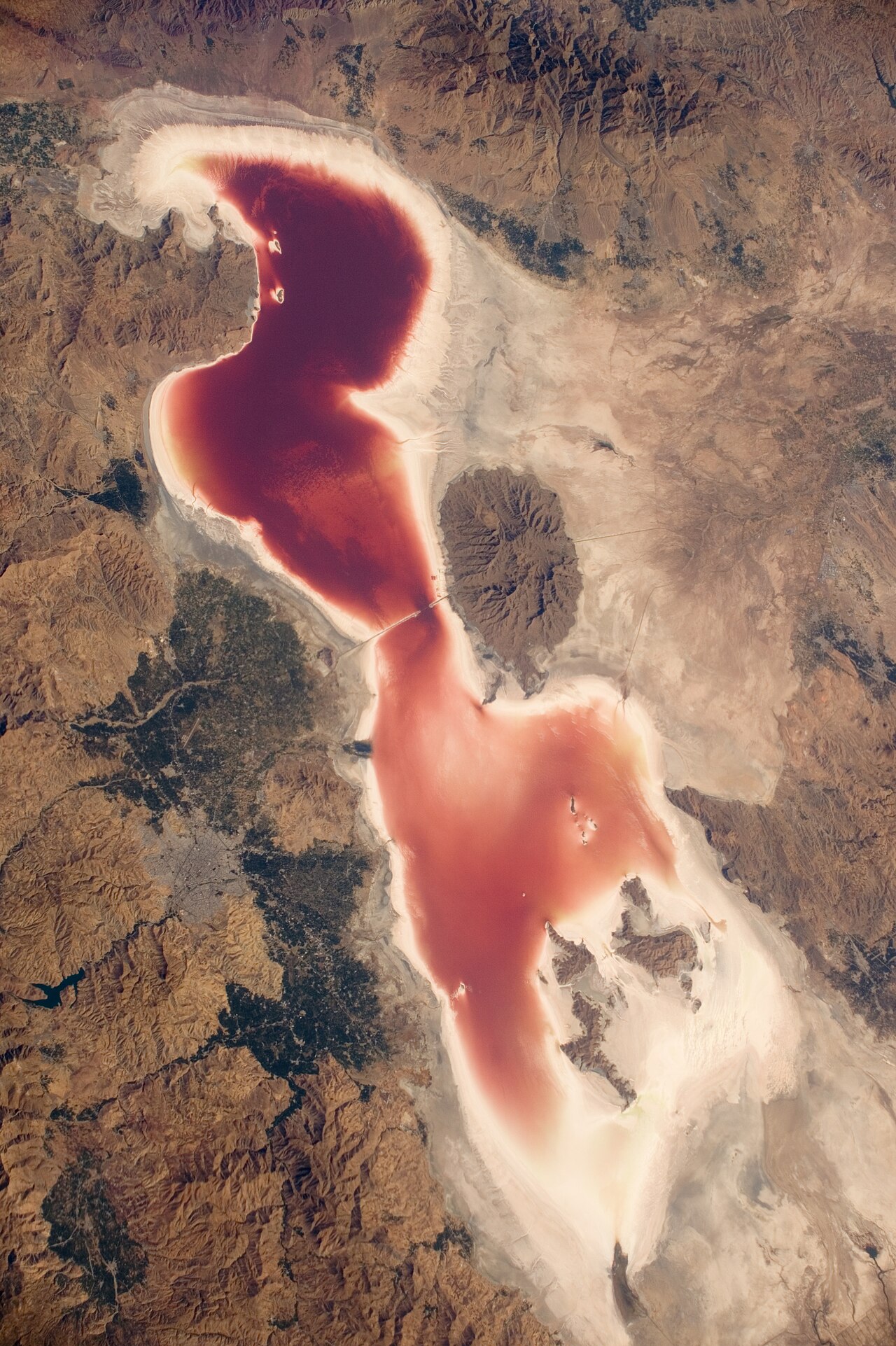
Persian speakers call it Daryâče-ye Orumiye, while Azerbaijani speakers use the name Urmu gölü.[6] Hulagu Khan and his son Abaqa are both interred on Shahi Island.[7] The Urmia Lake Bridge and its causeway, finished in 2008, split the lake into northern and southern sections.[8]
What the cited sources add
Thousands of Azerbaijani fans chanted "Lake Urmia is dying, the Majlis orders its execution" during a soccer match.[9] The Guardian reports that security forces on motorcycles clashed with thousands of protesters in Tabriz and Orumieh.[10] The Guardian notes that 36 dams have been built on rivers flowing to Lake Urmia.[10] The Encyclopædia Iranica entry states that many major towns in the region had a large Armenian population until recently.[11]
Amateur footage captured riot police attacking what looked to be a non-violent demonstration.[10]
References
- Wikipedia, "Lake Urmia" (CC BY-SA 4.0), which cites: "Britanica", Britannica.com (original not read by us) en.wikipedia.org
- Wikipedia, "Lake Urmia" (CC BY-SA 4.0), which cites: cf. Skjærvø, Prods Oktor (2006), "Iran, vi(1). Earliest Evidence", Encyclopaedia Iranica, Vol. 13 (original not read by us) en.wikipedia.org
- Wikipedia, "Lake Urmia" (CC BY-SA 4.0), which cites: List from: Farahang-e Joghrafiyayi-e shahrestânhâ-ye Keshvar (Shahrestân-e Orumiyeh), Tehran 1379 Hs. (original not read by us) en.wikipedia.org
- Wikipedia, "Lake Urmia" (CC BY-SA 4.0), which cites: Stevens, "Hydroclimatic variations over the last two glacial/interglacial cycles at Urmia Lake, Iran", Journal of Paleolimnology, 1 April 2012, p. 647; Stevens, "Hydroclimatic variations over the last two glacial/interglacial cycles at Urmia Lake, Iran", Journal of Paleolimnology, 1 April 2012, p. 647; Stevens, "Hydroclimatic variations over the last two glacial/interglacial cycles at Urmia Lake, Iran", Journal of Paleolimnology, 1 April 2012, p. 647 (we also read that source) en.wikipedia.org
- Wikipedia, "Lake Urmia" (CC BY-SA 4.0), which cites: C. A. Burney, Excavations at Yanik Tepe, North-West-Iran, Iraq 23, 1961, pp. 138ff. (original not read by us) en.wikipedia.org
- Wikipedia, "Lake Urmia" (CC BY-SA 4.0), which cites: Amurian, "Armenians of modern Iran", Encyclopædia Iranica, 15 December 1986; Russell, "Zoroastrianism in Armenia", Harvard University, 1987, p. 430; "Armenian Highland", armin.am (we also read that source) en.wikipedia.org
- Wikipedia, "Lake Urmia" (CC BY-SA 4.0), which cites: Boyle, "The Thirteenth-Century Mongols' Conception of the After Life: The Evidence of their Funerary Practices", Mongolian Studies, 1974, p. 7 (original not read by us) en.wikipedia.org
- Wikipedia, "Lake Urmia" (CC BY-SA 4.0), which cites: "Drought in Urmia Lake, the largest natural habitat of brine shrimp Artemia", World Aquaculture, 2012, p. 36–38 (original not read by us) en.wikipedia.org
- "Armeni Activists Detained in Iran For Environmental Protests", RFE/RL, 26 August 2011. facts only, no text reused. rferl.org
- "Iranian greens fear disaster as Lake Orumieh shrinks", The Guardian, 5 September 2011. facts only, no text reused. theguardian.com
- Amurian, "Armenians of modern Iran", Encyclopædia Iranica, 15 December 1986. facts only, no text reused. iranicaonline.org
Each numbered sentence above was checked against the source it cites before publication. Sentences citing Wikipedia adapt text from the English Wikipedia article Lake Urmia (contributors), used under CC BY-SA 4.0; this entry is available under the same licence. Other sources were used for facts only; no text or images are copied from them.
Ranked in
More in Lakes Of The World
Sources
Compiled from Wikipedia and the sources listed below. Text from Wikipedia is available under CC BY-SA 4.0; this entry is adapted from it.
- Wikipedia: Lake Urmia (CC BY-SA 4.0).
Spotted an error? Know more?
Reader corrections go straight into our review queue. Suggest an edit · How this site is sourced