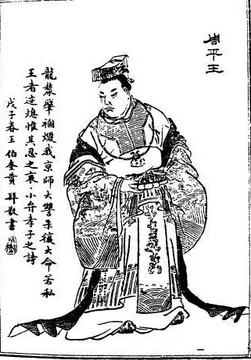
King Wu of Zhou
Founding king of the Zhou dynasty, overthrew the Shang.
Ji Fa, known as King Wu of Zhou, died around 1043 BC and founded the Zhou dynasty. He is seen as a model Confucian ruler who began China's dynastic cycle. Taking over from his father King Wen around 1050 BC, he worked with Jiang Ziya to defeat the Shang king Di Xin. In 1046 BC, leading eight allied states, he won the Battle of Muye, captured the Shang capital Yin, and ended the dynasty. He then gave lands to relatives and allies, and his victory is a classic example of the Mandate of Heaven.
Quick Facts
- Reign
- 1050–1046 BCE
- Predecessor
- King Wen of Zhou
- Successor
- King Cheng of Zhou
- Birth name
- Ji Fa (姬發)
- Born
- c. 1097 BCE
- Birthplace
- Predynastic Zhou
- Died
- 1043 BCE (age 54)
- Place of death
- Haojing, Western Zhou
Facts from the source article.
Did You Know?
- The Yinggong ding records his name as 'Wǔ Dì Rì Dīng' (珷帝日丁) 'King Wu, the Thearch of the Ding Day.'
- King Wu had a wife, Yi Jiang, with whom he had 9 children.
Lineage
King Wu was the second son of Ji Chang, later called King Wen, and Tai Si. His older brother Bo Yikao was passed over as heir due to tradition, a detail recorded in the Book of Rites. Similarly, King Wu's grandfather Jili inherited Zhou despite having two older brothers. Stories that Di Xin killed Bo Yikao by lingchi appear only in much later writings, like the 9th-century Records of Emperors and Kings and the novel Fengshen Yanyi, making them historically improbable.
Reign
The chronology of King Wu's overall reign is disputed. His reign as ruler of Predynastic Zhou is thought to have begun in 1050 BC, and his reign as King of China around 1046 BC, with his death about three years later. Upon succession, he worked with his father-in-law Jiang Ziya to overthrow the Shang dynasty and its ruler Di Xin, who was alleged to be a cruel and inept tyrant. He resided largely in the capital Fengjing, while the royal center remained in Zhouyuan near Mount Qi. In the ninth year of his reign, he made a sacrifice at Bi, assisted by Duke Dan of Zhou, the Duke of Bi, and the Duke of Shao. He marched to the Mengjin ford and met with more than 800 elders, but did not yet attack Shang, considering the timing unpropitious. In the eleventh year, allegations against Di Xin worsened after he killed his uncle Bi Gan and imprisoned Jizi. Taishi Ci and Shaoshi Qiang fled to Zhou with their instruments. On the wumu day of the twelfth month (c. January 21, 1048 BC), King Wu led an army of 300 chariots, 3,000 elite warriors, and 45,000 armed soldiers to the Mengjin ford, where he composed the Great Declaration that Di Xin had lost the Mandate of Heaven.
Illness and death
King Wu fell ill two years after his victory, during his fourteenth year of rule. In response, Duke Dan of Zhou prayed for his recovery and wrote the "Metal-Bound Coffer," a text later included in the Book of Documents. The prayer, as recorded by Wang Chong, has Dan offering himself as more talented and better suited to serve spirits and deities than King Wu. After ruling China for five years, King Wu died in the winter of his seventeenth year as Zhou ruler. His death sparked rebellions against his young successor, King Cheng, and the regent Ji Dan. Three of King Wu’s own brothers joined Wu Geng’s conspiracy in these uprisings. A burial mound at Zhouling in Xianyang Prefecture, Shaanxi, was once believed to be King Wu’s tomb, and a Qing dynasty headstone was placed there bearing his name. Modern archaeology has since shown the tomb dates to the Han dynasty, not the Zhou. The actual location of King Wu’s grave remains unknown, though scholars now think Zhou lords were generally buried near Zhougong Miao in Qishan County.
Legacy
King Wu of Zhou is a central figure in classical Chinese literature, often cited as the catalyst for the dynastic cycle after he overthrew the Shang. His deeds are recorded in bronze inscriptions that celebrate his victory at Yin. He is regularly named alongside Tang of Shang and Yu the Great as one of the "Three Kings," exemplary rulers held up for study, and appears with his father King Wen in the basic Three Character Classic. While most ancient sources praise him, the Shi Fu chapter of the Yi Zhou Shu offers a harsher picture, describing him taking prisoners, beheading Shang soldiers, and entering a temple bloodied to perform a rite for King Wen. This text was mostly dismissed by scholars and criticized by Mencius, and its surviving version is badly corrupted. In Confucian thought, King Wu is a culture hero and a model leader, having repeated Tang's pattern of defeating a tyrant—in his case, Di Xin. Philosophers Xunzi and Mencius justified his killing of Di Xin through the Mandate of Heaven: since Di Xin had lost the mandate and abandoned his duties, he was effectively a commoner, so the act was not regicide but a punishment. Xunzi compares this deposition to those carried out by the Three Sovereigns and Tang. Jia Yi, in The Faults of Qin, contrasts King Wu and Tang with the Qin dynasty. He argues that Qin failed because it pursued power without virtue, whereas Wu and Tang cultivated their innate authority and expanded their reach, allowing them to establish dynasties that endured for centuries.
More in Kings of the Zhou Dynasty
Spotted an error? Know more?
Reader corrections go straight into our review queue. Suggest an edit · How this site is sourced