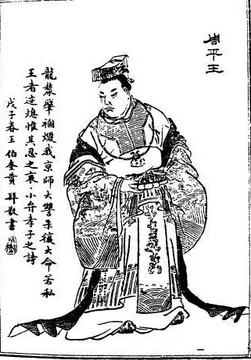
King Mu of Zhou
Fifth Zhou king who reformed government and campaigned against western tribes.
King Mu of Zhou, personal name Ji Man, was the fifth king of the Zhou dynasty of China. His reign is dated either 976–922 BC or 956–918 BC. He is noted for introducing reforms that shifted the Zhou government from a hereditary system to one based on merit and administrative skill.
Quick Facts
- Reign
- 976 BC–922 BC
- Predecessor
- King Zhao of Zhou
- Successor
- King Gong of Zhou
- Full name
- Ancestral name: Jī (姬); Given name: Mǎn (滿)
- Birth name
- Ji Man (姬滿)
- Born
- 992 BC
- Died
- 922 BC
- Posthumous name
- King Mu (穆王) or King Miu (繆王)
Facts from the source article.
Life
King Mu of Zhou became king after his father, King Zhao, died in a war with Chu. His rule lasted almost fifty-five years, from roughly 976 BC to 922 BC. He was known for being more ambitious than careful, but he did manage to change how the Zhou government worked. Instead of handing out jobs based on family ties, he started choosing officials for their skills and knowledge. Mu tried to push back against groups attacking from the west and wanted to stretch Zhou power eastward. At one point, he led a huge army against the Quanrong people living in the west. During his travels, he met many tribes, convincing some to join the Zhou and forcing others to surrender. Still, the campaign might not have been very successful, since he only came back with four white wolves and four white deer. Without meaning to, he created anger that later led those same tribes to invade China in 771 BC. In his thirteenth year, the Xu Rong—likely the southeastern state of Xu—attacked near the eastern capital of Chengzhou. The fighting ended with a truce that gave Xu more land and power in exchange for a show of submission. Historians have mixed views on Mu. Some praise his wins over the Quanrong, while others point out that during his time, the fourth border state stopped having ties with the Zhou. The Shang Shu says he set up China’s first written legal code. Stories claim Mu lived to be 105 and visited the legendary Kunlun mountain. A later book, the Tale of King Mu, Son of Heaven, tells of these journeys. His son, King Gong, took over after him.
In mythology
King Mu of Zhou once dreamed of becoming immortal and set his sights on Kunlun, the divine paradise where the Peaches of Immortality grew. The charioteer Zaofu drove him there. A fourth-century BC romance, The Tale of King Mu, Son of Heaven, recounts his meeting with the Queen Mother of the West. The late Tang poet Li Shangyin later turned the story into a four-line poem. In fictional accounts, King Mu is often linked to eight horses, known as his Eight Stallions. Some of their names come from older texts like Xunzi and Liezi, but most were invented later.
Automaton
In the third-century BC text Liezi, an account describes an encounter between Mu and a mechanical engineer named Yan Shi, an 'artificer'. Yan Shi presented the king with a life-size, human-shaped figure of his mechanical handiwork. The king stared in astonishment as the figure walked with rapid strides, moving its head up and down, appearing to be a live human. The artificer touched its chin, and it sang perfectly in tune; he touched its hand, and it postured in perfect time. As the performance ended, the robot winked and made advances to the ladies in attendance. The king became incensed and would have executed Yan Shi, but the artificer, in mortal fear, instantly took the robot to pieces to show what it really was. It turned out to be a construction of leather, wood, adhesive and lacquer, variously coloured. Inside were complete internal organs—liver, gall, heart, lungs, spleen, kidneys, stomach and intestines—and over these, muscles, bones, joints, skin, teeth and hair, all artificial. When the king removed the heart, the mouth could no longer speak; removing the liver caused the eyes to lose sight; removing the kidneys made the legs unable to move. The king was delighted.
More in Kings of the Zhou Dynasty
Spotted an error? Know more?
Reader corrections go straight into our review queue. Suggest an edit · How this site is sourced