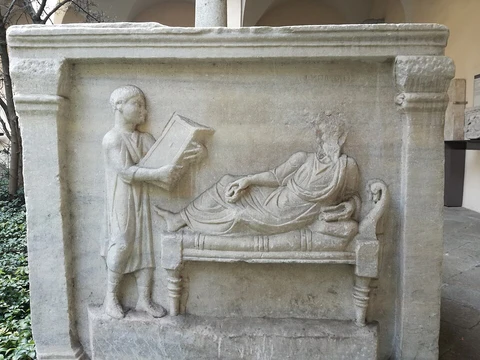
Gaius (jurist)
Roman jurist whose Institutes shaped later legal education.

Gaius, a Roman jurist who flourished between approximately AD 130 and 180, remains a figure of considerable obscurity. Even his full name is unknown, with "Gaius" (or "Caius") serving only as his personal name, or praenomen. The span of his life is difficult to determine precisely, though it is assumed he lived from at least AD 130 to AD 179, based on his writings about legislation enacted during that period. Internal evidence from his works places his active career under the reigns of Hadrian, Antoninus Pius, Marcus Aurelius, and Commodus. Despite the lack of biographical detail, his posthumous influence was immense. Emperor Theodosius II, in his Law of Citations, designated Gaius as one of the five jurists—alongside Papinian, Ulpian, Modestinus, and Paulus—whose opinions were to be followed by judicial officers, cementing his writings as a foundational source of Roman law. His most famous work, the *Institutes*, written around AD 161, served as a complete introductory textbook on Roman legal institutions, divided into four books covering persons, things (including wills), intestate succession and obligations, and actions. He also authored treatises on the Edicts of the Magistrates, the Twelve Tables, and the Lex Papia Poppaea. His work is particularly valuable for its interest in legal antiquities and for preserving details of the formulary system of legal procedure, which had disappeared by the time of Justinian. In the disputes between the two schools of Roman jurists, Gaius generally sided with the Sabinians, who advocated strict adherence to ancient rules. The *Digest* of Justinian I contains many quotations from his works, and Justinian's own *Institutes* were directly modeled on Gaius's, often copying passages word for word. For centuries, Gaius's *Institutes* remained the standard textbook for students of Roman law. The work was lost to modern scholars until 1816, when a palimpsest was discovered in the Verona chapter library, with the text of Gaius hidden beneath writings of St. Jerome. This discovery, along with later papyrus fragments, illuminated previously obscure areas of Roman legal history, particularly ancient forms of legal procedure.
- field
- Roman law
- nationality
- Roman
- known_for
- Institutes of Gaius; named in the Law of Citations
Lore & Background
Little is known about Gaius's personal life, including his name, which is merely his praenomen. He flourished under the emperors Hadrian, Antoninus Pius, Marcus Aurelius, and Commodus, and his works were composed between AD 130 and 180. After his death, his writings gained great authority, and Emperor Theodosius II named him in the Law of Citations, alongside Papinian, Ulpian, Modestinus, and Paulus, as one of the five jurists whose opinions were binding on judicial officers. Besides his famous *Institutes*, an introductory textbook on Roman law divided into four books—covering persons, things and wills, intestate succession and obligations, and actions and their forms—Gaius authored treatises on the Edicts of the Magistrates, the Twelve Tables, and the Lex Papia Poppaea. He generally adhered to the Sabinian school, which favored strict adherence to ancient rules and resisted innovation. His work is especially valuable to historians because he lived when legal actions were tried under the formulary system, allowing scholars to see how rigid ancient rules were modified by praetorian equity. The *Institutes* were lost until 1816, when a palimpsest was discovered in the Verona chapter library, with earlier writings beneath works of St. Jerome; this text was largely deciphered with help from August von Bethmann-Hollweg. Later, papyrus fragments were also found. Gaius’s work provides crucial information on ancient legal procedures absent from Justinian’s compilations, offering comparative law valuable illustrations of primitive legal forms.
Reader's Guide
The Institutes of Justinian copied the method and arrangement of Gaius's work, with many passages word for word the same. Gaius also wrote treatises on the Edicts of the Magistrates, the Twelve Tables, and the Lex Papia Poppaea, and his interest in the antiquities of Roman law makes his work valuable to historians of early institutions. The formulary system of actions, described by Gaius, shows how Roman law was modified by praetorian equity, a process obscured in Justinian's compilations. Gaius generally attached himself to the Sabinian school, advocating strict adherence to ancient rules and resisting innovation. His works appear in the Digest, created by Tribonian at the direction of Justinian I, securing a permanent place in the Corpus Juris Civilis.
Did You Know?
- Gaius's full name is unknown; 'Gaius' is merely his personal name or praenomen.
- Emperor Theodosius II named Gaius in the Law of Citations as one of five jurists whose opinions were binding on judges.
- A marble relief of Gaius, created by Joseph Kiselewski in the 1950s, is located over a gallery doorway at the U.S. House of Representatives.
Frequently Asked Questions
Who is Gaius (jurist)?
Gaius was a Roman legal scholar active in the second century AD, identified only by his praenomen because his full name has been lost to history. He practiced and composed his writings under four successive emperors, from Hadrian through Commodus.
What is Gaius (jurist) most famous for?
His surviving work, the Institutes, served as a foundational textbook for teaching Roman law to students. It organized the subject into persons, things, and actions, a structure that shaped legal education for centuries afterward.
Why is Gaius (jurist) important in legal history?
Emperor Theodosius II later named him in the Law of Citations as one of only five jurists whose opinions carried binding force in court. That imperial endorsement made his writings a cornerstone of the Roman legal tradition still echoed in modern civil-law systems.
What do we know about Gaius (jurist)'s personal life?
Almost nothing survives beyond his praenomen; his family background, birthplace, and personal relationships are entirely unknown to modern scholars. What remains is limited to his legal writings and the later imperial recognition of their authority.
More in Jurists And Legal Scholars 1-24
Spotted an error? Know more?
This is a living reference — every entry is fact-audited, and reader corrections feed straight into our audit queue. Suggest an edit · See this site's audit record