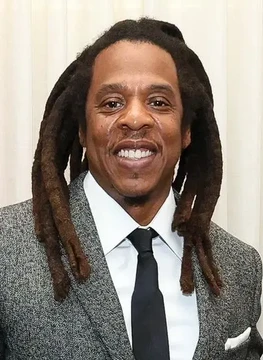
The Black Album
Fourteen tracks that turned a black cover into a cultural monument and a career into a dynasty.

The Black Album is the fourth studio album by Jay-Z, released in 1998 on Roc-A-Fella and Arista Records. It arrived at the peak of the East Coast hip-hop renaissance and is widely regarded as the record that cemented Jay-Z's status as a generational force in rap. The album's stark all-black cover and title were deliberate statements about Black identity, cultural ownership, and the weight of legacy in a post-Notorious B.I.G. landscape. Musically, the record blends the gritty boom-bap of RZA and DJ Premier with the futuristic production of Timbaland and Tim & Bob, creating a sonic palette that felt simultaneously rooted and forward-looking. Tracks like 'Can't Take Nothing,' 'Mo Money Mo Problems,' and the reimagined 'Hard Knock Life (Ghetto Anthem)' gave the album a range that few rap records of the era matched, moving between philosophical reflection, celebratory swagger, and raw street narrative.
Quick Facts
- Artist
- Jay-Z
- Released
- November 14, 2003
- Recorded
- July – October 2003
- Studio
- Baseline (New York) · Hit Factory Criteria (Miami) · The Mansion (Los Angeles) · 54 Sound (Ferndale, Michigan)
- Genre
- East Coast hip-hop
- Length
- 55:32
- Label
- Roc-A-Fella · Island Def Jam
- Producer
- Shawn Carter · 3H · 9th Wonder · Aqua · The Buchanans · Eminem · DJ Quik · Just Blaze · Kanye West · Luis Resto · The Neptunes · Rick Rubin · Timbaland
- Prev Title
- Blueprint 2.1
- Prev Year
- 2003
- Next Title
- Unfinished Business
- Next Year
- 2004
Facts from the source article.
Lore & Background
The Black Album arrived in a moment of extraordinary tension in hip-hop. The Notorious B.I.G. had been murdered less than two years earlier, the East Coast–West Coast rivalry still cast a long shadow, and the industry was hungry for a new anchor on the East. Jay-Z, already a respected figure after three studio albums, used this record to declare that the torch had been passed. The inclusion of Biggie's voice on 'Mo Money Mo Problems'—recorded before his death—gave the album an almost elegiac quality, as if the past and present were sharing a microphone. The title itself carried weight beyond marketing. In a culture where Michael Jackson's 'Thriller' had defined what a 'blockbuster' album looked like, Jay-Z's all-black sleeve was a quiet, pointed counter-statement: this was a Black record, made for Black listeners, and it did not need to borrow anyone else's color to be seen. The cover's simplicity—no photo, no logo, just the word 'Black' in white—became one of the most recognizable images in hip-hop history. Lyrically, the album oscillates between the aspirational and the confessional. 'Can't Take Nothing' wrestles with mortality and materialism in a single verse. 'Dead Wrong' (with Nas) is a cold, precise dissection of betrayal. 'I'll Be There for You/You' softens the armor into a love letter. Together, these tracks paint a portrait of a man at the crossroads between the kid from Marcy Projects and the architect of an empire, and they do so without ever losing the street-level specificity that made his earlier work resonate.
Reader's Guide
The hook of 'Can't Take Nothing' repeats a short, blunt phrase that functions as both a philosophical thesis and a rhythmic anchor. The construction is deliberately simple: a negation stacked on itself, creating a mantra-like cadence that the beat locks into. The wordplay operates on two levels simultaneously—the literal (you cannot physically carry possessions into the afterlife) and the street-level (you cannot walk away from your reputation, your debts, your name). The repetition strips away ornamentation, forcing the listener to sit with the finality of the statement. It appears as the album's closing track, giving the record a funereal, reflective resolution after the swagger of earlier cuts. Jay-Z retains the melodic skeleton and the structural phrasing of the original but replaces the child's optimistic narration with the voice of a kid in the public housing projects. The cultural reference is the key move: by taking a song associated with mainstream, family-friendly theater and recontextualizing it through the lens of systemic poverty, the track reframes what 'hard knock life' actually means. The sample is not hidden; it is the entire foundation, and the commentary lives in the contrast. On 'Mo Money Mo Problems,' the hook distills the album's central tension into three short phrases. The wordplay is ironic: the very thing that should solve every problem (money) becomes the engine of new ones. The track features the late Notorious B.I.G. and D'Angelo, and the production—smooth, almost R&B-adjacent—contrasts with the lyrical content about paranoia and excess. The placement mid-album gives the record a moment of luxurious stillness before returning to harder beats. The cultural reference here is to the broader hip-hop tradition of 'flexing' while simultaneously warning that the flex is a trap.
Did You Know?
- 'Mo Money Mo Problems' features vocals from The Notorious B.I.G., who passed away in 1997, making the track a posthumous collaboration that many fans cite as one of the most emotionally charged moments in the album.
- The album was produced by a notably diverse roster including RZA of Wu-Tang Clan, Timbaland, DJ Premier, and Tim & Bob, giving it a sonic range that spans traditional boom-bap to forward-looking R&B-tinged production.
More in Albums & EPs
Elsewhere in Jay-Z
Spotted an error? Know more?
Reader corrections go straight into our review queue. Suggest an edit · How this site is sourced