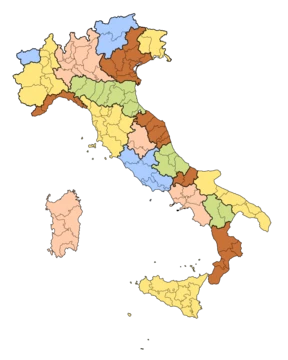
Molise
Second smallest Italian region, created in 1963 from Abruzzo.

Molise is a small administrative region in southern Italy, the second smallest in the country after Aosta Valley, covering 4,460.65 square kilometers. As of 2026, its population stands at 285,940. The regional capital and largest city is Campobasso, which also serves as the capital of one of the region’s two provinces—the other being the Province of Isernia. Molise was created in 1963 when it split from Abruzzo; the two had previously formed the combined region of Abruzzi e Molise.
The name “Molise” first appeared in the High Middle Ages, referring to a Norman county located roughly between the modern towns of Torella del Sannio and Duronia. The county took its name from the ruling family, the de’ Moulins.
Human presence in Molise dates back to the Paleolithic period, as shown by the archaeological site of Isernia La Pineta. There, traces of habitation up to 700,000 years old have been found, along with the fossil of a child who lived 583,000 years ago and remains of animals and plants—making it one of the most ancient and significant sites in Italy and Western Europe.
Before the Romans, Molise was part of Samnium, inhabited by Samnite peoples. The Pentri tribe settled around the 7th century BC in the area of modern Isernia and the countryside near Campobasso, interacting frequently with the Frentani, another Italic tribe descended from the Samnites. From the 4th century BC, Roman expansion led to conflict with the Samnites, sparking the Samnite Wars. During the Second and Third Samnite Wars, Roman forces captured major cities like Isernia and Bojano—the Pentri’s capital—though the Samnites were only fully defeated after Sulla’s victory in the Social War. Under Augustus, Molise’s territory was placed in the Regio IV Samnium.
During late antiquity, Molise’s economy and population declined sharply. When the Lombards arrived, they found a sparsely populated region with few important urban centers. Under the Duchy of Benevento, the area was divided into gastaldates. Paul the Deacon’s *Historia Langobardorum* records that one such gastald, the Gastaldate of Bojano, was created around 667 AD by King Grimoald I and granted to the Bulgarian commander Alzeco. Many towns and villages were founded under Lombard rule, and the Lombards spread the cult of Saint Michael. From the 9th to the 11th century, the Normans ruled Molise. In 1045, Rudolf of Moulins came to southern Italy with the Hauteville family and conquered what became the County of Bojano. During this period, the area began to be called *comitatus molisii*, likely from the Moulins family name. After the Moulins lost power around the end of the 11th century, the county broke into smaller fiefs. Under Frederick II’s reforms, the Contado di Molise became the seat of a justiciarate, administered jointly with the Terra di Lavoro as the Justitiaratus Molisii et Terra Laboris.
In 1538, Molise was separated from Terra di Lavoro and merged into the Capitanata. In 1806, Joseph Bonaparte extended the French provincial model to the Kingdom of Naples, and by 1811 the borders of the Province of Molise were largely fixed to their modern extent. From 1817, the province faced a crisis due to brigandage.
Geographically, Molise covers 4,460.65 square kilometers. It borders Abruzzo to the north, Apulia to the east, Lazio to the west, and Campania to the south. To the northeast, it has 35 kilometers of sandy coastline on the Adriatic Sea, facing the Tremiti Islands. The landscape is mostly mountainous—55% of the area is mountainous, with the rest consisting of hills sloping down to the sea. The mountainous terrain spans the Appennino campano and the Appennino sannita, both parts of the Apennines. Minor massifs include the Monti della Meta (marking the border with Lazio and Abruzzo), the Monti delle Mainarde, and the Monti del Matese.
Part of the border with Abruzzo follows the Trigno River, and part of the border with Apulia follows the Fortore. Other important rivers are the Biferno and the Sangro. The Volturno—southern Italy’s longest river by length and basin size—and the Tammaro both originate in Molise. The region is rich in water resources but has no natural lakes of significant size. The largest lakes are the artificial Lago di Guardialfiera and Lago di Occhito, the latter shared with Apulia.
Molise’s climate is classified as Mediterranean under the Köppen system, with significantly lower temperatures inland. As of 2026, the population is 285,940, with 49.7% male and 50.3% female.
- Capital
- Campobasso
- Provinces
- Campobasso and Isernia
- Established
- 1963
- Nationality
- Italian
Lore & Background
The name Molise first appeared during the High Middle Ages as the name of a Norman county, roughly between Torella del Sannio and Duronia. The county's name came from the de' Moulins family. Before the Romans, Molise was part of Samnium, inhabited by Samnite populations. The Samnite Wars with Rome led to Roman conquest, and under Augustus the territory was placed in Regio IV Samnium. During the Middle Ages, under the Lombards, the region was divided into gastaldates, and many towns were founded. The Normans ruled from the 9th to 11th centuries, and the area became known as comitatus molisii. After Frederick II's reforms, the Contado di Molise became part of a single administrative district with Terra di Lavoro.
Reader's Guide
Its history as a Norman county and later as part of the Kingdom of Naples reflects the shifting political boundaries of southern Italy. The region's geography is mostly mountainous, with 55% covered by mountains and a 35 km coastline on the Adriatic Sea. The region is home to two ethnic minorities: Molisan Croats and Arbëresh speakers. Its legacy includes medieval castles, cathedrals, and archaeological sites that attract visitors interested in history and culture.
Did You Know?
- Molise was created in 1963 from the division with Abruzzo.
- The region's name comes from the Norman de' Moulins family.
- Molise has 35 km of sandy coastline on the Adriatic Sea.
Frequently Asked Questions
What are Molise's powers/role?
Molise's defining trait is its small, self-contained scale—it governs a tight inland-and-coastal strip without the sprawling complexity of its neighbors. That compactness lets it maintain a distinct local identity and a manageable two-province administrative structure.
Where does Molise come from?
Molise was split off from the combined Abruzzi e Molise region in 1963, gaining full independence as its own administrative entity. Before that division it had been administratively bundled with Abruzzo for decades.
Why is Molise important?
Molise stands out as one of Italy's most recent regional creations, proving that a small, largely inland territory can sustain its own government and cultural voice. Its 1963 separation became a model for how a sub-region can earn full autonomy within the Italian state.
How does Molise's story end?
Molise's story is still being written—it remains an active, self-governing Italian region well into the 21st century, continuing to balance its modest population against the pressures of a rapidly changing national landscape.
More in Italian Regions 1-17
Spotted an error? Know more?
This is a living reference — every entry is fact-audited, and reader corrections feed straight into our audit queue. Suggest an edit · See this site's audit record