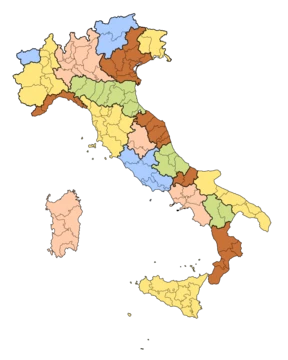
Marche
Central Italian region with a hilly landscape and Adriatic coastline.

Marche (pronounced MAR-kay in English, or [ˈmarke] in Italian), sometimes called the Marches (MAR-chiz), is one of Italy’s twenty regions. It sits in the central part of the country and has nearly 1.5 million residents, ranking thirteenth among Italian regions by population. Its capital and largest city is Ancona. To the north, Marche borders Emilia-Romagna and the Republic of San Marino; to the west lie Tuscany and Umbria; to the southwest, Lazio; to the south, Abruzzo; and to the east, the Adriatic Sea.
The land is mostly hilly, except for river valleys and a narrow coastal strip. A 19th-century railway from Bologna to Brindisi runs along the entire coast. Inland, the mountainous terrain makes north–south travel difficult even today, relying on winding roads over mountain passes. From the Middle Ages through the Renaissance, many Marche cities—especially Ancona, Pesaro, Urbino, Camerino, and Ascoli Piceno—were important cultural, artistic, and commercial centers. Urbino, a major Renaissance hub, was the birthplace of the painter and architect Raphael. The region also produced Gentile da Fabriano, Cyriacus of Ancona, Donato Bramante, Giovanni Battista Pergolesi, Giacomo Leopardi, Gioachino Rossini, and Maria Montessori.
The name “Marche” comes from the plural of the medieval word *marca* (a march or border zone), originally referring to border territories of the Holy Roman Empire, such as the March of Ancona and others in the ancient region.
In ancient times, Marche was known as Picenum. Its first cultural unity came in the Iron Age, when the Picentes inhabited most of the area; artifacts from that period are displayed in the National Archaeological Museum of the Marche Region in Ancona. In the 4th century BC, the northern part was occupied by the Senones, a Gallic tribe. The Battle of Sentinum was fought here in 295 BC, after which the Romans founded many colonies, connecting them to Rome via the Via Flaminia and Via Salaria. Ascoli was a center of Italic resistance during the Social War (91–87 BC). After the fall of the Western Roman Empire, the Goths invaded. Following the Gothic War, the region became part of the Byzantine Exarchate of Ravenna, with Ancona, Fano, Pesaro, Rimini, and Senigallia forming the Pentapolis. After the Exarchate fell, the Lombards held it briefly, then Charlemagne conquered it in the late 8th century. Between the 9th and 11th centuries, the marches of Camerino, Fermo, and Ancona were created, giving the region its modern name.
Marche was nominally part of the Papal States, but local lords controlled much of the territory, and major cities governed themselves as free communes. In the 12th century, the commune of Ancona resisted both Emperor Frederick Barbarossa and the Republic of Venice, functioning as an independent maritime republic. An attempt by Gil de Albornoz to restore Papal authority in the 14th century was short-lived. During the Renaissance, rival aristocratic families—such as the Malatesta of Rimini, Pesaro, and Fano, and the House of Montefeltro of Urbino—fought over the region. The last independent entity, the Duchy of Urbino, was dissolved in 1631, after which Marche remained firmly under the Papal States, with many towns governed by hereditary urban patriciates. In the Napoleonic era, the short-lived Republic of Ancona existed in 1797–98; the region merged with the Roman Republic in 1798–99, then with the Kingdom of Italy from 1808 to 1813, and was briefly occupied by Joachim Murat in 1815. After Napoleon’s defeat, Marche returned to Papal rule until 4 November 1860, when it was annexed to the unified Kingdom of Italy by plebiscite. During World War I, the Bombardment of Ancona occurred as part of the Adriatic campaign. The 1916 Rimini earthquakes damaged buildings in Pesaro, Fano, and their hinterlands. The Battle of Ancona took place during the Italian campaign of World War II. Following a 2006 referendum, seven municipalities of Montefeltro—Casteldelci, Maiolo, Novafeltria, Pennabilli, San Leo, Sant’Agata Feltria, and Talamello—were detached from the Province of Pesaro and Urbino and joined the Province of Rimini (Emilia-Romagna) on 15 August 2009. Many towns in Marche have been devastated by powerful earthquakes over the centuries, most recently in August and October 2016. In September 2022, the region experienced heavy flooding.
Marche covers 9,366 square kilometers (3,616 square miles) of the central Adriatic slope. It borders Emilia-Romagna to the north, Tuscany and Umbria to the west, Lazio and Abruzzo to the south, and the Adriatic Sea to the east. The Umbrian enclave of Monte Ruperto (part of the comune of Città di Castello) lies entirely within the Province of Pesaro and Urbino, which forms the region’s northern part. Most of the region is mountainous or hilly: the Apennine range runs longitudinally along the eastern border, descending through hills toward the Adriatic. Except for Monte Vettore (2,476 meters, or 8,123 feet), the mountains are below 2,400 meters (7,900 feet). Hills cover two-thirds of the region, cut by wide gullies, many short rivers, and alluvial plains perpendicular to the Apennines. The main mountain range features several deep river gorges, the best known being Furlo, Rossa, and Frasassi. The coastline stretches 173 kilometers (107 miles).
- Capital
- Ancona
- Provinces
- Ancona, Ascoli Piceno, Fermo, Macerata, Pesaro and Urbino
Quick Facts
- Official Name
- Marche
- Native Name Lang
- it
- Other Name
- The Marches
- Settlement Type
- Region
- Shield Size
- 50px
- Anthem
- it · Inno delle Marche
- Subdivision Type
- Country
- Subdivision Name
- Italy
- Seat Type
- Capital
- Seat
- Ancona
- Government Type
- Presidential system
- Leader Party
- FdI
Facts from the source article.
Lore & Background
Marche was known in ancient times as the Picenum territory. In the Iron Age, the region was almost entirely inhabited by the Picentes. In the fourth century BC, the northern area was occupied by the Senones, a tribe of Gauls. Following the fall of the Western Roman Empire, the region was invaded by the Goths, then became part of the Byzantine Exarchate of Ravenna, with Rimini, Pesaro, Fano, Senigallia, and Ancona forming the so-called Pentapolis (the Pentapolis Maritima). After the fall of the Exarchate, it was briefly held by the Lombards, but was conquered by Charlemagne in the late eighth century. In the ninth to eleventh centuries, the marches of Camerino, Fermo and Ancona were created under the Carolingian Empire, hence the modern name.
Reader's Guide
Marche was nominally part of the Papal States, but most of the territory was under local lords, while major cities ruled themselves as free communes. In the twelfth century, the commune of Ancona resisted both the imperial authority of Frederick Barbarossa and the Republic of Venice, and was a maritime republic on its own. During the Renaissance, the region was fought over by rival aristocratic families, such as the Malatesta of Rimini, Pesaro, Fano and the house of Montefeltro of Urbino. From the Middle Ages to the Renaissance, many cities of the Marche were important cultural, artistic and commercial centres, the most prominent being Ancona, Pesaro, Urbino, Camerino and Ascoli Piceno. Urbino was a major centre of Renaissance history and the birthplace of Raphael. The region is also the birthplace of Gentile da Fabriano, Cyriacus of Ancona, Donato Bramante, Giovanni Battista Pergolesi, Giacomo Leopardi, Gioachino Rossini and Maria Montessori.
Did You Know?
- The name Marche derives from the plural of the medieval word marca, a march or mark, referring to a borderland territory of the Carolingian Empire.
- Urbino, in Marche, was the birthplace of the Renaissance painter and architect Raphael.
The Hilly Heart of Central Italy
Marche stretches across 9,366 square kilometres of central Adriatic coastline, bordered by Emilia-Romagna to the north, Tuscany and Umbria to the west, Lazio and Abruzzo to the south, and the Adriatic Sea along its entire eastern edge. The Apennine range dominates the landscape, running longitudinally along the region's eastern border before descending through hilly terrain toward the sea. Except for Monte Vettore at 2,476 metres, no peak exceeds 2,400 metres, and the hilly zone occupies roughly two-thirds of the total area. Deep river gorges cut through the main range, the most celebrated being those of the Furlo, the Rossa, and the Frasassi. The 173-kilometre coastline is largely flat and straight, broken only by the hilly stretch between Gabicce and Pesaro in the north and the eastern slopes of Monte Conero near Ancona. Climate shifts from a continental pattern of cold, snowy winters in the interior to a milder Mediterranean feel along the shore, with annual rainfall between 1,000 and 1,500 millimetres inland and 600 to 800 millimetres on the coast. A curious geographic oddity is the Umbrian enclave of Monte Ruperto, entirely encircled by the Province of Pesaro and Urbino.
From Picenum to the Kingdom of Italy
The territory now called Marche was known in antiquity as Picenum, home in the Iron Age to the Picentes, whose artefacts are still displayed in the National Archaeological Museum in Ancona. By the fourth century BC, the Senones, a Gallic tribe, had occupied the northern reaches. The Romans arrived after the Battle of Sentinum in 295 BC, founding colonies linked to the capital by the Via Flaminia and Via Salaria, while Ascoli became a stronghold of Italic resistance during the Social War of 91 to 87 BC. After the fall of the Western Roman Empire, Goths swept through the region, followed by Byzantine rule under the Exarchate of Ravenna, where Ancona, Fano, Pesaro, Rimini, and Senigallia formed the Pentapolis. Charlemagne conquered the area in the late eighth century, and by the ninth to eleventh centuries the marches of Camerino, Fermo, and Ancona were established, giving the region its modern name. Ancona in the twelfth century defied both Frederick Barbarossa and Venice, operating as a maritime republic. The Renaissance saw the Malatesta and Montefeltro families contest control, and the Duchy of Urbino was not dissolved until 1631. Napoleonic upheavals brought a brief Republic of Ancona and eventual incorporation into the Kingdom of Italy, but the region returned to Papal rule until the plebiscite of 4 November 1860 finally annexed it to the unified Italian state.
A Cradle of Renaissance Genius
From the Middle Ages through the Renaissance, Marche's cities—Ancona, Pesaro, Urbino, Camerino, and Ascoli Piceno—flourished as vital centres of culture, art, and commerce. Urbino stands as the region's most celebrated cultural landmark, serving as a major hub of Renaissance history and the birthplace of Raphael, one of the era's most consequential painters and architects. The region's roster of extraordinary native sons and daughters reads like a who's who of Western civilisation: the painter Gentile da Fabriano, the traveller-scholar Cyriacus of Ancona, the architect Donato Bramante, the composer Giovanni Battista Pergolesi, the poet Giacomo Leopardi, the operatic giant Gioachino Rossini, and the pioneering educator Maria Montessori all drew their first breath on Marche soil. Ancona, the capital and largest city, anchors a region of nearly 1.5 million inhabitants, making it the thirteenth most populous of Italy's twenty regions. The National Archaeological Museum of the Marche Region, housed in Ancona, preserves artefacts from the Picentes era, linking the region's modern identity to its deepest Iron Age roots.
A Land Shaped by Conflict and Catastrophe
Marche's history is punctuated by devastating natural and military events. During World War I, the Adriatic campaign brought the Bombardment of Ancona, while the 1916 Rimini earthquakes damaged or destroyed buildings across Pesaro, Fano, and their hinterlands. World War II saw the Battle of Ancona fought on Italian soil. The region's vulnerability to seismic activity continued into the modern era, with powerful earthquakes striking in both August and October of 2016, and heavy flooding sweeping through Marche in September 2022. The mountainous interior has long constrained movement, limiting north-south travel to twisting roads over mountain passes, while a 19th-century railway from Bologna to Brindisi traces the narrow coastal strip. In a more recent administrative shift, a 2006 referendum led to seven Montefeltro municipalities—Casteldelci, Maiolo, Novafeltria, Pennabilli, San Leo, Sant'Agata Feltria, and Talamello—being detached from the Province of Pesaro and Urbino to join the Province of Rimini in Emilia-Romagna on 15 August 2009.
Frequently Asked Questions
Who is Marche?
Marche is a central Italian region governed from the port city of Ancona. With roughly 1.48 million residents, it ranks as the thirteenth-most-populated of Italy's twenty regions.
What is Marche's role on the broader map?
It sits in a central corridor, touching Emilia-Romagna to the north, Tuscany and Umbria to the west, Lazio and Abruzzo to the south, and opening onto the Adriatic coast to the east. That position makes it a natural crossroads linking the northern and southern halves of the peninsula.
How does Marche's story end?
As a living, self-governing entity rather than a fixed narrative, Marche has no scripted finale. Its present-day borders and provincial layout are the product of centuries of political reorganisation, and it continues to function as an active region within the Italian Republic.
Why is Marche important to fans of Italian geography?
The combination of a hilly interior and a modest Adriatic coastline gives it a distinctive dual character that sets it apart from both the flat plains of Emilia-Romagna and the mountainous interior of Umbria. It also serves as a key transit corridor between the western and eastern halves of central Italy.
More in Italian Regions 1-17
Spotted an error? Know more?
This is a living reference — every entry is fact-audited, and reader corrections feed straight into our audit queue. Suggest an edit · See this site's audit record