Imam
Islamic leadership role with differing Sunni and Shia interpretations.

In Islam, the title "imam" (Arabic: إمام) refers to a leadership role, but its meaning differs sharply between Sunni and Shia traditions. For Sunni Muslims, an imam is typically a religious scholar or the person who leads congregational prayer. This position is not considered hereditary or divinely appointed—anyone who studies basic Islamic teachings can become one. In everyday practice, an imam leads formal prayers when two or more people gather, even outside a mosque. The congregation follows the imam’s actions, and Friday sermons are usually given by an appointed imam. While all mosques have an imam, this person may simply be a member of the congregation rather than a salaried official. Women are not permitted to lead prayers when men are present, but they may do so for groups of women. According to Hadith, an imam should be chosen for his knowledge of the Quran and Sunnah, as well as his moral character.
The term is also used as an honorary title for recognized religious authorities, especially jurists (fuqaha) and the founders of the four Sunni schools of jurisprudence. It can apply to experts in Quranic exegesis, such as Al-Tabari or Ibn Kathir, as well as to scholars of Hadith. In some contexts, it has referred to the heads of Muhammad’s family in their respective generations.
In Turkey, imams are state-appointed officials who must graduate from an İmam Hatip high school or hold a university degree in theology. Only men are appointed to this role, while women work as preachers, Qur’an course tutors, and religious services experts under the same state body, the Presidency of Religious Affairs. These officials are expected to follow the Hanafi school of Sunni Islam. The title "imam" is also used for central figures in Islamic movements, such as Imam Nawawi in Syria.
In Shia Islam, the concept of imam is far more central and elevated. An imam is not just a leader but is seen as participating fully in the names, attributes, and acts that theology usually reserves for God. Twelver and Ismaili Shia believe these imams are chosen by God to be perfect examples for humanity, free from all sin (a state called ismah), and must be followed because they are divinely appointed. For Twelver Shia, there are twelve imams, all from the Ahl al-Bayt (the family of Muhammad). The final imam, the Mahdi, is believed to return at the end of time. Fatimah, Muhammad’s daughter, is also considered infallible but is not counted as an imam. The Zaidi Shia of Yemen also used the title for their imams, who eventually founded the Mutawakkilite Kingdom of Yemen.
At times, imams have held both secular and religious authority. This occurred in Oman among the Ibadi (Kharijite) sects, where imams were sometimes elected and sometimes inherited the position, as with the Yaruba dynasty (1624–1742). In West Africa, the Imamate of Futa Jallon (1727–1896) was a Fulani state where secular power alternated between two hereditary lines of imams (almami). In Yemen, Zaidi imams served as both spiritual and secular leaders for over a thousand years, beginning with al-Hadi ila’l-Haqq Yahya in 897, a theocratic system that lasted into the late 20th century. Saudi leaders were also called "imams" until Ibn Saud replaced the title with "king." Ruhollah Khomeini is officially referred to as imam in Iran, and several places and institutions there bear his name.
- field
- Islamic leadership and religious authority
- known_for
- Leading prayers, scholarly authority, and in Shia Islam, infallible spiritual leaders
- nationality
- Varies across Islamic world
- born
- Not specified in article
- died
- Not specified in article
Lore & Background
In Shia Islam, the imam holds a more central belief, being chosen by God as a perfect example for the faithful, free from sin (ismah), and must be followed. Twelver Shi'ism recognizes twelve Imams, the final being the Mahdi who will return at the end of times. Ismaili and Zaidi branches also have their own lines of imams. At times, imams have held both secular and religious authority, as in Oman among Ibadi sects, in Yemen under Zaidi rulers, and in West Africa with the Imamate of Futa Jallon.
Reader's Guide
The concept of imam is central to Islamic history and theology, but its meaning diverges sharply between Sunni and Shia traditions. For Sunnis, the imam is a functional and scholarly role, often local and non-hereditary, while for Shia, the imam is a divinely appointed, infallible leader essential to faith. This distinction is often overlooked by non-Muslims. The term has also been used for secular rulers, such as in Oman, Yemen, and West Africa, and for modern figures like Ruhollah Khomeini in Iran. The role continues to evolve, with state-appointed imams in Turkey and the ongoing expectation of the Mahdi's return in Twelver Shi'ism. Understanding the imam is key to grasping the diversity of Islamic authority and community organization.
Did You Know?
- In Sunni Islam, anyone can study basic Islamic teachings and become an imam.
- Shia Muslims believe the Imams are chosen by God and free from sin (ismah).
- In Turkey, imams are appointed by the state and must be graduates of an İmam Hatip high school or have a theology degree.
- Ruhollah Khomeini is officially referred to as imam in Iran.
The Ceremonial Architecture of Islamic Marriage
Across the vast and diverse Muslim world, a shared ceremonial skeleton underpins the journey from two separate lives to a united household. Despite enormous regional variation in food, dress, and local custom, four sequential stages recur: the khitbah, in which families arrange and vet a prospective pairing; the nikah, the formal agreement-to-marry ceremony that legally binds the couple; the zifaf or rukhsati, the symbolic 'sending off' of the bride from her family home; and the walimah, the communal wedding banquet that publicly celebrates the new union. This progression matters because it separates the private negotiation phase from the public declaration phase, ensuring that the community witnesses and affirms the marriage rather than discovering it later. The architecture also reflects a broader Islamic principle: marriage is not merely a personal contract between two individuals but a social institution whose legitimacy is reinforced by collective recognition. Even where governments impose additional civil requirements, these four ritual pillars remain the cultural and religious backbone that families plan around, from the first whispered conversation between elders to the final shared meal with extended kin.
Family as the Engine of Matchmaking
Because Islamic law imposes strict boundaries on unsupervised interaction between marriageable men and women, the search for a spouse traditionally bypasses the individual and routes through the family. Parents, uncles, aunts, and trusted community members act as scouts, comparing a young person's character, faith, and long-term plans against those of a potential partner. During the khitbah stage, the two prospective spouses may speak only under close supervision, never alone and never in physical contact; a woman wearing a niqab may, however, unveil briefly so the suitor can see her face. If both sides are satisfied, the families enter a committed phase analogous to engagement, though the word 'fiancé' itself is not used in Islamic terminology. Regional flavors differ markedly: Arab communities often stage elaborate approval ceremonies, South Asian families emphasize social alliance through exchanges of jewelry and gifts, and Southeast Asian traditions weave in communal engagement rituals. A pious modern alternative, sometimes called 'halal dating,' allows the couple to meet in public with a chaperone or friend group, focusing conversation on faith, personality, and mindset rather than physical attraction.
The Contractual Heart: Mahr, Nikah, and the Imam's Role
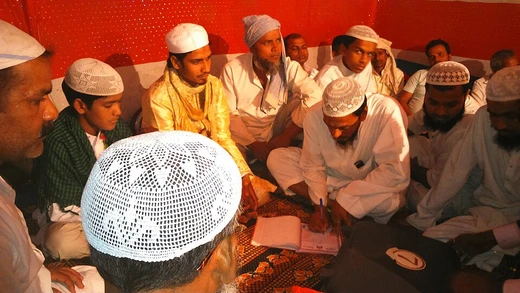
At the legal and spiritual core of an Islamic marriage sits a set of precise contractual requirements that distinguish it from a mere social celebration. The mahr—a mandatory gift from the groom to the bride, paid for her exclusive benefit and explicitly commanded in the Quran (4:4)—must be agreed upon before the ceremony. The nikah itself demands the physical presence of the groom, the bride, her wali (typically her father acting as Islamic legal guardian), two Muslim witnesses, and an officiant, most commonly an Imam, though the venue can be a private home or a qadi's office rather than a mosque. The wali first elicits the bride's consent, then the groom's commitment, and both parties verbally declare 'Qubool'—'I accept'—three times. Only after this spoken exchange is the written marriage contract signed, at which moment the couple is legally husband and wife. Attendees then recite the Fatihah, and the Imam delivers a khutbah sermon anchored in specific verses from Surah An-Nisa, Al-Imran, and Al-Ahzab, framing the union within a broader theological narrative.
Tradition in Tension with Modernity
Islamic marriage law sits at a crossroads between scriptural ideals and the realities of contemporary nation-states. The Quran points to puberty (baligh) as a marker of maturity, and many Muslim-majority countries have codified minimum marriage ages—eighteen for both sexes in Egypt, nineteen for women and twenty-one for men in Indonesia—yet in Pakistan and Afghanistan, child marriages persist despite being illegal, sustained by weak enforcement and deeply entrenched cultural norms. At the same time, non-Muslim wedding customs such as tiered cakes, exchange of rings, and live music have crept into Muslim celebrations, prompting revivalists and reformers to push back and reassert what they see as authentically Islamic practice. The khitbah stage itself has evolved: where once it was almost exclusively a family-to-family negotiation, some communities now incorporate pre-marital counselling, and the 'halal dating' model offers a structured, chaperoned space for prospective spouses to evaluate each other's faith and personality. These shifts do not overturn the core contractual requirements—mahr, wali, witnesses, the triple Qubool—but they reveal a living tradition constantly negotiating its boundaries in a globalized world.
Frequently Asked Questions
What is an Imam in Islam?
An Imam is a leadership position in Islam that can refer to a person who guides the community in worship, a respected religious scholar, or—depending on the tradition—a divinely designated spiritual authority. The Arabic term broadly conveys the idea of 'one who stands before' or serves as a guide for others.
How is the Imam role different in Sunni vs Shia Islam?
In Sunni practice, the Imam is typically a qualified community member who leads congregational prayer or serves as a local religious teacher, with no requirement of divine appointment. In Shia theology, the Imams form a specific lineage of infallible leaders drawn from the Prophet Muhammad's family (Ahl al-Bayt) who hold both spiritual and political authority by divine designation.
Is the position of Imam hereditary in Islam?
In Sunni Islam the role is not passed down through bloodlines; any qualified individual can serve as a prayer leader or community scholar. In Shia Islam, however, the Imamate is understood as a hereditary office restricted to the descendants of the Prophet's household.
What does an Imam actually do in daily practice?
Most commonly, an Imam leads the five daily congregational prayers, reciting and guiding the physical movements of the worshippers behind him. He may also deliver the Friday sermon (khutbah) and provide ongoing religious education to the community.
Are all Imams considered infallible in Islam?
No—this is a major point of divergence between the two traditions. Sunni Islam does not attribute infallibility to Imams, whereas Shia theology holds that the Imams from the Ahl al-Bayt are divinely protected from error in matters of faith and law.
More in Islamic Concepts And Practices 1-16
Spotted an error? Know more?
This is a living reference — every entry is fact-audited, and reader corrections feed straight into our audit queue. Suggest an edit · See this site's audit record