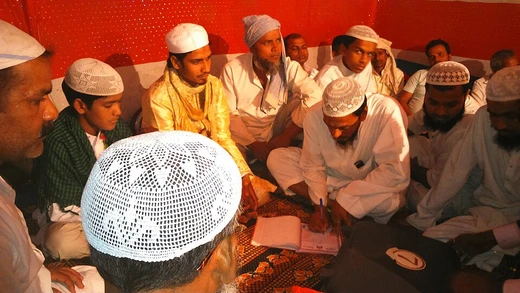
Five Pillars of Islam
Five obligatory acts of worship in Sunni Islam.

The Five Pillars of Islam, known in Arabic as *arkān al-Islām* or *arkān ad-dīn* (meaning "pillars of the religion"), are core practices considered obligatory acts of worship in Islam, especially within Sunni tradition. These duties are outlined in the hadith of Gabriel. While Sunni and Shia Muslims generally agree on the basic performance of these acts, Shia groups sometimes have their own lists—for example, Twelver Shia follow the Ancillaries of the Faith (which include four pillars and six obligatory acts), and Ismailis recognize Seven Pillars. The five pillars are: the profession of faith (Shahada), prayer (Salah), almsgiving (Zakat), fasting during Ramadan (Sawm), and pilgrimage to Mecca (Hajj).
The Arabic word *rukn* literally refers to a building’s corner, while pillars are called *umud*. It can also mean the basic elements or first principles of something. In military terms, *arkan* refers to the general staff. Because of this, translating the term as "five principles of Islam" is more precise than "five pillars."
These ritual obligations are recognized and practiced by Muslims around the world, despite differences among communities. They are seen as compulsory for anyone who genuinely wants to follow the life of the Islamic prophet Muhammad. Like other religions, Islam has standard practices, but not every person who identifies as Muslim necessarily observes them all. Individual commitment varies—some may not pray daily, fast, perform Hajj, or give large amounts in charity. Certain groups, such as Alevis, reject the Five Pillars entirely and instead follow a Four Doors system.
Shortly after early Muslim conquests, mosques, castles, and other commemorative works were built as expressions of faith and culture. The religious practice of Islam—meaning "submission to God"—rests on these fundamentals, each of which is mentioned in the Quran across various chapters (*suwar*). More detailed instructions are provided in the Hadith. Although similar practices existed in pre-Islamic Arabia and among Jews and Christians at the time of Muhammad, they were transformed in the Quran and Hadith to focus strictly on monotheism and to be tied to Muhammad’s life. The Shahada does not appear in full in the Quran, but verse 8:20 urges believers to obey God and His Messenger. Prayer is referenced multiple times, with specific times given in 20:130 and acts of bowing and prostrating in 48:29. Several chapters encourage both prayer and almsgiving (e.g., 5:12), though the details of what, when, and to whom to give are clarified in the Hadith. Fasting is covered in 2:183–187, which names Ramadan and outlines who should or should not fast under certain conditions. The longest Quranic passage on Hajj (2:196–203) specifies the pilgrimage’s destination, conduct, and activities, urging participants to keep God in mind.
**First Pillar: Shahada (Declaration of Faith)** The Shahada is the assertion of faith. It consists of two statements: "There is no god but God" and "Muhammad is the messenger of God." This formula is typically recited in Arabic: *lā ʾilāha ʾillā-llāhu muḥammadun rasūlu-llāh*. Uttering it is essential to becoming a Muslim or converting to Islam. The first part promotes the essential unity of faith, declaring that no god exists but God. The Tawhid—the prayer stating "no god but God"—is a major component of Islam, affirming monotheism and God’s unity as the source of existence. The second part demonstrates God’s mercy, proclaiming Muhammad as the last prophet and the prime example of guidance for all Muslims. According to Islamic belief, earlier communities (such as Jews and Christians) distorted the revelations they received; Muhammad received the Quran’s guidance and now bears it for the entire Muslim community. The Shahada is recited five times daily during prayer, spoken to a newborn at birth, and whispered to a person on their deathbed, showing how the pillars accompany a Muslim from the start of life to its end.
**Second Pillar: Salah (Prayer)** Salah, or prayer, is the second pillar. Before praying, ablutions are performed—washing the hands, face, and feet. A caller (called a *muezzin* in Arabic) chants aloud from a raised place in the mosque. Verses from the Quran are recited either loudly or silently. These prayers are a specific, physical type of worship involving prostrations. They are performed five times daily at set times, with the individual facing Mecca. The prayer times are: Fajr (dawn), Dhuhr (noon), ʿAṣr (afternoon), Maghrib (evening), and ʿIshāʾ (night). Fajr is done before sunrise, Dhuhr in the midday after the sun has passed its highest point, Asr in the evening before sunset, and Maghrib at dusk.
- field
- Islamic religious practice
- known_for
- Core obligatory acts of worship in Sunni Islam
- components
- Shahada, Salah, Zakat, Sawm, Hajj
Lore & Background
The Five Pillars are: profession of faith (Shahada), prayer (Salah), almsgiving (Zakat), fasting in the month of Ramadan (Sawm), and pilgrimage to Mecca (Hajj). Each pillar is alluded to in the Quran, though in various chapters, with further details given in the Hadith. The Shahada consists of two declarations: 'There is no god but God' and 'Muhammad is the messenger of God,' and is essential to becoming a Muslim. Salah involves specific prayers performed five times daily at set times, facing Mecca, preceded by ablutions. Zakat is almsgiving, typically about 2.5% of one's wealth, used to support the community and assist the needy.
Reader's Guide
The Five Pillars are viewed as compulsory for individuals who genuinely wish to pursue a life like that which Islamic prophet Muhammad led. Though similar practices existed in pre-Islamic Arabia and among Jews and Christians, they were changed in the Quran and Hadith to have a carefully monotheistic center. The Sunni and Shia agree on basic details of performance, but Shia denominations may have their own lists, such as the Twelver Ancillaries of the Faith or the Ismaili Seven Pillars. Some Muslim communities, like the Alevis, reject the Five Pillars and follow a Four Doors system. The pillars are instrumental from birth to death: the Shahada is said to a newborn and to a person on their death-bed. The translation 'five principles of Islam' is considered more accurate than 'five pillars' because the Arabic word rukn refers to a corner or basic element.
Did You Know?
- The standard Arabic term for the Five Pillars is 'arkan' (أركان), which literally means 'corners' or 'supports', not 'umud' (pillars).
- The Shahada does not appear in full in the Quran, but Quran 8:20 urges believers to obey God and His messenger.
Theological Foundations and the Nature of the Divine
Both Islam and Sikhism anchor their faith in a single, eternal God, yet they diverge sharply on how that deity relates to the material world. Islam's core doctrine of tawhid insists that Allah is absolutely one, begetting none and begotten by none, with no likeness to Him. The Quranic declaration frames God as the Eternal Absolute, wholly separate from His creation. Sikhism, by contrast, embraces a panentheistic vision: Waheguru is formless (nirankar) in the nirgun aspect—unmanifest, without attributes, yet all-pervading—and simultaneously manifest in the sargun aspect, visible through the entirety of creation. The Sikh teaching that creator and creation are one and the same stands in direct tension with the Islamic conviction that God remains distinct from what He made. Interestingly, the Islamic theosophical concept of wahdatul wujud carries notable parallels with this Sikh panentheism, suggesting a deeper philosophical overlap beneath the doctrinal differences.
Daily Devotion and the Architecture of Practice
Islam structures its worship around mandatory pillars that bind every believer. Daily prayers are obligatory for all Muslims, annual zakah demands alms-giving as a religious duty, and the Hajj pilgrimage to Mecca represents a culminating act of devotion. The entire legal and moral framework rests on Sharia, derived from the Quran and the Sunnah. Sikhism, by contrast, rejects formal ritual systems and contains no equivalent to Sharia within the Guru Granth Sahib. Instead, Guru Nanak Dev Ji established three foundational practices: Naam Japna, the meditation and chanting of the divine Name; Kirat Karna, earning an honest livelihood free from corruption; and Vand Chhako, the selfless sharing of one's earnings through seva. Baptized Sikhs observe a daily routine called Nitnem, reading the five banis. While Islam mandates the Hajj pilgrimage, Sikhism holds no belief in pilgrimages as such, though many Sikhs do journey frequently to the Harmandir Sahib in Amritsar.
Historical Encounters and Cross-Religious Exchange
The relationship between Islam and Sikhism is marked by both constructive exchange and conflict. The very first convert to Sikhism was a Muslim named Mardana, who became Guru Nanak's lifelong companion and traveled with him on his journeys. Mardana is believed to have played the rebab while Guru Nanak recited the sacred hymns that would eventually form the Adi Granth. The earliest major interfaith encounter occurred when Guru Nanak spent two years in Mecca and the broader Middle East, where he studied Islam and engaged in detailed theological discussions with Muslim sheikhs. The Guru Granth Sahib itself preserves teachings from Muslim figures, notably Baba Farid and Kabir, embedding their spiritual wisdom within the Sikh scripture. This history of mutual influence coexists with a more adversarial strand: hardline Muslim scholars have categorized Sikhism as kafir mushrikun, a designation rooted in Sikhism's rejection of Islamic prophecy and its placement of Guru Nanak's revelation roughly eight centuries after the Prophet Muhammad.
Finality, Apostasy, and the Question of Religious Exclusivity
Islam presents itself as the perfect and final religion, with Prophet Muhammad as the last messenger to whom the Quran was revealed in the seventh century CE. The faith warns against innovation (bid'ah) to what is revealed in the Quran and Hadiths, and teaches that non-Islamic traditions have been distorted by human desire. Apostasy—abandoning Islam for another faith or atheism—is treated as a religious crime; traditional sharia has prescribed death by the sword for a sane adult male who voluntarily leaves, and the Hadiths reference beheading, crucifixion, or banishment. Sikhism takes a fundamentally different stance, allowing freedom of conscience and teaching that many religious traditions are valid paths to the same Waheguru. It explicitly rejects the notion that any single religion holds a monopoly on absolute truth, and it acknowledges messengers from other faiths, including Moses, Jesus, and Muhammad, as part of a broader spiritual lineage.
Frequently Asked Questions
What are the Five Pillars of Islam?
The Five Pillars (arkān al-Islām) are the set of core obligatory acts of worship that form the foundation of practice in Sunni Islam. They are recognized by Muslims worldwide as the essential framework for a believer's religious life.
What are the five components of the Five Pillars?
The five acts are Shahada (declaration of faith), Salah (prayer), Zakat (almsgiving), Sawm (fasting during Ramadan), and Hajj (pilgrimage to Mecca). Together they cover verbal, physical, financial, and spiritual dimensions of devotion.
Where does the Five Pillars concept originate in Islamic tradition?
The framework is drawn from the hadith of Gabriel, in which the angel Gabriel asks the Prophet Muhammad to enumerate the essentials of the faith. This narration has become the standard reference point for summarizing Islamic obligation.
Who is expected to observe the Five Pillars?
They are considered obligatory for all Muslims, with the concept being most formally articulated within Sunni Islam. In practice, individual participation can vary depending on circumstance, ability, and local tradition.
Why are the Five Pillars important in the broader Islamic canon?
They serve as the foundational structure of worship, tying together belief, ritual, charity, self-discipline, and communal pilgrimage into a single cohesive system. Their centrality makes them the primary reference point for understanding what Islamic practice demands of a believer.
More in Islamic Concepts And Practices 1-16
Spotted an error? Know more?
This is a living reference — every entry is fact-audited, and reader corrections feed straight into our audit queue. Suggest an edit · See this site's audit record