ISS National Lab
Last updated
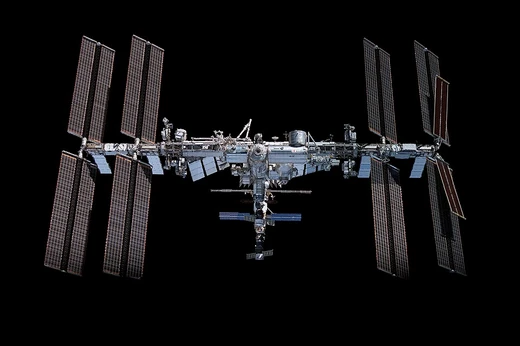
The ISS National Lab is a U.S. government-funded laboratory created on December 30, 2005, under the 2005 NASA Authorization Act. Its main research facilities are housed in the U.S. portion of the International Space Station, supporting work in life sciences, physical sciences, technology development, and remote sensing for academic, government, and commercial users. The Center for the Advancement of Science in Space has sent 270 payloads to the ISS, with 176 of those for commercial firms such as Merck & Co., Novartis, Eli Lilly and Company, Hewlett Packard Enterprise, Honeywell, and Procter & Gamble.
History
The U.S. segment of the International Space Station was designated a national laboratory by the 2005 NASA Authorization Act, with the goal of improving life on Earth, building partnerships between NASA, other federal agencies, and private industry, and promoting STEM education using microgravity. This followed the Destiny module’s activation in February 2001, which made the ISS an operational science platform. In 2010, Congress required NASA to select a nonprofit to run the lab. NASA chose the Center for the Advancement of Science in Space (CASIS) in August 2011 under a ten-year agreement, later extended in July 2017 to manage the lab through September 2024.
Facilities
Scientific research facilities on the National Lab provide infrastructure and equipment to conduct experiments in microgravity. Facilities typically remain on station for extended periods to support repeat and long-term research. Many facilities are managed by private sector companies. Facility managers support use of on-station equipment for investigations from organizations other than the hardware's developer and owner, validating a business model for in-orbit commercial services at lower costs.
The National Lab now has 14 commercially operated laboratory facilities managed by eight companies, including two newly installed facilities in FY18 and one new facility manager. The ADvanced Space Experiment Processor is a thermally controlled facility that accommodates experiments in cell technology, model organisms, multiphase fluids, solution chemistry, separation science, microencapsulation, and crystal growth. The Bone Densitometer provides bone density scanning of mice during space flight to help researchers study human bone disease.
The Materials ISS Experiment-Flight Facility tests materials, coatings, and components in space, showing how they react to ultraviolet radiation, atomic oxygen, ionizing radiation, ultra-high vacuum, charged particles, thermal cycles, electromagnetic radiation, and micrometeoroids. Industries that benefit include advanced materials, automotive, aeronautics, energy, space, transportation, and micro-meteoroid on-orbit debris.
Research
All living organisms on Earth are continually influenced by gravitational forces on both macro and molecular levels. The microgravity conditions in space induce changes in DNA regulation, expression of genes, and cell structure and function. Understanding the impact of gravitational force on living systems advances research in biology, genetics, health care, medicine, microbiology, plant and crop sciences, nanotechnology, and pharmaceutical and regenerative medicine.
Stem cells may grow faster in microgravity as compared to cells grown conventionally in gravity. Space conditions also allow for the formation of three-dimensional tissues coupled with the differentiation of stem cells into different cell types that better mimic the functions of tissues and organ systems. One scientist is experimenting with human stem cells in space to improve treatments for stroke victims, aiming to expand the population of stem cells that will induce regeneration of neurons and blood vessels in patients who have suffered a hemorrhagic stroke.
This kind of research is conducted on Earth using incubators, but growing stem cells takes an extended period of time; testing in space is believed to accelerate growth. Researchers are also using organs-on-chips or tissues-on-chips to build tiny versions of human systems.
These microchip-like devices are embedded with living cells that will react in space as if the full organ was there. Scientists believe these chips will eventually replace traditional dish cultures and animal testing for studying disease and testing new drugs. The latest tissues-on-chip experiment on the ISS involves growing functional bone tissue.
More in International Space Station
Sources
Compiled from Wikipedia and the sources listed below. Text from Wikipedia is available under CC BY-SA 4.0; this entry is adapted from it.
- Wikipedia: ISS National Lab (CC BY-SA 4.0).
Spotted an error? Know more?
Reader corrections go straight into our review queue. Suggest an edit · How this site is sourced