Manufacture of the International Space Station
Last updated
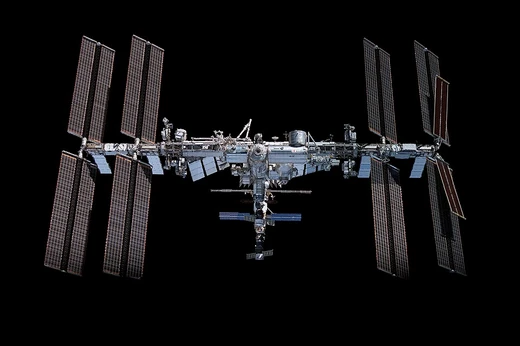
The International Space Station was manufactured through a global effort involving facilities in the United States and Europe, overseen by five space agencies. Hundreds of contractors fabricated modules, trusses, experiments, and other hardware. The project required cooperation among sixteen countries, creating engineering challenges in language, culture, politics, and standards.
Quick Facts
- Overseeing agencies
- NASA
- Roscosmos
- European Space Agency
- JAXA
- Canadian Space Agency
- Participating countries
- 16
- Key materials
- steel, aluminium alloys
- Transport aircraft used
- Airbus Beluga
- Antonov An-124
- Aero Spacelines Super Guppy
- Final processing location
- Kennedy Space Center Space Station Processing Facility and Operations and Checkout Building
- Rack weight range
- 700 to 1,100 kg / 2,425 lb
Facts from the source article.
History and planning
The project originated as the US-only Space Station Freedom, delayed by funding and technical problems. After 1980s authorization by Ronald Reagan with a ten-year construction plan, it was redesigned in the 1990s to cut costs and broaden international involvement.
In 1993, the United States and Russia merged their separate station plans into one facility, incorporating contributions from the European Space Agency and Japan. An international agreement board later recruited additional agencies and companies. The International Organization for Standardization helped unify engineering methods, languages, standards, and techniques across all manufacturing activities.
Transportation
Most station elements were flown by Airbus Beluga or Antonov An-124 aircraft to the Kennedy Space Center Space Station Processing Facility for final manufacturing and launch processing; some arrived by ship at Port Canaveral. Each module traveled in a custom shipping container with foam insulation and sheet metal shell. American and Canadian components—such as the US lab, Node 1, Quest airlock, truss and solar array segments, and Canadarm-2—were flown by Aero Spacelines Super Guppy or moved by road and rail. After final manufacturing and testing, all components were placed in a payload transfer container shaped like the Space Shuttle payload bay, then hoisted vertically at the launch pad gantry for transfer to the orbiter.
Pre-launch processing and last stages of manufacturing
Except for the Russian module Rassvet, all ISS components were processed at the Space Station Processing Facility or the Operations and Checkout Building at Kennedy Space Center. At the SSPF, modules, trusses, and solar arrays were prepared in two large 100,000-class clean rooms where workers wore non-contaminant clothing. Modules were cleaned, polished, and partially disassembled for installation of cables, electrical systems, and plumbing. Steel truss parts and module panels were assembled with screws, bolts, and connectors, some with insulation.
International Standard Payload Rack frames were assembled and welded, then fitted with instruments and science experiment boxes. Fully assembled racks, weighing 700 to 1,100 kg each, were hoisted by a manually operated robotic crane and maneuvered into modules, secured with screws and latches.
Cargo bags for MPLM modules were filled on-site and loaded by the same crane. In the Operations and Checkout Building, modules were tested in a vacuum chamber for leaks and systems checks were conducted. Similar processing occurred there if the SSPF was full or for certain preparation stages.
More in International Space Station
Sources
Compiled from Wikipedia and the sources listed below. Text from Wikipedia is available under CC BY-SA 4.0; this entry is adapted from it.
- Wikipedia: Manufacture of the International Space Station (CC BY-SA 4.0).
Spotted an error? Know more?
Reader corrections go straight into our review queue. Suggest an edit · How this site is sourced