Zygentoma
Primitive wingless insects with three tail-like filaments.
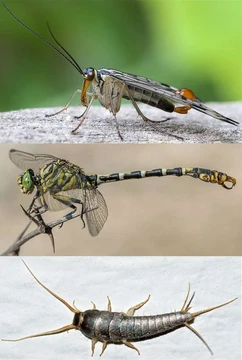
Zygentoma is an order of insects in the class Insecta, comprising about 550 known species, including silverfish (or fishmoths) and firebrats. They are among the most primitive living insect lineages, having diverged before the evolution of winged insects, and are more closely related to winged insects than to the bristletails (Archaeognatha). A conspicuous feature is the three long caudal filaments: two lateral cerci and a medial epiproct, nearly equal in length.
Quick Facts
- Taxon
- Zygentoma
Facts from the source article.
Lore & Background
Zygentoma have dorsiventrally flattened bodies, generally elongated or oval, with slender mobile antennae. Their compound eyes tend to be small; some families lack eyes entirely. The mandibles are short and mouthparts unspecialized. Most extant species have a body length less than 2 cm, though Carboniferous fossils about 6 cm long are known. Silverfish are so-called because of the silvery glitter of scales covering the bodies of the most conspicuous species (family Lepismatidae), and their movement has been described as fish-like.
Silverfish may be found in moist, humid environments or dry conditions, both free-living and as nest-associates. In domestic settings, they feed on cereals, paste, paper, starch in clothes, rayon fabrics, and dried meats; in nature, they feed on organic detritus. Wild species often inhabit dark, moist habitats such as caves or under rocks, and some are commensals living in ant and termite nests. There are no current species formally considered at conservation risk, though several troglobites limited to one or a few caves run an exceptionally high risk of extinction.
Aggregation behavior in Zygentoma is triggered not by pheromones but by an endosymbiotic fungus, Mycotypha microspora, and an endosymbiotic bacterium, Enterobacter cloacae, both present in the feces of the firebrat Thermobia domestica. Firebrats detect E. cloacae based on its external glycocalyx of polysaccharides, likely its D-glucose component. Mycotypha microspora is detected only in the presence of cellulose, suggesting metabolites of enzymatic cellulose digestion serve as the aggregation cue. Gray silverfish also respond to Mycotypha microspora, but common silverfish do not.
Reader's Guide
Zygentoma holds significance as one of the most primitive living insect orders, providing insight into the early evolution of insects before the development of wings. Their phylogenetic position as sister group to the Dicondylia (which includes winged insects) makes them crucial for understanding insect relationships. The order was historically classified as a suborder of Thysanura until the late twentieth century, when Thysanura was recognized as paraphyletic, leading to the elevation of Zygentoma to an independent monophyletic order.
The order's name, derived from Greek meaning 'yoke' or 'bridge' and 'insects', reflects an obsolete view that the taxon formed a link between Pterygota and Apterygota. Their reproductive biology features an elaborate courtship ritual involving a silk thread and spermatophore. As ametabolous insects, they continue to moult throughout life, with lifespans of up to eight years recorded. Their ability to consume lignocellulose has made them subjects of research for biofuel production, as their guts act as natural bioreactors breaking down cellulose. The fossil record is poor, with the oldest unambiguous fossils from the Early Cretaceous, though the group likely diverged during the Early Carboniferous or Devonian.
Did You Know?
- The name 'Zygentoma' is derived from Greek words meaning 'yoke' or 'bridge' and 'insects', reflecting an obsolete view that the taxon formed a link between Pterygota and Apterygota.
- Aggregation behavior in firebrats is triggered by an endosymbiotic fungus (Mycotypha microspora) and an endosymbiotic bacterium (Enterobacter cloacae) present in their feces, not by pheromones.
- Silverfish have an elaborate courtship ritual where the male deposits a spermatophore under a silk thread and coaxes a female to walk under it to pick up the sperm packet.
- Some molecular phylogenies have found the family Tricholepidiidae to form an independent, more basal branch of insects unrelated to other zygentomans.
More in Insect Families 1-20
Spotted an error? Know more?
Reader corrections go straight into our review queue. Suggest an edit · How this site is sourced