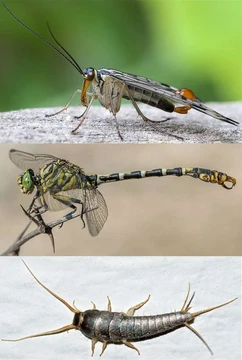
Odonata
Order of predatory flying insects including dragonflies and damselflies.

Odonata is an order of predatory flying insects. It includes dragonflies (Anisoptera), damselflies (Zygoptera), and the Epiophlebia damsel-dragonflies. Dragonflies are generally bulkier, with large compound eyes that meet and wings held spread out or flat when resting. Damselflies are more slender, with eyes set apart and wings folded together along the body at rest. Adults can perch but rarely walk.
All odonates have aquatic larvae called naiads or nymphs. Both larvae and adults are carnivorous, feeding almost entirely on insects. Larvae will eat anything they can overpower, including small fish, tadpoles, and even adult newts. Adults are superb aerial hunters, with legs specialized for catching prey in flight.
Odonata in its narrow sense is a subgroup of the broader Odonatoptera, which includes other dragonfly-like insects. The scientific study of Odonata is called odonatology.
The term Odonata was coined by Johan Christian Fabricius in 1793 from the Ancient Greek word for "tooth," possibly because their maxillae are notably toothed. "Dragonfly" usually refers only to Anisoptera, but sometimes means all Odonata. Enthusiasts avoid ambiguity by using "true dragonfly" or "anisopteran." The alternative term "warriorfly" has been proposed.
The largest living odonate is the giant Central American helicopter damselfly *Megaloprepus coerulatus*, with a wingspan of 191 mm. The heaviest are *Tetracanthagyna plagiata* (wingspan 165 mm) and *Petalura ingentissima* (body length up to 125 mm, wingspan 160 mm). The longest is the Neotropical helicopter damselfly *Mecistogaster linearis*, with a body length of 135 mm. The smallest dragonfly is *Nannophya pygmaea* from east Asia (body length 15 mm, wingspan 20 mm). The smallest damselflies, and smallest odonates, are species of *Agriocnemis* (wingspan 17–18 mm).
Odonates have large rounded heads covered mostly by well-developed compound eyes, legs for catching prey in flight, two pairs of long transparent wings that move independently, and elongated abdomens. They have three ocelli and short antennae. Mouthparts are on the underside of the head and include simple chewing mandibles. Flight is direct, with muscles attaching directly to the wings, allowing independent control of each wing's amplitude, frequency, angle of attack, camber, and twist.
Quick Facts
- Taxon
- Odonata
Facts from the source article.
Lore & Background
Johan Christian Fabricius coined the term Odonata in 1793 from the Ancient Greek ὀδών (odṓn) meaning 'tooth', possibly because their maxillae are notably toothed. The two major groups are dragonflies (Anisoptera), which are bulkier with large compound eyes together and wings spread at rest, and damselflies (Zygoptera), which are more slender with eyes apart and wings folded along the body at rest. Adult odonates can land and perch but rarely walk.
Odonates have large rounded heads covered mostly by compound eyes, legs specialized for catching prey in flight, two pairs of long transparent wings that move independently, and elongated abdomens. Their flight is direct, with muscles attaching directly to the wings, allowing independent control of each wing. Most families have a pterostigma on the wing that assists in gliding by preventing flutter. Nymphs have a unique prehensile organ called a labial mask for grasping prey.
Members of the crown group Odonata first appeared during the Late Triassic, while their total group Odonatoptera appeared in the Late Carboniferous. The fossils of related Paleozoic 'giant dragonflies' like Meganeuropsis permiana reached wing spans up to 71 cm, making them the largest insects of all time. The Odonata is closely related to mayflies in a group called Palaeoptera.
Reader's Guide
Odonata are significant as one of the earliest groups of winged insects, with a fossil record spanning 319 million years. Their unique direct flight mechanism and independent wing control represent a primitive condition compared to the Neoptera. The order's ecological role as both aquatic and aerial predators makes them important in controlling insect populations and as bioindicators of water quality. The distinction between dragonflies and damselflies, based on wing position and body morphology, is a classic example of adaptive radiation within a single order. The complex mating system, including intra-male sperm translocation and the 'wheel' position, is unique among insects. The largest known insect of all time, Meganeuropsis permiana, belongs to the related extinct order Meganisoptera, highlighting the ancient lineage of these insects. The term 'Odonata' itself, coined by Fabricius, reflects the toothed maxillae that characterize the group.
Did You Know?
- The smallest living dragonfly is Nannophya pygmaea from east Asia, with a body length of 15 mm.
- Male Odonata have a secondary set of copulatory organs on the second and third abdominal segments, separate from the primary genitals.
- The fossil Meganeuropsis permiana from the Permian had a wing span of up to 71 cm, making it the largest insect of all time.
Anatomy and the Mechanics of Flight
These insects possess a head that is disproportionately large and rounded, dominated by well-developed compound eyes that grant them keen visual acuity, supplemented by three small ocelli and notably short antennae. Their mouthparts sit on the underside of the head and include simple chewing mandibles in the adult stage. Two pairs of long, transparent wings extend from the thorax, and each wing operates with a degree of independence rarely seen in the insect world. Unlike most other winged insects, where flight muscles attach to the thorax and move the wings indirectly, odonates have direct flight muscles anchored to the wings themselves. This arrangement permits each of the four wings to be controlled separately in amplitude, frequency, angle of attack, camber, and twist, giving the adult an extraordinary range of aerial maneuverability. Along the leading edge near the wingtip, most families bear a pterostigma—a thickened, hemolymph-filled, often colorful patch bounded by veins. This heavier segment serves a critical aerodynamic function: it suppresses self-exciting vibrations called flutter that would otherwise set in above a critical speed, thereby making sustained gliding possible. Without this structural reinforcement, the wing would destabilize and gliding would be impossible.
A Carnivorous Life from Water to Air
Every odonate, regardless of suborder, passes through an aquatic larval stage known as a naiad or nymph before emerging as a winged adult. Both life stages are unapologetically carnivorous, feeding almost exclusively on other insects, though the larvae are opportunistic enough to take down small fish, tadpoles, and even adult newts whenever they can overpower them. The nymphal body is stockier and shorter than the adult form, with smaller eyes, longer antennae, and a less mobile head. Most strikingly, the nymph's labium is modified into a unique prehensile structure called a labial mask, a rapid-extending grasping organ used to seize prey in the water. Respiration differs between the two major groups: damselfly nymphs breathe through external gills attached to the abdomen, while dragonfly nymphs respire via a specialized organ located in the rectum. Once the adult emerges, it becomes a superb aerial hunter. Its legs are specialized for snatching prey mid-flight, and although it can land and perch on vegetation or structures, it almost never walks. The adult's entire predatory apparatus—eyes, wings, and legs—is tuned for the open sky.
Deep Roots in the Fossil Record
The lineage that would become modern dragonflies and damselflies stretches back to the Late Carboniferous, when members of the broader superorder Odonatoptera first appeared in the fossil record. The crown group Odonata itself emerged during the Late Triassic, making this order one of the earliest lineages of winged insects to evolve. Their fossil record is remarkably complete, spanning roughly 319 million years. Among the most spectacular ancient relatives are the Paleozoic giant dragonflies, such as Meganeuropsis permiana from Permian-age North America, which reached a wingspan of 71 centimeters and a body length of 43 centimeters—making it the largest insect ever known. However, this species belonged to the extinct order Meganisoptera, the griffenflies, which are close relatives but not members of the modern Odonata in its restricted sense. Odonates share with mayflies a distinctive method of wing articulation and a characteristic resting posture, linking them within a broader assemblage called the Palaeoptera, though the precise boundaries of that grouping remain unresolved. A prehistoric family, Tarsophlebiidae, occupies an ambiguous position as either a basal odonate lineage or the order's immediate sister taxon.
Naming, Classification, and the Language of Taxonomy
The name Odonata was coined by Johan Christian Fabricius in 1793, drawn from the Ancient Greek word for "tooth," a reference that one hypothesis links to the notably toothed maxillae of these insects. The common name "dragonfly" creates persistent ambiguity: it typically refers only to the suborder Anisoptera, yet is sometimes applied loosely to the entire order. Enthusiasts sidestep this confusion by saying "true dragonfly" or simply "anisopteran" when they mean the bulkier group with large, closely set compound eyes and wings held spread at rest, as opposed to the more slender Zygoptera, whose eyes sit apart and whose wings fold neatly along the body. An alternative term, "warriorfly," has been proposed to resolve the nomenclature problem. The scientific study of this order is called odonatology. Taxonomically, the placement of Anisoptera has shifted over time: it was long treated as a suborder alongside a third group, the Anisozygoptera, but when that group was recognized as likely paraphyletic, the combined suborder Epiprocta was proposed, demoting Anisoptera to an infraorder. Four living species now sit in the infraorder Epiophlebioptera, representing the damsel-dragonflies. Whether the broader grouping is called Odonatoptera or Odonatoidea, the Odonata and their extinct relatives undeniably form a single clade.
Frequently Asked Questions
Who is Odonata?
Odonata is an order of predatory flying insects that includes dragonflies (Anisoptera), damselflies (Zygoptera), and the rare Epiophlebia damsel-dragonflies. Adults are agile aerial hunters with large compound eyes, while their larval stage—called naiads or nymphs—spends its entire life submerged in water.
What are Odonata's powers/role?
Both larvae and adults are strict carnivores that feed almost exclusively on other insects, with adults able to snatch prey mid-flight. Bulkier dragonflies have eyes that nearly meet and hold their four wings spread flat at rest, while slender damselflies keep theirs folded neatly along the body.
Why is Odonata important?
As apex aerial predators, odonates keep mosquito and other flying-insect populations in check, making them vital to wetland and freshwater ecosystems. Their fossil record stretches back 230–240 million years to the Late Triassic, marking them as one of the oldest surviving insect lineages on Earth.
What are Odonata's weaknesses?
Despite their aerial dominance, adults can perch but rarely walk, leaving them exposed and vulnerable on the ground. Their entire larval stage is bound to water, so loss of streams, ponds, and wetlands directly threatens their survival.
More in Insect Families 1-20
Spotted an error? Know more?
Reader corrections go straight into our review queue. Suggest an edit · How this site is sourced