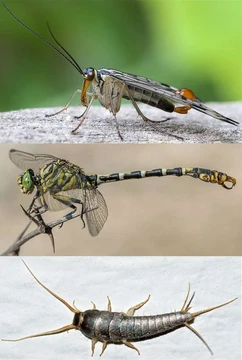
Zoraptera
Small, polymorphic insects that live in colonies under rotting wood.
Zoraptera is an order of small, soft-bodied insects commonly known as angel insects or ground lice. They are found on most continents but are absent from Canada, New Zealand, Australia, and Europe. The name Zoraptera, meaning 'pure wingless,' was given by Filippo Silvestri in 1913, though it is misleading because winged forms were later discovered. These insects live in small colonies beneath rotting wood, under stones, or in leaf litter, feeding on fungus, detritus, and occasionally smaller arthropods.
Quick Facts
- Taxon
- Zoraptera
- Diversity
- 51 species
Facts from the source article.
Lore & Background
Zorapterans are hemimetabolous insects, with nymphs resembling small adults. They exhibit polymorphism: most individuals are wingless, pale, and eyeless, while a few females and even fewer males develop into winged forms with compound eyes, ocelli, and pigmentation. The winged forms can shed their wings at a basal fracture line, similar to termites. Under favorable conditions, the blind, wingless form predominates; when conditions deteriorate, offspring develop into winged adults that disperse to establish new colonies. Colonies typically number about 30 individuals, though they can range from a few dozen to several hundred. Males are slightly larger than females and establish a linear dominance hierarchy based on age or duration of colony membership, with the dominant male monopolizing a harem of females. In some species, such as Latinozoros barberi, courtship involves nuptial feeding, where males secrete a fluid from a cephalic gland and offer it to females. In Spermozoros impolitus, fertilization occurs via a spermatophore containing a single giant sperm cell that unravels to about the length of the female, physically blocking her genital tract to prevent fertilization by other males.
Reader's Guide
Zoraptera, though small and often overlooked, play a role in ecosystem nutrient cycling by consuming detritus and dead arthropods. Their unique polymorphism—where environmental conditions trigger the production of winged dispersers—illustrates an adaptive strategy for survival in ephemeral habitats like rotting logs. The order's phylogenetic position within Polyneoptera remains controversial; some studies place Zoraptera as the sister group to Dermaptera (earwigs), while a 2026 study found it to be the earliest diverging lineage of Polyneoptera. The fossil record extends to the Cretaceous, with the oldest known fossils around 130–125 million years old from Jordanian and Burmese amber. These fossils belong to modern subfamilies, suggesting the group originated earlier, possibly in the late Paleozoic in tropical latitudes of Pangaea. The disjunct modern distribution—absent from Europe, Canada, Australia, and New Zealand—is thought to result from the fragmentation of Pangaea and the group's preference for tropical rainforests. Historically, all species were placed in the genus Zorotypus, but a 2020 molecular study reclassified them into two families, four subfamilies, and nine genera, with 51 extant species and 11 extinct species known from fossils.
Did You Know?
- The name Zoraptera means 'pure wingless,' but winged forms were discovered years after the wingless forms were described.
- In Spermozoros impolitus, males transfer a spermatophore containing a single giant sperm cell that unravels to about 3 mm, roughly the length of the female.
- The oldest zorapteran fossils are from Cretaceous amber, around 130–125 million years old.
More in Insect Families 1-20
Spotted an error? Know more?
Reader corrections go straight into our review queue. Suggest an edit · How this site is sourced