Pterygota
Subclass of insects comprising all winged and secondarily wingless forms.

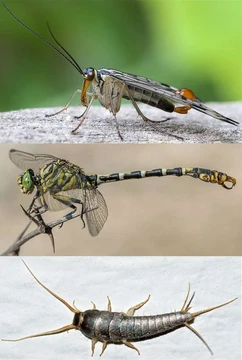
Pterygota is a subclass of insects that includes all winged insects and those that have secondarily lost their wings. This group comprises 99.9% of all insects, excluding only the primitively wingless orders Archaeognatha (jumping bristletails) and Zygentoma (silverfishes and firebrats).
Quick Facts
- Taxon
- Pterygota
Facts from the source article.
Lore & Background
The oldest known representatives of Pterygota appeared during the mid-Carboniferous, around 328–324 million years ago, and the group subsequently underwent rapid diversification. Claims that they originated substantially earlier during the Silurian or Devonian based on molecular clock estimates are unlikely based on the fossil record and are likely analytical artefacts.
Unlike the primitively wingless Archaeognatha and Zygentoma, pterygotes do not have styli or vesicles on their abdomen, and with the exception of the majority of mayflies, also lack the median terminal filament present in ancestrally wingless insects. The group is traditionally divided into the infraclasses Paleoptera and Neoptera, though Paleoptera is now strongly suspected of being paraphyletic.
The classification of Pterygota includes many orders, both extant and extinct, such as Ephemeroptera (mayflies), Odonata (dragonflies and damselflies), Orthoptera (grasshoppers), Coleoptera (beetles), Lepidoptera (butterflies and moths), and Diptera (true flies), among others.
Reader's Guide
Pterygota represents the vast majority of insect diversity, encompassing 99.9% of all insect species. Its significance lies in the evolution of flight, which allowed insects to colonize nearly every terrestrial and freshwater habitat. The group includes both ancient lineages like mayflies and dragonflies, as well as highly derived holometabolous orders such as beetles, flies, and butterflies.
The fossil record places the origin of Pterygota in the mid-Carboniferous, around 328–324 million years ago, with rapid diversification following. The group's internal systematics remain debated: the traditional division into Paleoptera and Neoptera is challenged by evidence that Paleoptera is paraphyletic, and relationships among neopterans are not fully resolved. The Exopterygota may represent a similar assemblage of ancient hemimetabolous insects, while the holometabolous Endopterygota appear to contain several clades of related orders whose status is not agreed upon.
Pterygota's legacy includes the evolution of complete metamorphosis in Endopterygota, which enabled extreme specialization and ecological dominance. The group's classification continues to be refined as new fossil and molecular data emerge.
More in Insect Families 1-20
Spotted an error? Know more?
Reader corrections go straight into our review queue. Suggest an edit · How this site is sourced