Mecoptera
An order of insects including scorpionflies and hangingflies.
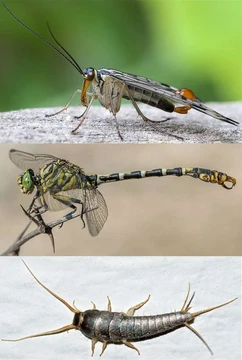
Mecoptera is an order of insects in the superorder Holometabola, comprising about six hundred extant species in nine families worldwide. They are sometimes called scorpionflies after their largest family, Panorpidae, in which males have enlarged genitals raised over the body that resemble scorpion stingers, and long beaklike rostra. Another prominent family is the Bittacidae, or hangingflies, known for elaborate mating rituals where females choose mates based on the quality of gift prey offered by males. A smaller group, the snow scorpionflies (Boreidae), are sometimes seen walking on snowfields, while most species inhabit moist environments in tropical locations. Mecoptera are closely related to Siphonaptera (fleas) and more distantly to Diptera (true flies), and early members may have played an important role in pollinating extinct gymnosperms before the evolution of other insect pollinators such as bees.
Quick Facts
- Taxon
- Mecoptera
Facts from the source article.
Lore & Background
Mecopterans are small to medium-sized insects with long slender bodies, narrow membranous wings, and long beaklike rostra. Their mouthparts are relatively simple, with a long labium, long mandibles, and fleshy palps. The fore and hind wings are similar in shape, long and narrow with numerous cross-veins, though some genera have reduced or lost wings. The abdomen typically curves upward in males, superficially resembling a scorpion's tail, with an enlarged genital bulb at the tip. Larvae are caterpillar-like with hard sclerotised heads, short true legs on the thorax, prolegs on the first eight abdominal segments, and a suction disc or pair of hooks on the terminal segment. Pupae have free appendages (exarate) and are not secured within a cocoon.
Most mecopterans breed in moist environments such as leaf litter or moss, and eggs may not hatch until the wet season. Larvae mostly feed on vegetable matter, and non-feeding pupae may pass through a diapause until weather conditions are favorable. Adults of modern species are overwhelmingly predators or consumers of dead organisms. In a few areas, some species are the first insects to arrive at a cadaver, making them useful in forensic entomology. Distribution is worldwide, with greatest species-level diversity in the Afrotropic and Palearctic realms, but greater generic and family diversity in the Neotropic, Nearctic, and Australasian realms. They are absent from Madagascar and many islands, suggesting low dispersal ability.
Reader's Guide
Mecoptera hold special importance in the evolution of insects. Two major orders, Lepidoptera (butterflies and moths) and Diptera (true flies), along with Trichoptera (caddisflies), probably evolved from ancestors belonging to or strictly related to the Mecoptera. Evidence includes anatomical and biochemical similarities as well as transitional fossils such as Permotanyderus and Choristotanyderus, which lie between Mecoptera and Diptera. The group was once much more widespread and diverse than now, with four suborders during the Mesozoic. Early Mecoptera may have been important pollinators of early gymnosperm seed plants during the late Middle Jurassic to mid–Early Cretaceous, before other pollinating groups like bees evolved. These were mainly wind-pollinated plants, but fossil mecopterans had siphon-feeding apparatus that could have fertilized them by feeding on nectar and pollen. The lack of iron enrichment in their fossilized probosces rules out their use for drinking blood. Extinct species from the clade Aneuretopsychina, with probosces up to 10 mm long, likely transferred pollen on their mouthparts and head surfaces, though no associated pollen has been found even in finely preserved Eocene Baltic amber. The relationships among Mecoptera families remain debated, and it is unclear whether the order forms a single clade or is paraphyletic with respect to Siphonaptera (fleas).
Did You Know?
- The name Mecoptera comes from Greek 'mecos' meaning long and 'ptera' meaning wings.
- Male scorpionflies have enlarged genitals raised over the body that look similar to scorpion stingers.
- Early Mecoptera may have pollinated extinct gymnosperms before the evolution of bees.
More in Insect Families 1-20
Spotted an error? Know more?
Reader corrections go straight into our review queue. Suggest an edit · How this site is sourced