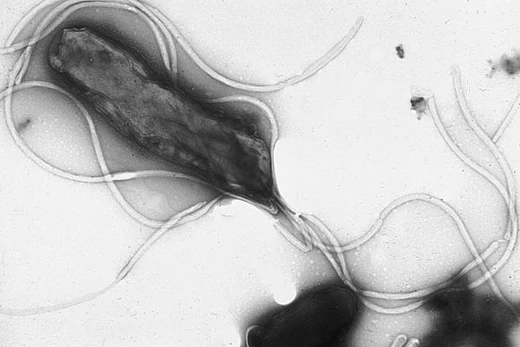
Helicobacter heilmannii sensu lato
A group of zoonotic Helicobacter bacteria causing upper GI diseases.

Helicobacter heilmannii sensu lato (H. heilmannii s.l.) is a group of bacterial species within the Helicobacter genus, distinguished from the more prominent Helicobacter pylori by being larger in size and having flagella at both ends. These bacteria are associated with upper gastrointestinal tract diseases in humans, including gastritis, peptic ulcers, and MALT lymphoma, and are considered zoonotic pathogens transmitted from animals such as cats, dogs, and pigs.
Quick Facts
- Complications
- Infections associated with malignant and nonmalignant stomach diseases
- Treatment
- Antibiotic-based drug regimens can cure stomach diseases due to these bacteria.
Facts from the source article.
Lore & Background
Helicobacter heilmannii sensu lato refers to a grouping of Helicobacter species that are identified primarily by histopathological or electron microscopic appearance, rather than by precise molecular methods. These bacteria are two to three times larger than H. pylori and have flagella at both ends, unlike H. pylori's single-ended flagella. The group is further divided into H. heilmannii sensu stricto (clearly defined species) and H. heilmannii sensu lato (unidentified species).
Reader's Guide
H. heilmannii s.l. is clinically significant because it causes upper gastrointestinal diseases similar to those caused by H. pylori, including gastritis, peptic ulcers, and extranodal marginal zone B-cell lymphoma. Although it accounts for less than 1% of Helicobacter-associated diseases in most regions, its prevalence is higher in some Asian countries, such as China (4%) and Thailand (6.2%). Importantly, these infections are zoonotic, often acquired through contact with domestic animals or consumption of raw pork. The diseases are treatable with antibiotic regimens used for H. pylori, such as amoxicillin, clarithromycin, and a proton pump inhibitor, which can lead to symptom relief and regression of associated lymphomas. Recognizing H. heilmannii s.l. as a cause of these diseases is crucial for appropriate treatment.
Did You Know?
- H. heilmannii s.l. is 3–6.5 micrometers long, larger than H. pylori's 2.5–5.0 micrometers.
- It has 4–10 flagella divided between both ends, while H. pylori has 4–6 flagella at one end.
- Transmission occurs through close contact with cats, dogs, pigs, or eating raw pork contaminated with H. suis.
- In Thailand, H. heilmannii s.l. accounts for 6.2% of all Helicobacter-associated upper GI diseases.
More in Infectious causes of cancer 1-24
Spotted an error? Know more?
Reader corrections go straight into our review queue. Suggest an edit · How this site is sourced