Carcinogenic bacteria
Bacteria known or suspected to directly cause cancer.

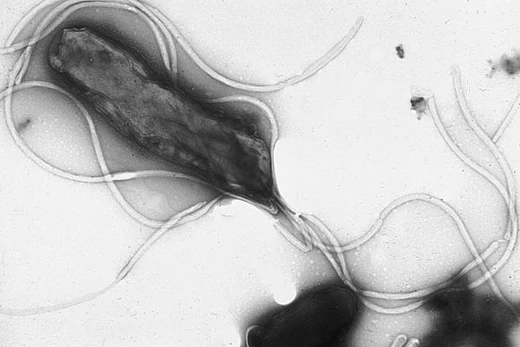
Carcinogenic bacteria are infectious organisms either proven or suspected to cause cancer. Although these bacteria have traditionally been viewed as opportunistic—meaning they invade tissues only after a cancer has already developed—some evidence suggests they can be directly responsible for triggering the disease. The most compelling case so far is the link between the bacterium *Helicobacter pylori* and stomach cancer.
*H. pylori* colonizes the human stomach and upper small intestine. It is classified as a Group 1 carcinogen. In certain infections, it can lead to stomach cancer and a type of lymphoma called MALT lymphoma. Experiments in animals have satisfied Koch’s third and fourth postulates, confirming *H. pylori*’s role in causing stomach cancer. The bacterium may cause cancer through chronic inflammation or through the direct action of its virulence factors, such as the protein CagA. Another member of this genus, *Helicobacter hepaticus*, causes hepatitis and liver cancer in mice.
Chronic inflammation plays a key role in many malignancies, but it is especially important in *H. pylori* infection. When the bacterium infects the stomach, immune cells like neutrophils are drawn to the site. To kill the bacteria, neutrophils release antimicrobial substances, including reactive oxygen species (ROS) and reactive nitrogen species (RNS). *H. pylori* can survive this oxidative stress by producing antioxidant enzymes like catalase. However, the excess ROS and RNS damage the DNA of infected stomach cells. At the same time, *H. pylori* suppresses major DNA repair pathways. This leads to mutations in both nuclear and mitochondrial DNA, causing genomic instability—a hallmark of cancer.
The CagA protein, a virulence factor of *H. pylori*, is linked to stomach cancer development. Once injected into a host cell, CagA alters cell signaling in ways that depend on phosphorylation and also in ways that do not. Phosphorylated CagA disrupts cell adhesion, spread, and migration, and it triggers the release of the inflammatory signal IL-8. Meanwhile, the non-phosphorylated form of CagA, through its CRPIA motif, persistently activates the PI3K/Akt pathway—a signaling route often overactive in many cancers. This activation turns on the pro-inflammatory NF-κB and β-catenin pathways and increases stomach cell growth.
- Known for
- Causing cancer, particularly H. pylori linked to gastric cancer
- Field
- Oncology, microbiology
- Key example
- Helicobacter pylori, a Class 1 carcinogen
- Mechanisms
- Chronic inflammation, virulence factor CagA, DNA damage
- Other example
- Helicobacter hepaticus causes hepatitis and liver cancer in mice
Lore & Background
The history of carcinogenic bacteria includes early 20th-century claims by researchers such as William Russell, who in 1890 described peculiar cellular inclusions in cancer tissues. These structures, now known as Russell bodies, were initially speculated by some to be related to a bacterial cause of cancer, though this interpretation has since been abandoned. In 1926, Canadian physician Thomas Glover reported isolating a specific bacterium from neoplastic tissues and claimed a serum from it gave remarkable results in 50 cases. Glover's work was challenged by scientists from the Public Health Service, and he refused to repeat his research for quality control; his claims are today not given serious merit.
In 1950, Virginia Livingston published a paper claiming a specific Mycobacterium was associated with neoplasia, later proposing the name Progenitor cryptocides and a treatment protocol.
Reader's Guide
Carcinogenic bacteria represent a significant shift in understanding cancer etiology, moving beyond the view that bacteria are merely opportunistic. The strongest evidence centers on Helicobacter pylori, a Class 1 carcinogen that can cause stomach cancer and MALT lymphoma. Animal models have demonstrated Koch's third and fourth postulates for H. pylori in stomach cancer causation. The mechanisms involve chronic inflammation, where H. pylori infection recruits immune cells that produce reactive oxygen and nitrogen species, causing DNA damage while the bacterium down-regulates DNA repair pathways, leading to genomic instability. Additionally, the virulence factor CagA alters cell signaling, activates pro-inflammatory pathways, increases cell proliferation, and inhibits tumor suppressor genes via hypermethylation. Despite historical controversies and unsubstantiated claims of a universal cancer bacterium, the established link between H. pylori and gastric cancer has influenced cancer prevention and treatment strategies. Other bacteria, such as Salmonella Typhi linked to gallbladder cancer and gut bacteria possibly related to colon cancer, remain speculative. The relationship between cancer and bacteria may be complicated by individual variations in response to different cancers.
Did You Know?
- Helicobacter pylori is described as a Class 1 carcinogen and can cause stomach cancer and MALT lymphoma.
- The virulence factor CagA in H. pylori can change cell signaling and activate the PI3K/Akt pathway, often overly active in many human cancers.
- H. pylori down-regulates major DNA repair pathways, leading to genomic instability in gastric cells.
- In 1990, the National Cancer Institute concluded that Virginia Livingston's claimed cancer bacterium was actually Staphylococcus epidermidis.
The Inflammatory Pathway to Gastric Cancer
H. pylori, a bacterium that takes up residence in the human stomach and duodenum, stands as the strongest confirmed bacterial link to malignancy, classified as a Class 1 carcinogen capable of producing stomach cancer and MALT lymphoma. Animal studies have satisfied Koch's third and fourth postulates, lending experimental weight to its causal role. The central mechanism revolves around persistent inflammation. When the bacterium colonizes gastric tissue, it triggers a massive recruitment of circulating immune cells, particularly neutrophils, which flood the site with antimicrobial weapons including reactive oxygen species and reactive nitrogen species. H. pylori itself evades this oxidative assault by manufacturing antioxidant enzymes like catalase, but the collateral damage to surrounding host cells is severe. Excess reactive species inflict multiple forms of DNA damage on gastric epithelial cells. Compounding the problem, the bacterium simultaneously suppresses the cell's major DNA repair machinery. The net effect is a progressive accumulation of genomic and mitochondrial mutations, driving the kind of genomic instability that is a recognized hallmark of cancer.
CagA: A Molecular Weapon Against the Host Cell
Beyond the general inflammatory damage, H. pylori wields a specific virulence factor called CagA that directly rewires the signaling landscape of infected gastric cells. Once injected into the host cell cytoplasm, CagA operates through both phosphorylation-dependent and phosphorylation-independent routes. In its phosphorylated form, it disrupts normal cell adhesion, spreading, and migration while simultaneously triggering the release of the proinflammatory chemokine IL-8. In its non-phosphorylated state, a region called the CRPIA motif drives persistent activation of the PI3K/Akt pathway, a signaling cascade that is characteristically hyperactive across many human cancers. This sustained activation cascades into the NF-κB and β-catenin pathways, pushing gastric cells toward uncontrolled proliferation. CagA also promotes hypermethylation of tumor suppressor genes by upregulating the methyltransferase DNMT1 through the AKT–NF-κB axis, effectively silencing the cell's own cancer-prevention mechanisms. Finally, CagA induces the enzyme spermine oxidase, which converts spermine to spermidine and generates hydrogen peroxide as a byproduct, further amplifying the oxidative stress already present in chronically inflamed tissue.
A Controversial Century of Bacterial Cancer Theories
Long before H. pylori earned its carcinogen designation, several researchers attempted to link bacteria to cancer with mixed and often disputed results. In 1890, Scottish pathologist William Russell presented circumstantial evidence suggesting a bacterial origin for cancer. A more ambitious claim came in 1926 from Canadian physician Thomas Glover, who reported isolating a pleomorphic organism from neoplastic tissues in both animals and humans, and claimed a derived serum produced remarkable results in fifty patient cases. Glover was invited to continue his work at the Public Health Service, which later became part of the National Institutes of Health, and published his findings in 1930. When PHS scientists requested he repeat his experiments under stricter quality controls, Glover declined and continued independently, and his claims have since been largely dismissed. In 1950, Virginia Livingston of Newark proposed that a specific Mycobacterium was tied to neoplasia and named it Progenitor cryptocides. A 1990 National Cancer Institute review found her classification contained remarkable errors, identifying the organism as nothing more than Staphylococcus epidermidis. Other figures from the 1930s through 1960s, including William Coley and Eleanor Alexander-Jackson, also explored bacterial links to cancer.
Beyond H. pylori: Speculative Bacterial Links to Cancer
While H. pylori remains the gold standard for bacterial carcinogenesis, a wider web of associations exists where the causal role of bacteria stays uncertain. Salmonella Typhi has been linked to gallbladder cancer, yet the same organism has also been explored as a potential vehicle for delivering chemotherapeutic agents against melanoma, colon, and bladder cancers. Gut microbiota may play a role in colon cancer, though the picture is muddied by the presence of chemoprotective probiotic bacteria that could counteract harmful effects. Microorganisms and their metabolic byproducts, or the chronic inflammation they provoke, have also been tentatively connected to oral cancers. The relationship between bacteria and cancer is further complicated by individual variability; different patients respond differently to the same microbial exposures, and the same bacterial species may interact with different tissue contexts in unpredictable ways. It is also worth noting that oncoviruses occupy a parallel niche as viral agents suspected of causing cancer, suggesting that infectious agents broadly—whether bacterial or viral—may contribute to malignant transformation in ways still not fully understood. Historically, cancer-associated bacteria were dismissed as mere opportunists colonizing already-damaged tissue, but the evidence now points toward a more active, potentially initiating role.
Frequently Asked Questions
What are carcinogenic bacteria?
Carcinogenic bacteria are infectious organisms that have been proven or are suspected to directly trigger the development of cancer. Although they were long dismissed as mere opportunists that colonize tissue only after a tumor already exists, growing evidence shows some can initiate the disease process themselves.
Which bacterium is the best-known example of a carcinogenic bacteria?
Helicobacter pylori is the standout example, as it colonizes the human stomach and upper small intestine and carries a Group 1 carcinogen designation. In certain chronic infections, it can drive the progressive changes that lead to gastric cancer.
How do carcinogenic bacteria actually cause cancer?
The primary mechanism involves sustained chronic inflammation in the infected tissue, which over time produces repeated DNA damage and mutagenesis. In the case of H. pylori, a virulence factor called CagA further accelerates cellular injury and oncogenic signaling.
What does the Group 1 carcinogen classification mean for H. pylori?
The Group 1 label, assigned by the IARC, indicates there is sufficient evidence in humans that the agent causes cancer. This places H. pylori in the same evidentiary tier as well-established carcinogens such as tobacco smoke.
Are there other examples of carcinogenic bacteria beyond H. pylori?
Yes—Helicobacter hepaticus has been shown to cause hepatitis and subsequently liver cancer in mouse models, demonstrating that the phenomenon is not limited to a single species or host. This supports the broader idea that bacterial infection can serve as a direct oncogenic trigger.
More in Infectious causes of cancer 1-24
Spotted an error? Know more?
Reader corrections go straight into our review queue. Suggest an edit · How this site is sourced