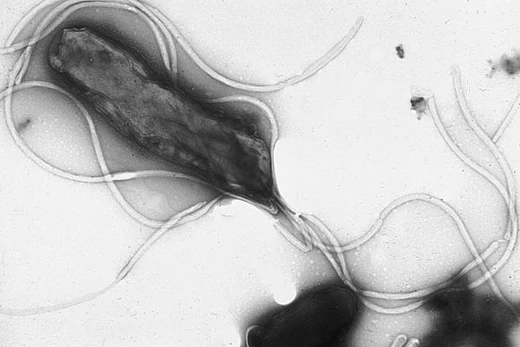
Helicobacter heilmannii s.s
A zoonotic bacterium linked to stomach ulcers and lymphoma.

Helicobacter heilmannii s.s. is a species of Gram-negative bacteria within the Helicobacter genus. It is one of several non-Helicobacter pylori species that can infect humans and cause gastrointestinal diseases, including stomach inflammation, ulcers, and certain stomach cancers. It is distinguished from the broader Helicobacter heilmannii group by the designation 's.s.' (sensu stricto).
Quick Facts
- Genus
- Helicobacter
- Species
- heilmannii s.s.
Facts from the source article.
Lore & Background
Helicobacter heilmannii s.s. is naturally found in the stomachs of cats, dogs, foxes, lynxes, and non-human primates. Humans, including children, are believed to acquire the infection through close contact with these animals, making it a zoonotic pathogen. The bacterium is grouped with four other non-H. pylori Helicobacter species—H. bizzozeronii, H. suis, H. felis, and H. salomonis—under the term Helicobacter heilmannii sensu lato, due to their shared association with similar gastrointestinal diseases.
Reader's Guide
Helicobacter heilmannii s.s. is significant because it demonstrates that non-H. pylori Helicobacter species can cause serious human diseases, including stomach inflammation, ulcers, and extranodal marginal zone lymphoma of the stomach. Its zoonotic nature highlights the importance of animal contact in disease transmission. Diagnosis of H. heilmannii s.s. and related species is clinically important because infections can be successfully treated and cured with antibiotic regimens, such as amoxicillin, clarithromycin, and a proton pump inhibitor, or metronidazole, clarithromycin, and a proton pump inhibitor. This offers a curative approach for associated lymphomas, distinguishing these infections from other causes of gastric lymphoma. The bacterium's role underscores the need for awareness among clinicians and patients with relevant gastrointestinal symptoms, especially those with animal exposure.
Did You Know?
- H. heilmannii s.s. is a Gram-negative bacterium within the Helicobacter genus.
- Human infection is thought to occur through close contact with these animals.
- Infections with H. heilmannii s.s. can be cured using antibiotic regimens that include amoxicillin, clarithromycin, and a proton pump inhibitor.
More in Infectious causes of cancer 1-24
Spotted an error? Know more?
Reader corrections go straight into our review queue. Suggest an edit · How this site is sourced