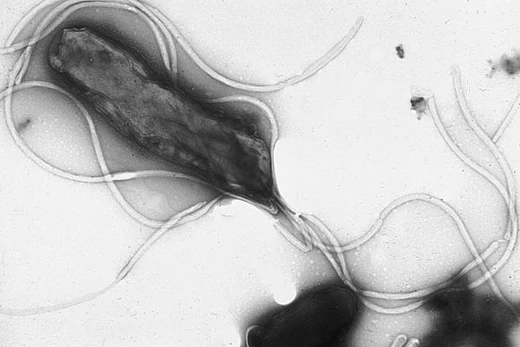
Chronic diseases and cancers linked to infectious microbes
Chronic diseases and cancers often linked to infectious microbes.

Chronic diseases and cancers linked to infectious microbes are conditions in which a microbe—such as a virus, bacterium, fungus, protozoan, or archaeon—is found more frequently in the tissues of patients than in healthy individuals. This association prompts researchers to investigate whether the microbe might be an underlying cause or play a causal role alongside other factors. These diseases are generally considered multifactorial, requiring multiple causal factors to precipitate illness.
- Associated microbes
- viruses, bacteria, fungi, protozoa, archaea
- Healthcare budget usa
- 90% of $4.9 trillion on chronic diseases and mental illnesses
- Example model
- murine model of Crohn's disease with norovirus, gene variant, and toxin
- Other causal factors
- environmental toxins, radiations, genetics, epigenetics, events during pregnancy, stress, diet, lifestyle
Lore & Background
Many chronic diseases and cancers are associated with infectious microbes, meaning the microbe is found more frequently in diseased tissues than in healthy bodies. Researchers may then investigate whether that microbe is the underlying cause or plays a causal role in conjunction with other factors. Other potential causal factors include environmental toxins, radiations, genetics, epigenetics, events during pregnancy, stress, diet, and lifestyle.
Reader's Guide
The concept of chronic diseases and cancers linked to infectious microbes is significant because it shifts the understanding of these illnesses from purely genetic or environmental to potentially infectious origins. The source article emphasizes that such associations are not proof of causation but a starting point for investigation. The multifactorial nature—illustrated by a murine model of Crohn's disease requiring a norovirus, a specific gene variant, and a gut-damaging toxin—highlights the complexity. In the USA, 90% of the $4.9 trillion annual healthcare budget goes to chronic diseases and mental illnesses, underscoring the economic weight of these conditions. This entry preserves the uncertainty noted in the source: association does not equal causation, and multiple factors are typically involved.
Did You Know?
- Chronic diseases and cancers are generally assumed to be multifactorial, meaning multiple factors must be present to precipitate the disease.
- In a murine model of Crohn's disease, a norovirus can precipitate the illness only when a specific gene variant and a certain toxin are also present.
- In the USA, 90% of the $4.9 trillion annual healthcare budget is spent on chronic diseases and mental illnesses.
- Associated microbes include viruses, bacteria, fungi, protozoa, and archaea.
Frequently Asked Questions
Who is Chronic diseases and cancers linked to infectious microbes?
This entry covers a category of medical conditions in which a microbe—virus, bacterium, fungus, protozoan, or archaeon—is detected at higher frequency in the tissues of affected patients than in healthy individuals, raising the question of whether the organism contributes to disease causation. These conditions are not single-factor events but multifactorial illnesses that require several converging elements before illness manifests.
What are Chronic diseases and cancers linked to infectious microbes's powers/role?
The microbial 'powers' span five domains of life—viruses, bacteria, fungi, protozoa, and archaea—each of which can be found more often in diseased tissue. Their role is to serve as one contributing factor within a larger causal web that also includes environmental toxins, radiation, genetics, epigenetics, pregnancy events, stress, diet, and lifestyle, rather than acting as a sole trigger.
Why is Chronic diseases and cancers linked to infectious microbes important?
These conditions command an enormous share of healthcare spending, with roughly 90% of the United States' $4.9 trillion budget directed at chronic diseases and mental illnesses. Pinpointing the microbial component within the broader causal picture opens avenues for prevention, early detection, and targeted intervention alongside other risk factors.
What other characters/factors appear alongside Chronic diseases and cancers linked to infectious microbes?
The supporting cast includes environmental toxins, ionizing radiation, inherited genetic variants, epigenetic modifications, events during pregnancy, chronic psychological stress, dietary patterns, and lifestyle choices. Together they form the multifactorial ensemble that must converge before the disease arc fully unfolds in a patient.
More in Infectious causes of cancer 1-24
Spotted an error? Know more?
Reader corrections go straight into our review queue. Suggest an edit · How this site is sourced