
Bala Nagamma (1942 film)
A 1942 Telugu film based on a popular Burrakatha.

Wikimedia Commons · Public domain
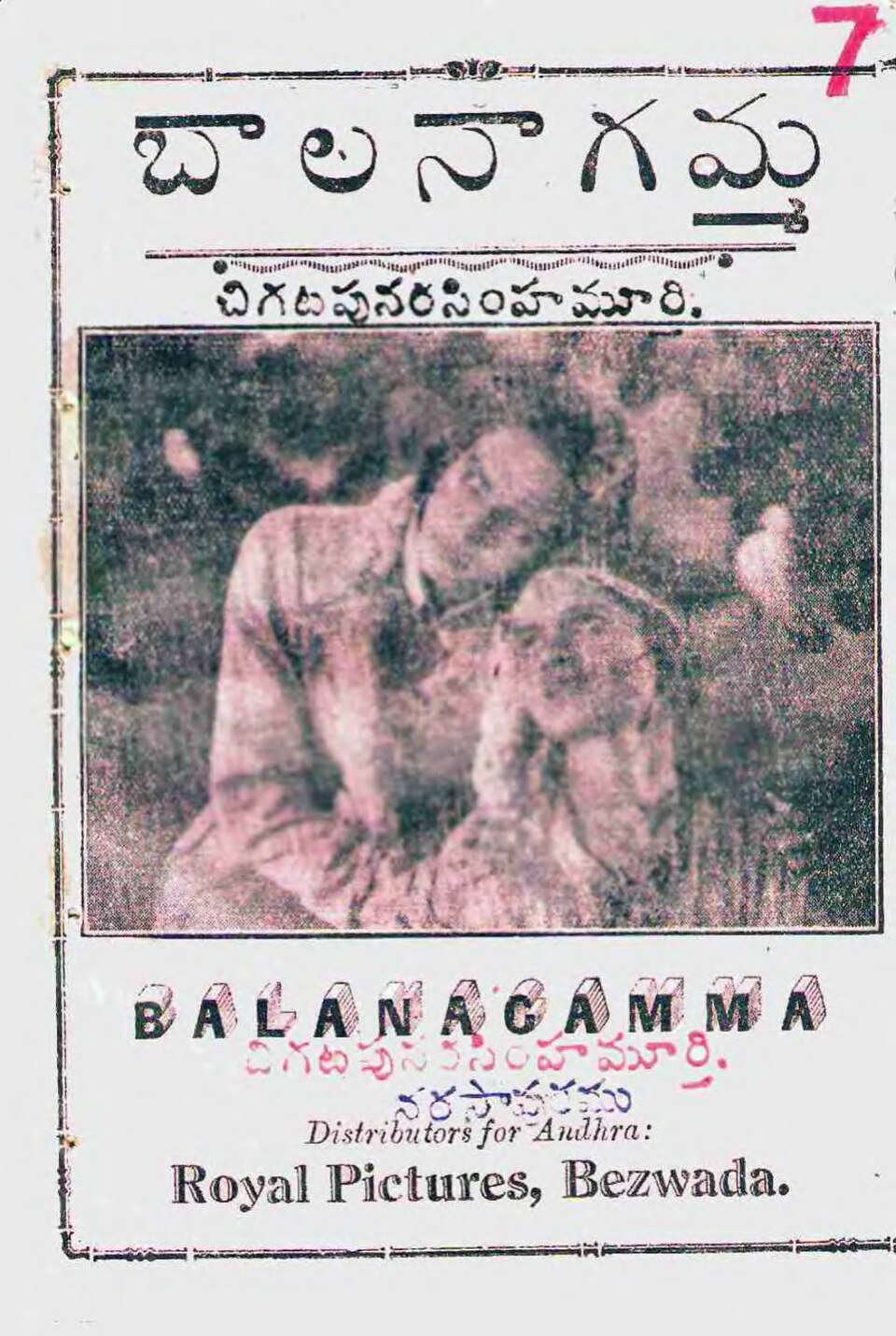
Bala Nagamma is a 1942 Telugu-language film directed by C. Pullayya and produced by S. S. Vasan. The story was one of the most popular Burrakathas and was one of the successful early films made by Gemini Studios in Telugu which was not remade in Tamil. It was remade in Hindi as Bahut Din Huwe (1954) and in Telugu in 1959.
- Release year
- 1942
- Language
- Telugu
- Director
- C. Pullayya
- Producer
- S. S. Vasan
- Production company
- Gemini Studios
- Based on
- Burrakatha story Bala Nagamma
Lore & Background
The film tells the story of Bala Nagamma, a young princess. Queen Bhulakshmi, wife of King Navabhojaraju, prays to Jatangi Muni for progeny and is blessed with seven children, the youngest named Bala Nagamma (Kanchanamala). She is married to Karyavardi Raju (Banda) but is kidnapped by Mayala Marathi (Govindarajula Subbarao), who turns her into a dog and takes her to his cave at Nagullapudi Gattu. There, he tries to take advantage of her, but she keeps him away by chanting Vratam and Pujas. She remains a prisoner for fourteen years, during which Mayala Marathi's mistress Sangu (Pushpavalli) becomes jealous. Meanwhile, her son Balavardi Raju grows up and discovers his mother's captivity. He seeks out the Fakir through a flower-vendor Tambali peddi by posing as her grandson, then defeats the Fakir and rescues his mother.
Reader's Guide
Bala Nagamma is notable as one of the successful early Telugu films produced by Gemini Studios, a major studio of the time. It was not remade in Tamil, unlike many other Gemini productions, but was remade in Hindi as Bahut Din Huwe (1954) and later in Telugu in 1959. According to film historian Randor Guy, the film netted a profit of ₹40 lakh (equivalent to ₹59 crore or US$6.1 million in 2023), indicating its commercial success. The film features three songs, including 'Naa Sogase Kani Marude Dasudu Kada' sung by Pushpavalli and 'Sri Jaya Jaya Gowri Ramana' by Bellary Lalitha. Its story, drawn from a popular Burrakatha tradition, reflects the folk narrative roots of Telugu cinema.
Did You Know?
- The film was based on one of the most popular Burrakathas.
- It was one of the successful early films made by Gemini Studios in Telugu which was not remade in Tamil.
- The film was remade in Hindi as Bahut Din Huwe (1954), starring Meena Kumari.
- A claim that Bala Nagamma netted a profit of ₹40 lakh is unverifiable and likely exaggerated; Randor Guy's writings do not mention this specific figure, and such a profit would be implausible for a 1942 Telugu film.
Production & Studio Significance
Bala Nagamma (1942) stands as a significant early Telugu production from Gemini Studios, the legendary house founded by S. S. Vasan. Vasan himself produced the film while C. Pullayya took the directorial chair. What makes this title particularly noteworthy within Gemini's broader catalog is that, unlike many of the studio's other Telugu ventures, it was never remade in Tamil. This distinguishes it from the studio's usual multilingual strategy of adapting successful stories across languages. The film drew its narrative from one of the most beloved Burrakathas of the era, giving it a deep cultural resonance with Telugu audiences who would already have known the tale through oral performance. As one of Gemini's successful early forays into Telugu cinema, Bala Nagamma helped establish the studio's creative presence in the language beyond its Tamil stronghold, demonstrating that the production house could craft compelling stories for a different linguistic market.
Narrative & Story Arc
The story centers on Bala Nagamma, the youngest of seven children born to Queen Bhulakshmi and King Navabhojaraju after the queen's prayers to Jatangi Muni. She is married to Karyavardi Raju, but her life takes a dark turn when Mayala Marathi kidnaps her, transforms her into a dog, and imprisons her in his cave at Nagullapudi Gattu. For fourteen long years she endures captivity, fending off the villain's advances by reciting sacred Vratam rites and Pujas. Meanwhile, his mistress Sangu grows jealous of her presence. The narrative's emotional core is the reunion: her son Balavardi Raju, now grown, learns of his mother's fate and tracks the Fakir down in Nagallapudi Gattu. Disguising himself as the grandson of a flower-vendor named Tambali peddi, he confronts and defeats Mayala Fakir, ultimately rescuing his mother from her long ordeal.
Remakes & Cross-Linguistic Legacy
Bala Nagamma's story proved compelling enough to cross linguistic boundaries, though in an interestingly selective way. Gemini Studios brought the narrative to Hindi audiences in 1954 with Bahut Din Huwe, a remake that featured the legendary Madhubala in the lead role. The film also received a Telugu remake in 1959, retaining the original title and directed by Vedantam Raghavayya. What is striking, however, is what did not happen: unlike many Gemini productions that were routinely adapted across Tamil, Telugu, and Hindi, Bala Nagamma was never remade in Tamil. This absence is a notable exception in the studio's otherwise prolific multilingual output. The 1954 Hindi version, with Madhubala's star power, likely introduced the Burrakatha-inspired tale to a broader North Indian audience, while the 1959 Telugu iteration kept the story alive for the original linguistic community that first embraced it.
Financial Success & Musical Score
The commercial performance of Bala Nagamma was remarkable by the standards of 1940s Indian cinema. Film historian Randor Guy recorded that the film generated a profit of ₹40 lakh, a sum that translates to approximately ₹59 crore or US$6.1 million in 2023 values. For a regional-language production of that era, such a figure underscores the deep audience connection the story commanded. Musically, the film was modest in scope, featuring just three songs. The soundtrack included "Naa Sogase Kani Marude Dasudu Kada," rendered by Pushpavalli, "Nanna Memu Delhi Potham," and "Sri Jaya Jaya Gowri Ramana," sung by Bellary Lalitha. Pushpavalli's involvement in both the cast and the vocal work highlights the integrated nature of early Telugu filmmaking, where performers often doubled as singers. The brevity of the musical score suggests a narrative-driven approach, letting the dramatic arc of the princess's captivity and liberation carry the emotional weight.
Gallery
Frequently Asked Questions
What is Bala Nagamma (1942)?
It is a 1942 Telugu-language fantasy film produced by Gemini Studios under S. S. Vasan and directed by C. Pullayya. The plot is adapted from a well-known Burrakatha narrative of the same name.
Who directed and produced Bala Nagamma (1942)?
C. Pullayya handled the direction, while S. S. Vasan oversaw production through his Gemini Studios banner.
What is Bala Nagamma (1942) based on?
The screenplay draws from a Burrakatha story called Bala Nagamma, which was already a widely recognized folk narrative among Telugu-speaking audiences before the film was made.
Was Bala Nagamma (1942) remade in other languages?
Yes, it was reworked into Hindi as Bahut Din Huwe in 1954 and received a second Telugu adaptation in 1959. Notably, it was one of the early Gemini Telugu films that did not get a Tamil-language remake.
Why is Bala Nagamma (1942) considered significant in Indian cinema history?
It counts as one of Gemini Studios' earliest successful Telugu productions, helping establish the studio's presence in the Telugu market. Its popularity was bolstered by the fact that the source Burrakatha was already a household name among audiences.
More in Indian fantasy films 1-24
Spotted an error? Know more?
This is a living reference — every entry is fact-audited, and reader corrections feed straight into our audit queue. Suggest an edit · See this site's audit record