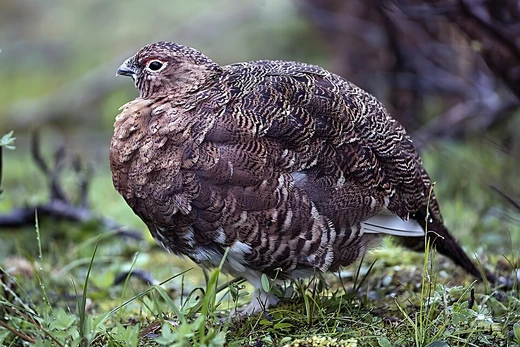
Meadow pipit
A small, abundant pipit of open habitats across the Palearctic.
Last updated
The meadow pipit (Anthus pratensis) is a small passerine bird that breeds across much of the Palearctic.[1] It measures 14.5–15 cm in length and weighs 15–22 g.[2] No subspecies are recognized for this monotypic species.[3]
Scientific classification
- KingdomAnimalia
- PhylumChordata
- ClassAves
- OrderPasseriformes
- FamilyMotacillidae
- GenusAnthus
- SpeciesAnthus pratensis
Named by (Linnaeus, 1758)
Close relatives
Other species of Anthus with a Codexery entry.
- South Georgia pipit Anthus antarcticus
Sources: Wikipedia taxobox: Meadow pipit (CC BY-SA 4.0) · order, family and genus agree with WoRMS AphiaID 426233 (CC BY 4.0)
Conservation status
Least Concern (LC)
- LC▲ this species
- NT
- VU
- EN
- CR
- EW
- EX
Source: IUCN Red List assessment · GBIF copy of the Red List category
Where the meadow pipit has been recorded
Each dot is a place where the species has been observed and reported (3,394,422 records, half-degree grid) — not a modelled range. 105 inland records left out (institution coordinates). 1 isolated far-off record not drawn.
Map: drawn by Codexery. Data: GBIF occurrence search (records CC0 / CC BY) · Natural Earth basemap (public domain)
Quick Facts
- Genus
- Anthus
- Species
- pratensis
Facts from the source article.
Biology and range
This species primarily inhabits open habitats such as grassland, moorland, and heathland, and also occurs on arable land.[4] The breeding range of the meadow pipit extends from southeastern Greenland and Iceland eastward to just beyond the Ural Mountains in Russia, reaching south to central France and Romania, with a separate group in the Caucasus Mountains.[1] While it migrates across most of its distribution, spending winters in southern Europe, North Africa, and southwestern Asia, populations in western Europe remain there all year.[1] Saltmarshes and occasionally open woodland serve as winter habitats for this species.[4]
Insects and other invertebrates, predominantly those measuring under 5 mm, form the bulk of its food.[1] A ground nest hidden among thick vegetation holds two to seven eggs; incubation lasts 11–15 days, and young leave the nest 10–14 days after hatching.[1] Typically, two broods are produced annually.[1]
What the specialist sources record
GBIF Backbone Taxonomy lists Anthus pratensis (Linnaeus, 1758) as an accepted species in the family Motacillidae, with 3,417,120 occurrence records as of 19 October 2026.[5]
References
- Wikipedia, "Meadow pipit" (CC BY-SA 4.0), which cites: Snow, "The Birds of the Western Palearctic", Oxford University Press, 1998; "Handbook of the Birds of the World, vol. 9", Lynx Edicions, 2004, p. 763 (we also read that source) en.wikipedia.org
- Wikipedia, "Meadow pipit" (CC BY-SA 4.0), which cites: Snow, "The Birds of the Western Palearctic", Oxford University Press, 1998; "Handbook of the Birds of the World, vol. 9", Lynx Edicions, 2004, p. 763; Snow, "The Birds of the Western Palearctic", Oxford University Press, 1998; "Handbook of the Birds of the World, vol. 9", Lynx Edicions, 2004, p. 763 (we also read that source) en.wikipedia.org
- Wikipedia, "Meadow pipit" (CC BY-SA 4.0), which cites: Linnaeus, "Systema Naturae per regna tria naturae, secundum classes, ordines, genera, species, cum characteribus, differentiis, synonymis, locis", Laurentii Salvii, 1758, p. 166; "Check-List of Birds of the World", Museum of Comparative Zoology, 1960, p. 159; Bechstein, "Gemeinnützige Naturgeschichte Deutschlands nach allen drey Reichen", Bey Siegfried Lebrecht Crusiu, 1805, p. 247, 302 Note; "Waxbills, parrotfinches, munias, whydahs, Olive Warbler, accentors, pipits", IOC World Bird List Version 11.1, January 2021; "Check-List of Birds of en.wikipedia.org
- Wikipedia, "Meadow pipit" (CC BY-SA 4.0), which cites: Snow, "The Birds of the Western Palearctic", Oxford University Press, 1998; "Handbook of the Birds of the World, vol. 9", Lynx Edicions, 2004, p. 763; Hagemeijer, W. J. M., & Blair, M. J., eds. (1997). The EBCC Atlas of European Breeding Birds. Poyser, London . (we also read that source) en.wikipedia.org
- GBIF Backbone Taxonomy and occurrence index, Anthus pratensis (taxon key 2490266). CC BY 4.0 (backbone); counts are facts. gbif.org
Each numbered sentence above was checked against the source it cites before publication. Sentences citing Wikipedia adapt text from the English Wikipedia article Meadow pipit (contributors), used under CC BY-SA 4.0; this entry is available under the same licence. Other sources were used for facts only; no text or images are copied from them.
More in Holarctic birds
Test yourself
Three questions drawn from this entry’s sources. Pick an answer to check it.
Answers checked against the source article
Sources
Compiled from Wikipedia and the sources listed below. Text from Wikipedia is available under CC BY-SA 4.0; this entry is adapted from it.
- Wikipedia: Meadow pipit (CC BY-SA 4.0).
- Classification: the source article's taxobox; order, family and genus checked against WoRMS, the World Register of Marine Species (CC BY 4.0).
- Conservation status: IUCN Red List assessment.
- Occurrence records: GBIF (CC0 / CC BY). Basemap: Natural Earth (public domain).
- Word definitions: the , each quoted from its Wikipedia article.
Spotted an error? Know more?
Reader corrections go straight into our review queue. Suggest an edit · How this site is sourced