Grey-headed chickadee
Last updated
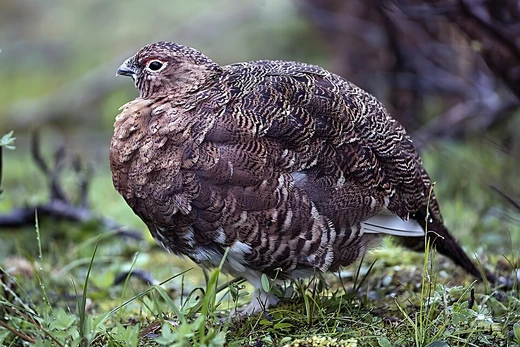
The grey-headed chickadee, also called the Siberian tit (Poecile cinctus), belongs to the tit family and lives year-round across subarctic Scandinavia, the northern Palearctic, Alaska, and far northwestern Canada. It specializes in conifer forests and rarely migrates. This tit is fairly large for its group, measuring 12.5 to 14 centimeters long and weighing 11 to 14.3 grams—somewhere between a willow tit and a great tit. Its head is dark brown, with the throat and eyestripe darkest and the crown slightly lighter; white cheeks stand out.
Taxonomy
The back is cinnamon-brown, wing feathers are blackish with pale edges, and the underside is whitish with pale rusty-brown flanks. In 1779, French scholar Georges-Louis Leclerc, Comte de Buffon described this bird in his Histoire Naturelle des Oiseaux based on a Siberian specimen. An engraved, hand-colored plate by François-Nicolas Martinet appeared in the Planches Enluminées D'Histoire Naturelle, overseen by Edme-Louis Daubenton to accompany Buffon’s text.
Neither the plate caption nor Buffon gave a scientific name, but in 1783 Dutch naturalist Pieter Boddaert assigned the binomial Parus cinctus in his catalog of the plates. Today, the grey-headed chickadee is one of 15 species in the genus Poecile, introduced by German naturalist Johann Jakob Kaup in 1829. The genus name comes from Ancient Greek poikilos, meaning “colorful”; a related word, poikilidos, referred to an unidentified small bird. The species name cinctus is Latin for “banded.”
Previously grouped with other tits in the genus Parus, analysis of mitochondrial DNA cytochrome b sequences and morphology now supports placing it in Poecile to better reflect its relationships. Four subspecies are recognized: P. c. lapponicus (Scandinavia to northern European Russia), P. c. cinctus (northeastern European Russia through Siberia to Kamchatka and north-central Mongolia), P. c. sayanus (southern Siberia and northwestern Mongolia), and P. c. lathami (northern and western Alaska and northwestern Canada).
Conservation
The North American subspecies P. c. lathami may now be extinct, with no confirmed sightings anywhere in its range since 2018 despite targeted searches. The western subspecies P. c.
Scientific classification
- KingdomAnimalia
- PhylumChordata
- ClassAves
- OrderPasseriformes
- FamilyParidae
- GenusPoecile
- SpeciesPoecile cinctus
Named by (Boddaert, 1783)
Close relatives
Other species of Poecile with a Codexery entry.
- Boreal chickadee Poecile hudsonicus
- Carolina chickadee Poecile carolinensis
- Marsh tit Poecile palustris
Sources: Wikipedia taxobox: Grey-headed chickadee (CC BY-SA 4.0)
Conservation status
Least Concern (LC)
- LC▲ this species
- NT
- VU
- EN
- CR
- EW
- EX
Source: IUCN Red List assessment · GBIF copy of the Red List category
How big is it?
Largest length in the source, 0.14 m, next to a 1.8 m person.
Diagram: drawn by Codexery, schematic shapes to scale (not a likeness). Length: Wikipedia: Grey-headed chickadee
More in Holarctic birds
Test yourself
Three questions drawn from this entry’s sources. Pick an answer to check it.
Answers checked against the source article
Sources
Compiled from Wikipedia and the sources listed below. Text from Wikipedia is available under CC BY-SA 4.0; this entry is adapted from it.
- Wikipedia: Grey-headed chickadee (CC BY-SA 4.0).
- Conservation status: IUCN Red List assessment.
- Word definitions: the Codexery glossary, each quoted from its Wikipedia article.
Spotted an error? Know more?
Reader corrections go straight into our review queue. Suggest an edit · How this site is sourced