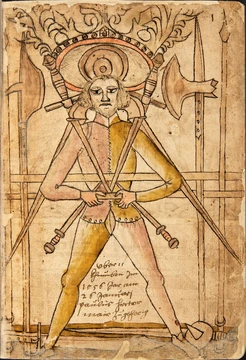
Francesco Alfieri
Venetian fencing master and author of several 17th-century treatises.
Francesco Ferdinando Alfieri was a 17th-century fencer and a representative of the Venetian school of fencing. He served as Maestro D’Arme to the Accademia Delia in Padua in 1640. Originally from Padua, then part of the Venetian Republic, he was praised by many Italian and Venetian fencing masters as a master of fencing.
Quick Facts
- Full name
- Francesco Ferdinando Alfieri
- Century
- 17th century
- School
- Venetian school of fencing
- Role
- Maestro D’Arme to the Accademia Delia in Padua
- Year of appointment
- 1640
- Place of origin
- Padua
- Territory
- Venetian Republic
Facts from the source article.
Works
Several treatises by Alfieri are known. La Bandiera, published in 1638, discusses the flag drill. La Scherma, published in 1640 and reprinted in 1645, discusses rapier fencing. La Picca, published in 1641, discusses the pike drill and appends the entirety of his treatise on the flag drill. L’arte di ben maneggiare la spada, published in 1653 and reprinted in 1683, includes the entirety of his treatise on rapier fencing and appends a section on the use of the Spadone (two-handed sword). A translation of the 1653 edition into Russian was published under the title "The Art of Excellent Possession of the Sword".
The Art of Excellent Swordplay
Francesco Alfieri earned a lasting reputation as an exceptional fencing master, largely due to his treatise "The Art of Excellent Sword Ownership." This work quickly gained widespread respect among fencing masters and remains regarded as one of the finest textbooks on the subject. One of his students noted that the book presents Alfieri’s own views on fencing, covering a full range of fundamental techniques and methods, along with the benefits that studying the Art of Arms brings both in combat and daily life. Alfieri was among a small number of authors who explained how fencing could be made practical and how a person could achieve mastery. His followers describe the treatise as written in the language of the heart, where the underlying causes and principles of fencing take root, and where fear and uncertainty in a fight fade away.
Alfieri’s experience and study led him to create a new Mixed Martial position. This stance is balanced and allows the fencer to move into a Counterblow position against the First, Second, Third, and Fourth combat positions. From a high form, a fencer can deflect a blow in the Third position, either outward or inward, then shift to the fourth battle position, leaving the opponent unable to break free. Direct movements in this situation can be deadly, so if the fencer wants to avoid being stabbed, they should change the shape of their stance and continue fencing, always aiming to keep a favorable position without restriction. When the moment is right, the fencer can strike at the nearest exposed part of the opponent’s body. Alfieri used this Mixed martial position to win every fight, preferring it for both defense and offense.
The treatise also covers the main weapons of the era, including the sword, dagger, dropon, kapa, targa, and broker. It is divided into sections on the basic principles of fencing, the formation of the knight, the forms of art, methods of determining shape, and the concept of time in art.
Features and distinctive features in Italian fencing
Alfieri's treatise "The art of excellent possession of the sword" laid the foundation of Italian fencing and draws attention to several distinctive features. The attack is equal to the defense, with no separation between attack and defense—parrying is not carried out separately. Work with a straight line is used: when the enemy strikes, he passes by and the swordsman strikes at that moment, provided knowledge of the sword device, its separation, the ability to work with the brush and forearm, and understanding how to control the enemy's sword. Blocking the movement of the opponent's free hand with one's sword is an element absent in other schools. Blocking the sword by hand involves inserting the hand in a glove as an obstacle when a piercing blow is struck, causing the enemy's sword to slip past, allowing the fencer to apply necessary blows with the other hand. Alfieri describes mechanisms of body movement or ways of setting the enemy in a position where the fencer takes the sword to the opponent, achieved with a straight line rather than an angle. Beat on the rotation uses rotation motions of the column formed when the body turns, allowing the sword to be skipped and a blow struck on the rotation, also demonstrating how to disarm the enemy. Strikes under the sword of the enemy are used. Opposing the sword of the dagger involves parrying the dagger with an executed attack with the sword, striking exactly where the dagger is. Parrying on the cross involves simultaneous parry with a dagger and sword, and simultaneous striking with both weapons is also used. There are practically no cutting and cutting blows; mainly punches are applied. Winding a raincoat on the hand for use as a shield is typical of the Italian school, and a mixed fighting position with a cloak wrapped around the arm and a sword is used to protect against an enemy attack before inflicting a fatal wound.
Approach and reputation
Alfieri stands out as the first Italian fencing writer to frequently cite and discuss earlier masters. He deeply respected Paduan master Salvator Fabris, hailing him as "a man of the greatest name in our profession," yet he strongly opposed Achille Marozzo and Ridolfo Capoferro. Later, Francesco Antonio Marcelli, a prominent late 17th-century master, quoted and praised Alfieri, suggesting his work held significant influence during that period.
More in Historical European Martial Arts
Spotted an error? Know more?
Reader corrections go straight into our review queue. Suggest an edit · How this site is sourced