Hiphop Tamizha
Indian duo that pioneered Tamil hip hop.

via Wikipedia: Hiphop Tamizha · see source
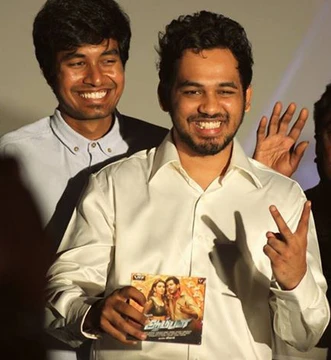
Hiphop Tamizha is an Indian musical duo from Chennai, Tamil Nadu, consisting of Rangadhithya 'Adhi' Ramachandran Venkatapathy and R. Jeeva. Their commercial breakthrough came with the 2011 song 'Club le Mabbu le', and in 2012 they released India's first Tamil hip hop album, Hip Hop Tamizhan, which achieved major success with both the public and critics. Originally independent musicians, they have primarily composed for films since 2013.
Quick Facts
- Birth name
- Rangadhithya Ramachandra Venkatapathy; R. Jeeva
- Born
- Adhi: 20 February 1990; Jeeva: 29 June 1991
- Genre
- Hip hop
- Years active
- 2005–present
- Current members
- Adhi; Jeeva
- Label
- Think Music India
- Sony Music
- Saregama
- T-Series
- Instrument
- Piano, DAW and Keyboard
Facts from the source article.
Personal lives
Rangadhithya 'Adhi' Ramachandran Venkatapathy was born on 20 February 1990; his father works at Bharathiar University and his mother comes from an agricultural background. Adhi's first exposure to rap came when a neighbour showed him Michael Jackson's 'Jam', and his interest in hip hop developed in the tenth grade. He uploaded rap songs online and received positive responses encouraging him to rap in Tamil, a decision he made to avoid looking like a 'wannabe'.
He named his YouTube account 'Hiphop Tamizha' with a profile picture of poet Subramania Bharati to avoid being caught by his parents. Adhi's father initially opposed his music career, giving him a year to pursue it without expecting help, but later supported him after seeing his efforts. Adhi studied at Chavara Vidya Bhavan and earned a degree in Electrical Engineering from Bannari Amman Institute of Technology, holds a state-level rank in the Tamil Nadu Common Entrance Test, and completed an MBA from the University of Madras.
He finished a PhD at Bharathiar University in June 2015 and obtained a doctorate in Music Entrepreneurship in August 2023. Jeeva, an alumnus of Loyola College, Chennai, adopted the moniker Jeeva Beatz after meeting Adhi in 2005. Jeeva seldom makes public appearances due to shyness, leading the name Hiphop Tamizha to be more associated with Adhi. Adhi married Latchaya on 30 November 2017 in a private ceremony at Tirupati.
Career
Adhi and Jeeva met via Orkut in 2005 and decided to create an independent Tamil music group. Adhi released Viswaroobam Arambam, the first Tamil hip hop mixtape in India, in the mid-2000s, which helped promote hip hop as part of Tamil culture. The duo remained underground until the Tamil Nadu State Election Commission asked them to compose an election anthem; their single 'Ezhuvoam Vaa' was chosen as the official anthem for the 2011 state elections.
Although commercially unsuccessful, they considered it their best work at the time. Adhi composed 'Club le Mabbu le' during his first year of college, inspired by observing traditional women and girls going to bars. After moving to Chennai, he met RJ Ma Ka Pa Anand, who allowed him to perform the song on Radio Mirchi with beatboxer Bharadwaj Balaji. The recording went viral, receiving over two million views within a week on YouTube.
Rémy Martin then launched Hiphop Tamizha as an official brand. The song later drew criticism for its portrayal of Tamil women.
Musical style
Adhi has cited Michael Jackson and Jay-Z as inspirations, and since July 2013 has said he draws inspiration from Tamil poetry, especially that of Subramania Bharati. Hiphop Tamizha frequently fuses Tamil folk music with western hip hop. Adhi has no formal music education and composes purely on instinct. Their songs address a wide range of topics: 'Club le Mabbu le' describes nontraditional behaviors of Tamil women such as drinking, smoking, consuming cannabis, and live-in relationships; 'Sentamizh Penne' contrasts this by celebrating a culturally rich girl; 'Tamizh Theriyum' ridicules those who mock the Tamil language; 'Vaadi Pulla Vaadi' focuses on conflicts of caste and love, inspired by Adhi's friends' experiences; 'Iraiva' discusses how love is not the end of life, noting that caste can prevent couples from being together due to lack of education and awareness; 'Karpom Karpippom' is dedicated to education as a tool to solve social problems; and 'Cheap Popularity' responds to critics of 'Club le Mabbu le'.
In 2014, Adhi stated the duo's aim is to counter the belief that speaking Tamil is 'not cool' and to help youngsters relate to being proud Tamizhans. While songs like 'Manithan Tamizhan' and 'Tamizhanda' glorify Tamil culture, Adhi has said they do not want to preach but to give the language more respect. He also wants to change the Indian urban hip-hop culture of baggy pants, bling, and gangsterism.
Controversies
The track 'Club le Mabbu le' drew heavy backlash for how it depicted Tamil women. Rapper Sofia Ashraf argued it was both insulting to women and an embarrassment to rap music. Adhi responded that hip hop thrives on self-expression, so controversy is expected, and described the song as a lighthearted piece with clever wordplay, noting the duo also addresses social issues like education. He later expressed regret over the song.
In December 2015, Janani Karthik of The Times of India listed it among several Tamil songs that had sunk to a new low in crassness. In 2016, Adhi put out the music video 'Takkaru Takkaru', which celebrated the Tamil tradition of jallikattu and aimed to rally support for its legalization, insisting the sport does not involve animal cruelty. PETA India's Bhuvaneshwari Gupta called the video factually wrong, pointing out it showed bulls being mistreated, and advised Hip Hop Tamizha to stick to music.
Adhi dismissed her comments, saying he would not take advice from a group run by foreigners on whether jallikattu harms bulls. In January 2017, Adhi joined protests against the jallikattu ban but later stepped away because he objected to anti-national and secessionist sentiments among the demonstrators.
More in Hip-hop Duos
Spotted an error? Know more?
Reader corrections go straight into our review queue. Suggest an edit · How this site is sourced