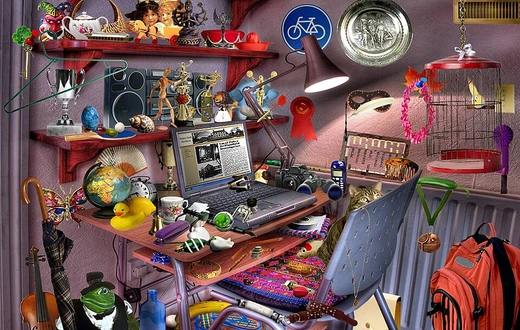
Alice: An Interactive Museum
A 1991 point-and-click adventure pioneering pre-rendered 3D graphics.

Alice: An Interactive Museum is a 1991 point-and-click adventure game developed by Toshiba-EMI Ltd and directed by Haruhiko Shono. It pioneered the use of pre-rendered 3D computer graphics, released two years before the highly notable The Journeyman Project and Myst. The game uses elements and ideas inspired by Lewis Carroll's Alice's Adventures in Wonderland and was initially designed for Mac computers, later released for Windows 3.x and Windows 95.
- Developer
- Toshiba-EMI Ltd
- Director
- Haruhiko Shono
- Release year
- 1991
- Genre
- Point-and-click adventure
- Platforms
- Mac, Windows 3.x, Windows 95
- Notable for
- Pioneering pre-rendered 3D computer graphics
Lore & Background
The player wanders through a mansion of twelve rooms including a gallery, an atelier, a wine cellar, and a photo studio. Each room is interconnected via halls, doors, and secret passages, one of which leads to the outside world. The player must collect all of the cards missing from a 53-card set of playing cards and then decipher associated clues that appear on the cards. Correctly solving the puzzle leads to The Last Room and the end game. The artwork on the walls is highly interactive, resulting in clues or surprises.
Reader's Guide
Alice: An Interactive Museum is significant for pioneering pre-rendered 3D computer graphics in video games, predating the landmark titles The Journeyman Project and Myst by two years. Its development used MacroMind Director and Ray Dream Designer, with music by Kazuhiko Katō and artwork by Kuniyoshi Kaneko, and was noted as an ambitiously artistic piece of software. In 1991, director Haruhiko Shono won the Minister of International Trade and Industry's AVA Multimedia Grand Prix Award for the game. In 1995, Newsweek coined the term 'cybergame' to describe games such as Alice and Shono's second game, L-Zone. Computer Gaming World in 1993 praised the game's art as 'a very elegant and richly rendered environment that makes it a browser's paradise' and recommended it as a surreal 'electronic toy.' Following the sleeper success of Shono's third title Gadget: Invention, Travel, & Adventure (1993), Alice and L-Zone were re-released in America.
Did You Know?
- Newsweek coined the term 'cybergame' in 1995 to describe Alice and Shono's second game, L-Zone.
- The game's artwork was created by Haruhiko Shono himself, with Kuniyoshi Kaneko contributing to later Shono games like L-Zone and Gadget.
Pioneering Pre-Rendered 3D in a Pre-Myst Era
Alice: An Interactive Museum arrived in 1991 as a point-and-click adventure that would later be recognized for a technological first a few years before its time. Developed by Toshiba-EMI Ltd under the direction of Haruhiko Shono, the title drew its narrative DNA from Lewis Carroll's beloved Wonderland tales while pushing the boundaries of what a CD-ROM experience could look and feel like. Its most significant contribution was the use of pre-rendered three-dimensional computer graphics, a technique that would not become widely associated with adventure gaming until The Journeyman Project and Myst both appeared in 1993. That two-year head start placed Alice squarely at the forefront of a visual revolution in interactive entertainment. The game was first built for Macintosh computers before finding its way onto Windows 3.x and Windows 95 platforms. Shono's vision was formally recognized in 1991 when he received the AVA Multimedia Grand Prix Award from Japan's Minister of International Trade and Industry, and by 1995, Newsweek had even minted the label "cybergame" to categorize Alice alongside Shono's follow-up, L-Zone. His third entry, Gadget: Invention, Travel, & Adventure, followed in 1993, cementing a short but influential trilogy.
A Twelve-Room Puzzle Palace
The player experience in Alice unfolds inside a sprawling mansion composed of twelve distinct rooms, each with its own character and purpose. Among the spaces are a gallery, an atelier, a wine cellar, and a photo studio, all stitched together by a network of halls, doors, and hidden passages. One of those secret routes even opens onto the outside world, a small but evocative escape from the enclosed architecture. The central challenge is deceptively simple in description: the player must locate every missing card from a full set of fifty-three playing cards scattered throughout the environment. Once all cards are gathered, the real intellectual work begins, as each card carries a clue that must be deciphered and correctly assembled. Solving the combined puzzle unlocks The Last Room, which serves as the game's finale. What elevates the experience beyond a straightforward scavenger hunt is the deeply interactive artwork adorning the walls. Paintings and decorative pieces are not mere set dressing; they respond to the player's curiosity, revealing hidden clues or triggering unexpected surprises that reward close observation and experimentation.
Artistic Ambition in a Technical Era
Alice: An Interactive Museum was crafted using MacroMind Director for its interactive framework and Ray Dream Designer for its visual rendering, a combination that gave the project a distinctly handcrafted feel even by the standards of early multimedia software. The musical score was composed by Kazuhiko Katō, adding an aural layer that complemented the visual richness of the environments. The artwork was the work of Kuniyoshi Kaneko, whose illustrations and painted details transformed each of the twelve rooms into something closer to a gallery exhibit than a typical game level. Taken together, these creative choices have led critics and historians to describe the game as an ambitiously artistic piece of software, a rare quality in a medium that in 1991 was still largely defined by functional, text-heavy adventure conventions. The Carroll-inspired source material provided a natural license for whimsy and visual playfulness, and the production team clearly seized on that opportunity. The result was a title that treated its CD-ROM medium not as a delivery mechanism for puzzles but as a canvas for a cohesive, immersive aesthetic experience.
Critical Acclaim and a Belated Second Life
When Computer Gaming World reviewed Alice in 1993, the magazine captured the game's elusive charm by likening it to a "charmingly weird and elusive scavenger hunt" in which the player is never entirely certain of the destination or the object of the search. The publication singled out the visual presentation as "a very elegant and richly rendered environment that makes it a browser's paradise," drawing a direct parallel to the dreamlike surrealism of painter René Magritte. Rather than recommending it as a conventional CD-ROM title, the magazine positioned Alice as a "surreal electronic toy," a framing that underscored its identity as an artful experience over a traditional game. Shono himself was recognized as a pioneer by both America's Newsweek and Japan's Ministry of International Trade and Industry, lending institutional weight to the game's cultural significance. Perhaps most notably, Alice and its companion title L-Zone found a second life in the American market after the sleeper success of Shono's 1993 follow-up, Gadget: Invention, Travel, & Adventure, which introduced a broader audience to the director's distinctive vision and prompted re-releases of his earlier work.
Frequently Asked Questions
Who created Alice: An Interactive Museum?
Toshiba-EMI Ltd developed the title, with Haruhiko Shono steering the project as director. It shipped in 1991 as a point-and-click adventure.
What makes Alice: An Interactive Museum historically significant?
The game was among the first to showcase pre-rendered 3D computer graphics, arriving roughly two years ahead of better-known titles like The Journeyman Project and Myst. That early leap into 3D visuals set it apart from most other adventures of its era.
What is Alice: An Interactive Museum based on?
The game pulls characters, settings, and ideas from Lewis Carroll's classic Alice's Adventures in Wonderland. Those familiar story elements form the backbone of the interactive museum experience.
What platforms can I play Alice: An Interactive Museum on?
The title was originally built for Mac computers, with later ports arriving for Windows 3.x and Windows 95. Fans on either major platform of the early '90s could eventually get their hands on it.
What genre does Alice: An Interactive Museum belong to?
It is classified as a point-and-click adventure, where players explore scenes and interact with objects to move the story forward. The pre-rendered 3D environments gave it a look that stood out from the flat 2D art common in other adventures of the period.
More in Hidden object games 1-24
Spotted an error? Know more?
Reader corrections go straight into our review queue. Suggest an edit · How this site is sourced