
Illicium verum
Evergreen tree whose star-shaped fruit is a spice and Tamiflu precursor.
Last updated

Bff · CC BY-SA 4.0
Illicium verum, also called star anise, badian, or Chinese star anise, is a medium-sized evergreen tree that grows naturally in South China and northeast Vietnam. Its fruit is a star-shaped pericarp picked just before it ripens, and it tastes very much like anise.
Drug precursor
China grows most of the world's supply, with Vietnam and other Southeast Asian countries producing the rest. The oil from star anise is strongly fragrant and is used in cooking, perfumes, soaps, toothpaste, mouthwash, and skin creams. Until 2012, Roche Pharmaceuticals used up to 90% of the global annual star anise harvest to make oseltamivir (Tamiflu) through shikimic acid, but the transition to using genetically modified E. coli was gradual, and star anise remained a major source for several years after 2012.
Etymology and nomenclature
The name Illicium comes from the Latin illicio, meaning "entice" or "seduce," and verum means "true" or "genuine." The word "badian" likely comes from the French badiane, which itself may come from the Chinese name bājiǎo, meaning "eight horns." However, it might also derive from the Persian bādiyān, meaning "fennel"; the Oxford English Dictionary says its earlier origin is unknown.
Description
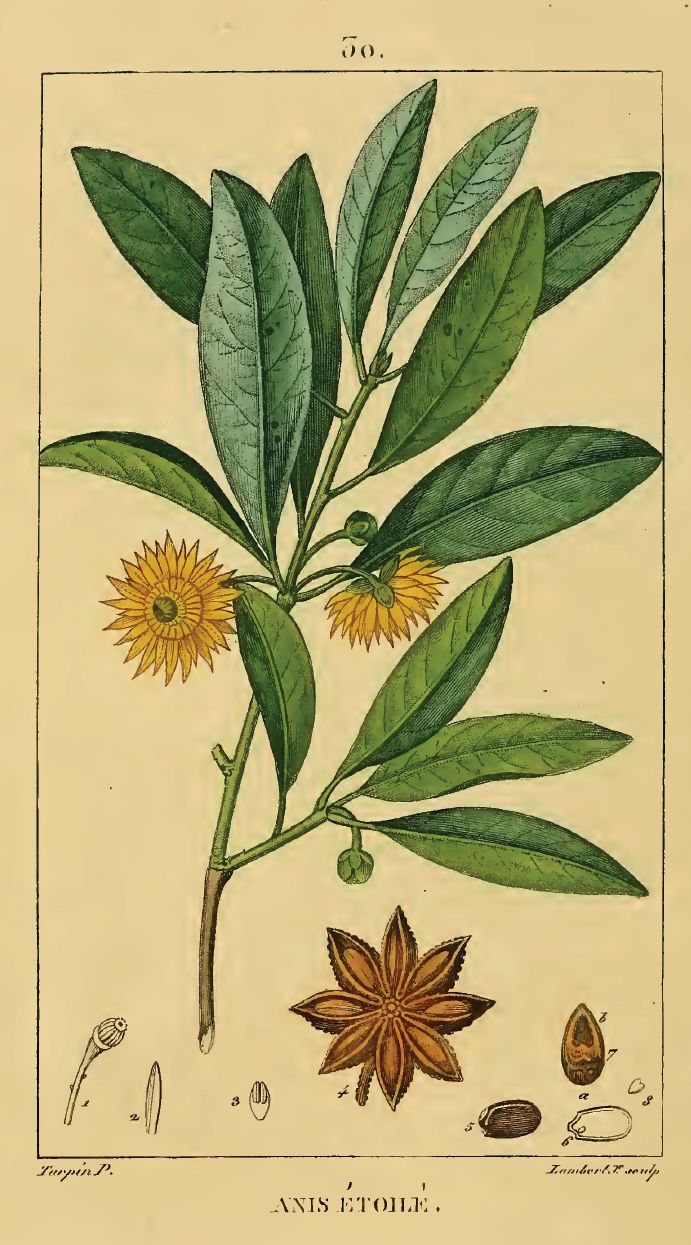
The leaves are aromatic, simple, and lanceolate, obovate-elliptic, or elliptic. They measure 5–15 cm long by 2–5 cm wide, are leathery to very leathery, with a pointed tip and a hairy underside. The flowers grow singly, are bisexual, and range from pink to dark red.
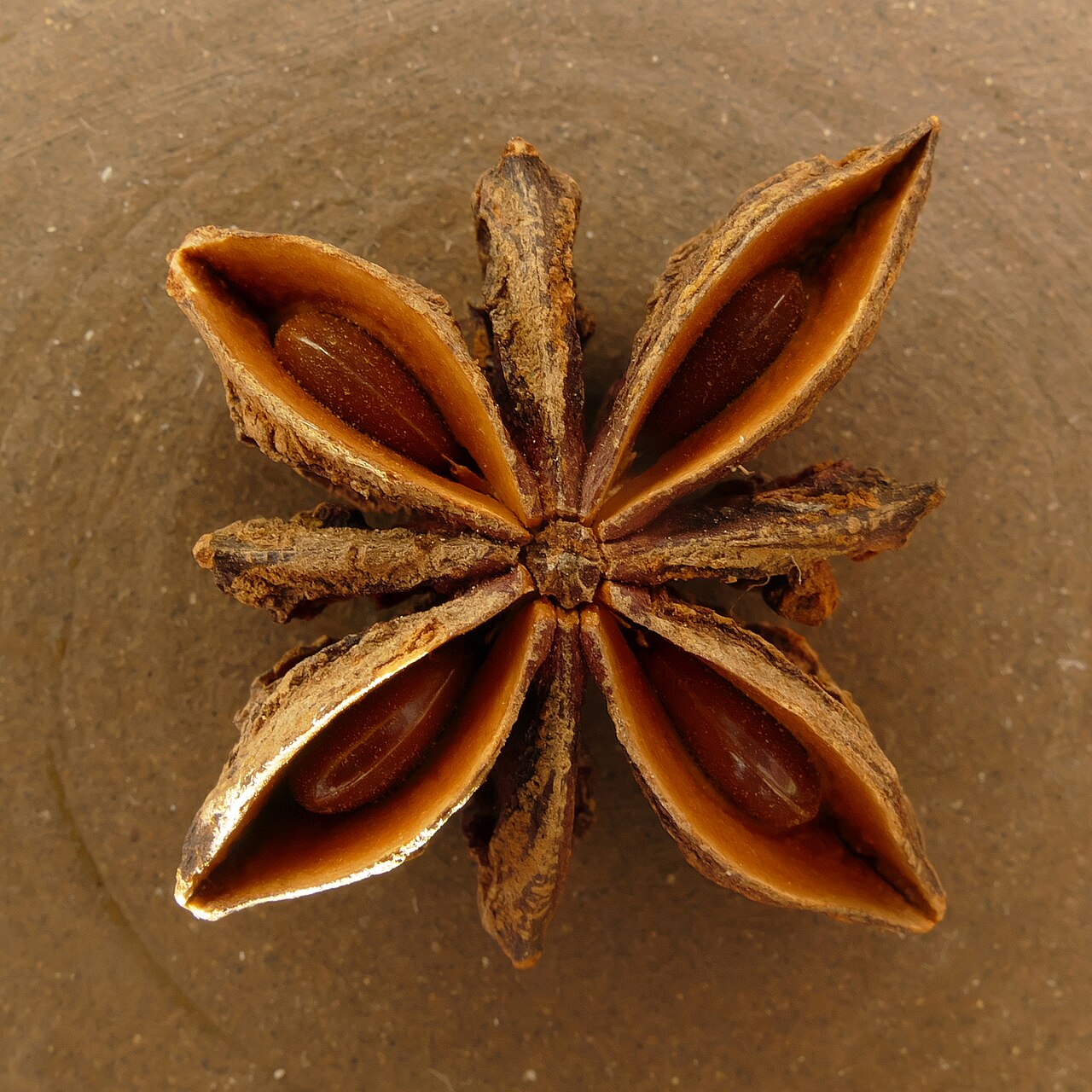
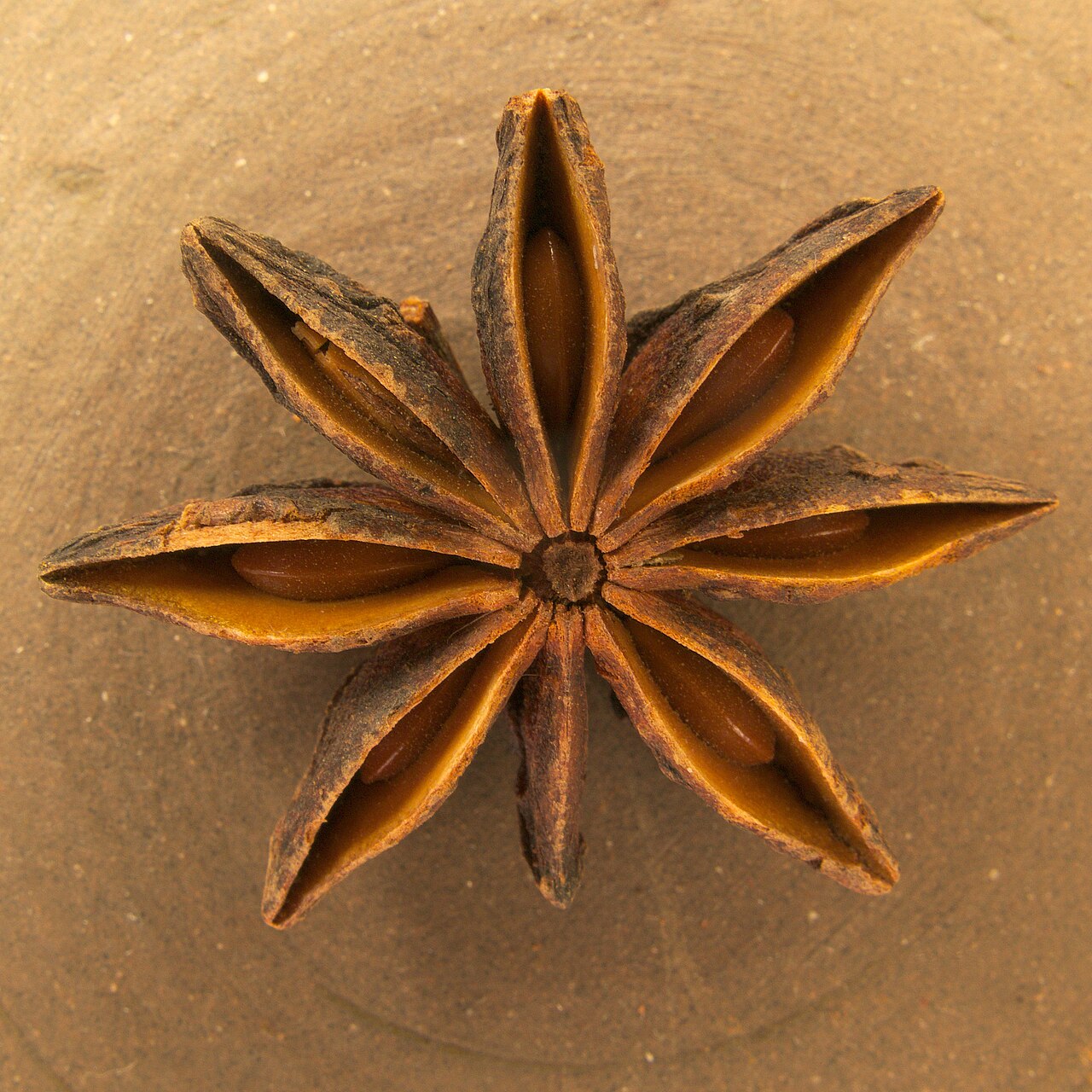
They appear in the leaf axils or near the branch tips. The flower has 7 to 12 spirally arranged lobes, 11 to 20 spirally arranged stamens with short, thick filaments, and usually 8 free carpels arranged in a single whorl. The flower stalk is 1.5–4 cm long, the tepals are broadly elliptic to broadly ovate, the anthers are 1–1.5 mm long, and the pollen grains are trisyncolpate. The fruit is a capsule-like follicetum, star-shaped, reddish-brown, made of six to eight boat-shaped follicles in a whorl.
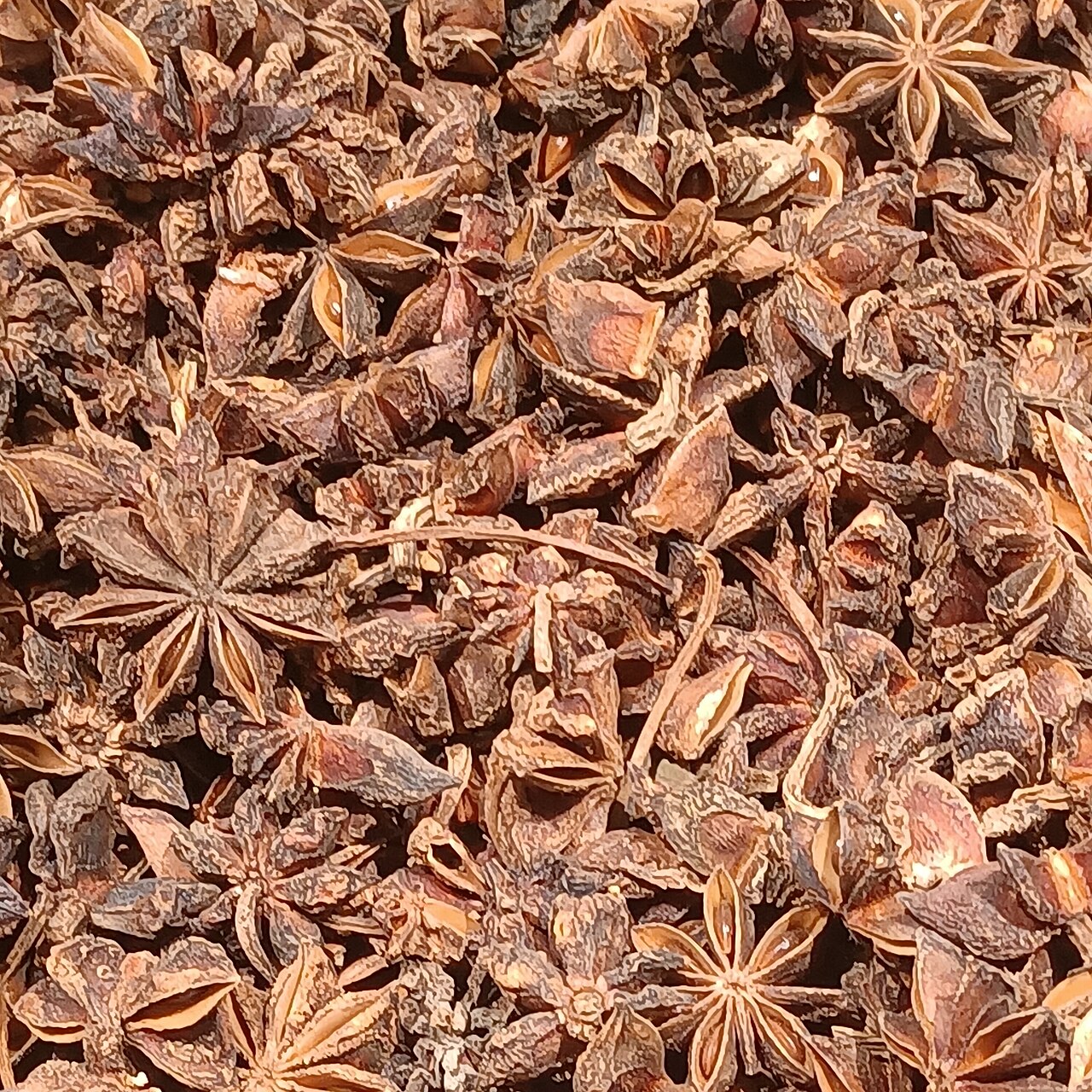
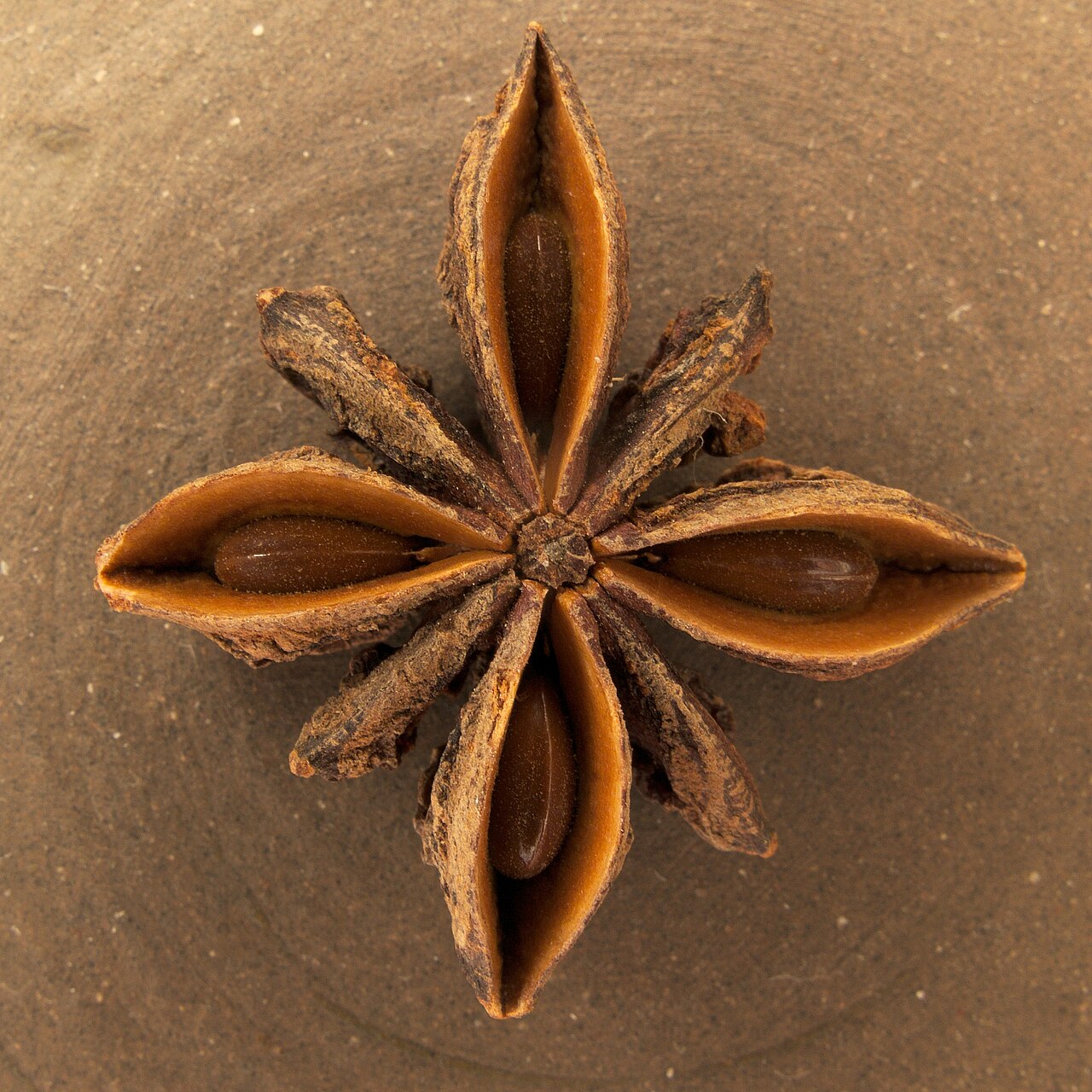
Each follicle is 1–2 cm long, rough, rigid, and reddish-brown, containing one seed. The follicles open along the inner edge when ripe. The seeds are brown, flattened and oval, smooth, shiny, and brittle, about 8–9 mm by 6 mm.
Toxicity of related species
Illicium verum is not toxic, but related species are. Japanese star anise (Illicium anisatum) has smaller fruits that do not form a regular star because some carpels fail to develop.
Scientific classification
- CladeTracheophytes
- CladeAngiosperms
- OrderAustrobaileyales
- FamilySchisandraceae
- GenusIllicium
- SpeciesIllicium verum
Named by Hook.f.
Sources: Wikipedia taxobox: Illicium verum (CC BY-SA 4.0)
Where the illicium verum has been recorded
Each dot is a place where the species has been observed and reported (357 records, half-degree grid) — not a modelled range. 94 inland records left out (institution coordinates).
Map: drawn by Codexery. Data: GBIF occurrence search (records CC0 / CC BY) · Natural Earth basemap (public domain)
Quick Facts
- Species
- verum
Facts from the source article.
Lore & Background
Illicium verum is a medium-sized evergreen tree with aromatic, simple leaves that are lanceolate, obovate-elliptic, or elliptic, measuring 5–15 cm by 2–5 cm. Its flowers are solitary, bisexual, pink to dark red, and axillary or subterminal, with 7–12 tepals arranged spirally and 11–20 stamens. The fruit is a star-shaped, reddish-brown follicetum consisting of six to eight boat-shaped follicles, each containing one brown, shiny seed. The plant is distinguished from the toxic Japanese star anise (Illicium anisatum) by its regular star shape, swollen follicles, and stronger odor.
Botanical Identity and Morphology
Star anise is a medium-sized evergreen tree whose natural range spans South China and northeast Vietnam. Its scientific name carries a poetic weight: the genus Illicium derives from the Latin illicio, meaning to entice or seduce, while the specific epithet verum simply asserts that this is the true, genuine species. The tree bears aromatic, simple leaves that are lanceolate to elliptic in shape, measuring roughly five to fifteen centimetres in length, with a thick, leathery texture and a slightly fuzzy underside.
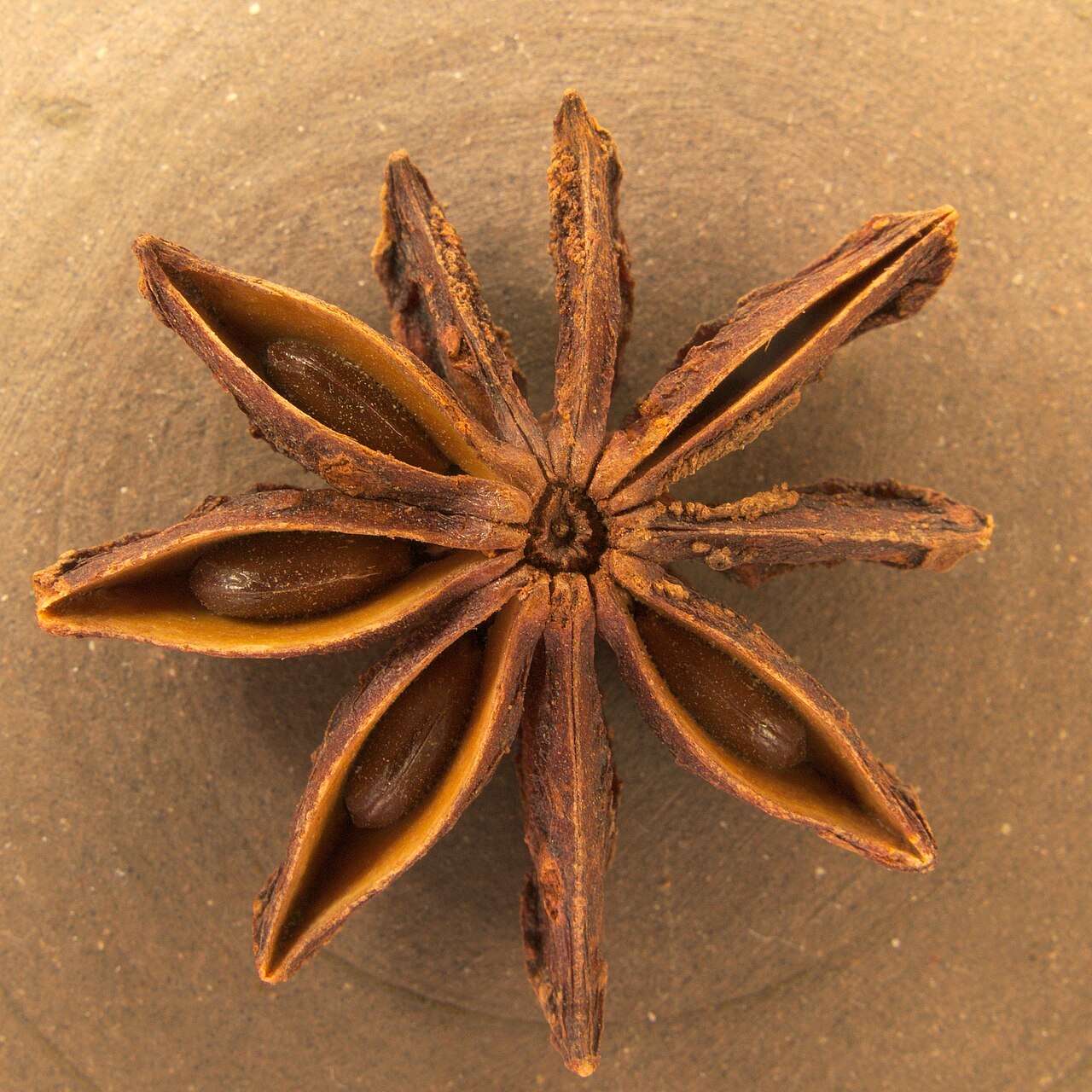
Its solitary, bisexual flowers appear in pink to dark red hues, positioned at leaf axils or near branch tips. Each bloom displays seven to twelve perianth lobes arranged in a spiral, alongside eleven to twenty stamens on short, stout filaments, and typically eight free carpels set in a single ring. The fruit is the star of the show—a reddish-brown, star-shaped follicetum composed of six to eight boat-shaped follicles, each one to two centimetres long, rough, and rigid, splitting open along its inner edge to release a single smooth, shiny, brittle brown seed measuring about eight to nine millimetres across.
A Spice That Crossed Every Table
Because star anise contains anethole—the very same compound responsible for anise's characteristic flavour—it has long served as a more affordable stand-in for anise in Western baking and distilling, most notably in the production of the liqueur Galliano. Yet its culinary footprint stretches far beyond European kitchens. In the Indian subcontinent, it features in biryani and masala chai. Across Chinese, Malay, and Indonesian cooking traditions, it is a staple; in Chinese cuisine it anchors the classic five-spice powder, and in Vietnam it is a major component of phở, the beloved noodle soup.
French home cooks drop whole pods into vin chaud, their mulled wine, and coffee drinkers find that steeping a pod in hot water deepens and enriches the brew. A practical bonus is that the pods release their flavour compounds more readily as hot water permeates them, meaning a single pod can be reused pot after pot, cup after cup. China remains the dominant global producer, with Vietnam and other Southeast Asian nations close behind, feeding this remarkably widespread culinary demand.
From Spice Rack to Pharmacy
Beyond the kitchen, star anise holds a critical role in global medicine. It is the principal natural source of shikimic acid, the key chemical precursor required to synthesize oseltamivir, better known by its brand name Tamiflu, an anti-influenza drug. For years, the pharmaceutical giant Roche relied so heavily on this botanical supply that it consumed as much as ninety percent of the world's entire annual star anise harvest to manufacture the drug. That dependence made the spice market vulnerable to price spikes, particularly during the 2009 swine flu pandemic, when demand for Tamiflu surged.
A turning point came in 2005, when researchers developed an industrial fermentation method using E. coli bacteria to produce shikimic acid. By 2012, Roche had transitioned to genetically modified E. coli, and by 2018 this biotechnological route had become the manufacturing process of choice. The shift not only secured a more reliable drug supply but also reversed the earlier price inflation that had driven up the cost of star anise as a raw agricultural commodity.
The Danger of Look-Alikes
Star anise itself is entirely non-toxic, but its close relatives in the genus Illicium present a serious hazard. Japanese star anise, Illicium anisatum, is highly toxic and inedible; in Japan it has traditionally been burned as incense rather than consumed. It harbours the neurotoxin anisatin, which can trigger seizures and cause severe inflammation of the kidneys, urinary tract, and digestive organs. Documented cases of people falling ill after drinking star anise tea have been attributed to deliberate, economically motivated adulteration with this poisonous species.
Similarly, swamp star anise, Illicium parviflorum, found in the southern United States, is highly toxic and must never be used in folk remedies or cooking. Distinguishing the safe species from its dangerous look-alikes is therefore essential. Japanese star anise can be told apart by its smaller, irregularly shaped fruit—some carpels abort, preventing a regular star—its more pointed follicle tips, a tendency to produce more than eight follicles, a weaker odour, and seeds that are flat or nearly spherical rather than compressed and ovoid. Standardized identification protocols, including fluorescent microscopy, gas chromatography, and HPLC-MS/MS, now help ensure the right species reaches consumers.
Reader's Guide
Illicium verum holds significance both as a culinary spice and as a pharmaceutical resource. Its flavor, derived from anethole, makes it a key ingredient in Chinese five-spice powder, Vietnamese phở, Indian biryani and masala chai, and French mulled wine. More critically, until 2012, Roche Pharmaceuticals used up to 90% of the world's annual star anise crop to produce oseltamivir (Tamiflu) via shikimic acid, a precursor extracted from the fruit.
An industrial method using genetically modified E. coli fermentation, discovered in 2005, later replaced star anise as the primary source for shikimic acid, addressing shortages during the 2009 swine flu pandemic. The species is not toxic, but adulteration with toxic relatives like Illicium anisatum (Japanese star anise) or Illicium parviflorum (swamp star anise) can cause severe neurological and renal effects. ISO standards (676:1995 and 11178:1995) and the European Pharmacopoeia provide specifications for identification and quality.
More in Herbs & Spices
Sources
Compiled from Wikipedia and the sources listed below. Text from Wikipedia is available under CC BY-SA 4.0; this entry is adapted from it.
- Wikipedia: Illicium verum (CC BY-SA 4.0).
- Occurrence records: GBIF (CC0 / CC BY). Basemap: Natural Earth (public domain).
- Word definitions: the Codexery glossary, each quoted from its Wikipedia article.
Spotted an error? Know more?
Reader corrections go straight into our review queue. Suggest an edit · How this site is sourced