
Jasminum sambac
A fragrant jasmine species native to Bhutan and India.
Last updated

Billjones94 · CC BY-SA 4.0
Jasminum sambac, also called Arabian jasmine, Sambac jasmine, or Mogra, originally comes from India. It is now grown widely, especially in West Asia, South Asia, and Southeast Asia, and has become naturalized in places like Mauritius, Madagascar, the Maldives, Chiapas, Central America, southern Florida, the Bahamas, Cuba, Hispaniola, Jamaica, Puerto Rico, and the Lesser Antilles.
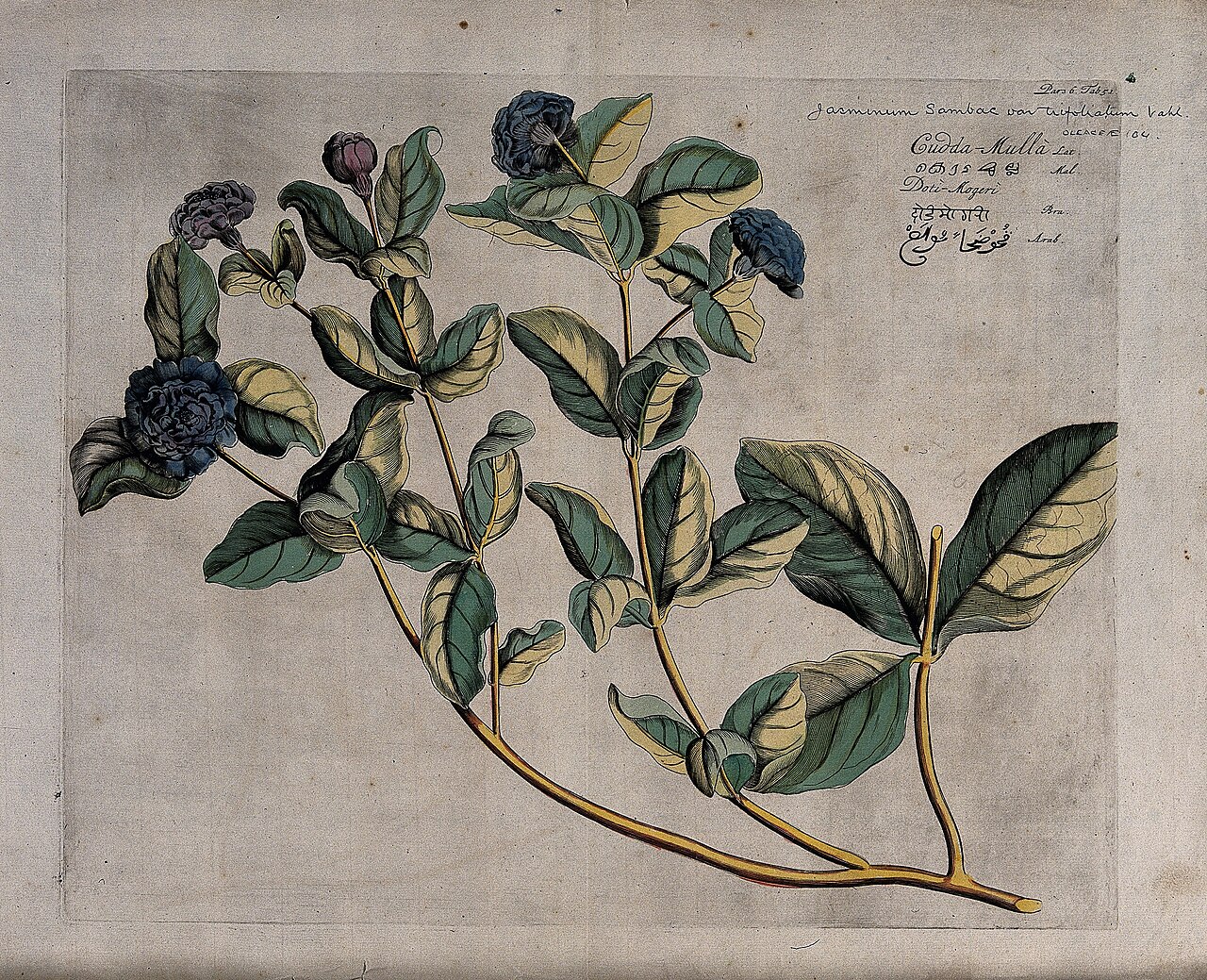
Southeast Asia
This small shrub or vine can reach 0.5 to 3 meters tall. People cultivate it mainly for its attractive, strongly fragrant flowers, which are used to scent perfumes and jasmine tea. It is the national flower of the Philippines, where it is called sampaguita, and one of three national flowers of Indonesia, known there as melati putih.
Description
The plant is an evergreen vine or shrub, varying a lot in form—likely due to spontaneous mutation, natural hybridization, and autopolyploidy. Cultivated plants rarely produce seeds, so they are reproduced by cuttings, layering, marcotting, or other asexual methods. Its leaves are ovate, 4 to 12.5 cm long and 2 to 7.5 cm wide, arranged opposite each other or in whorls of three. Unlike most other jasmines, the leaves are simple, not pinnate, and are smooth except for a few hairs on the veins near the leaf base.
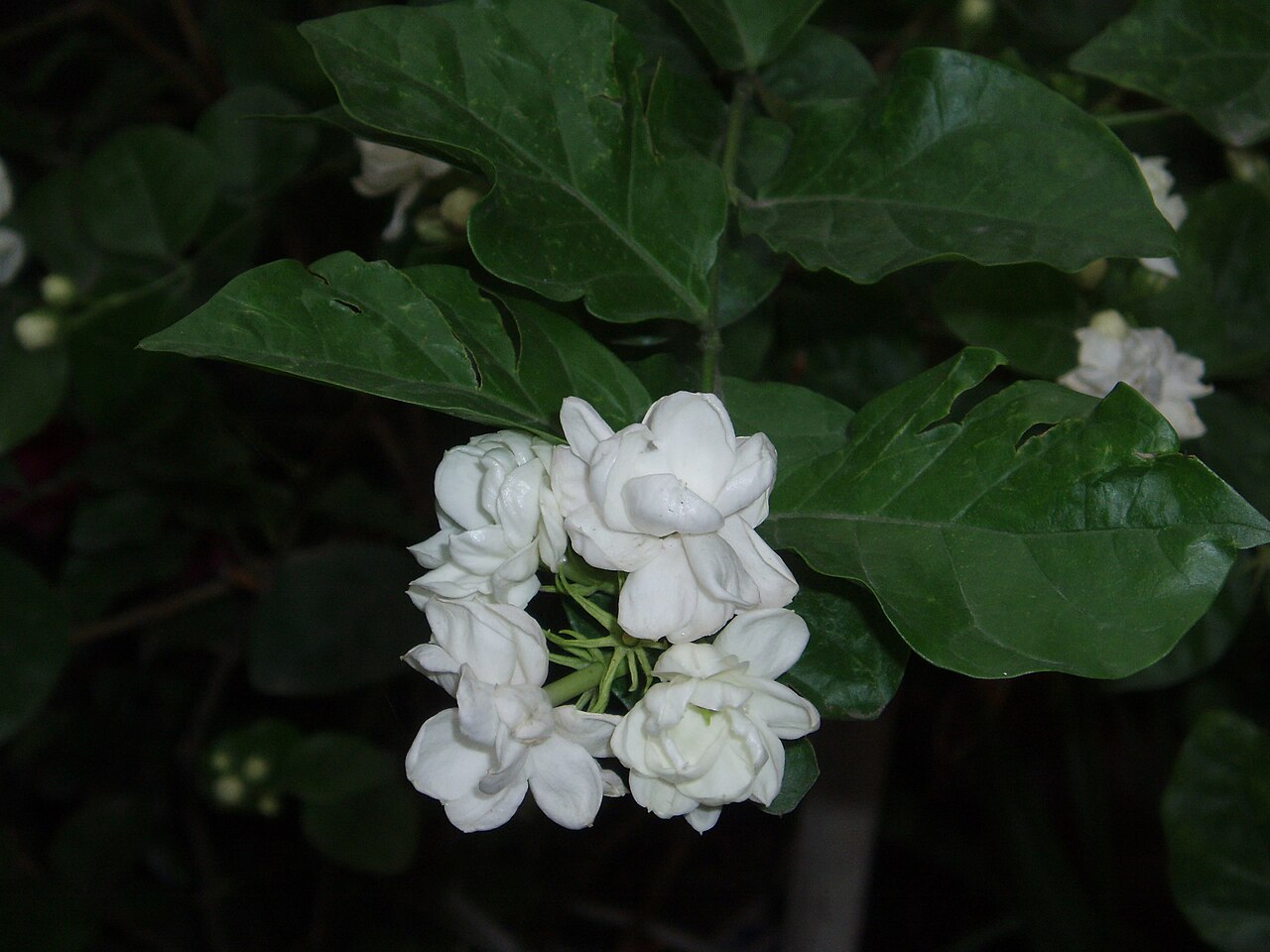
Flowers bloom year-round in clusters of 3 to 12 at the branch tips. They are strongly scented, with a white corolla 2 to 3 cm across that has 5 to 9 lobes. The flowers open at night, usually between 6 and 8 pm, and close in the morning, staying open for 12 to 20 hours. The fruit is a purple to black berry about 1 cm in diameter.
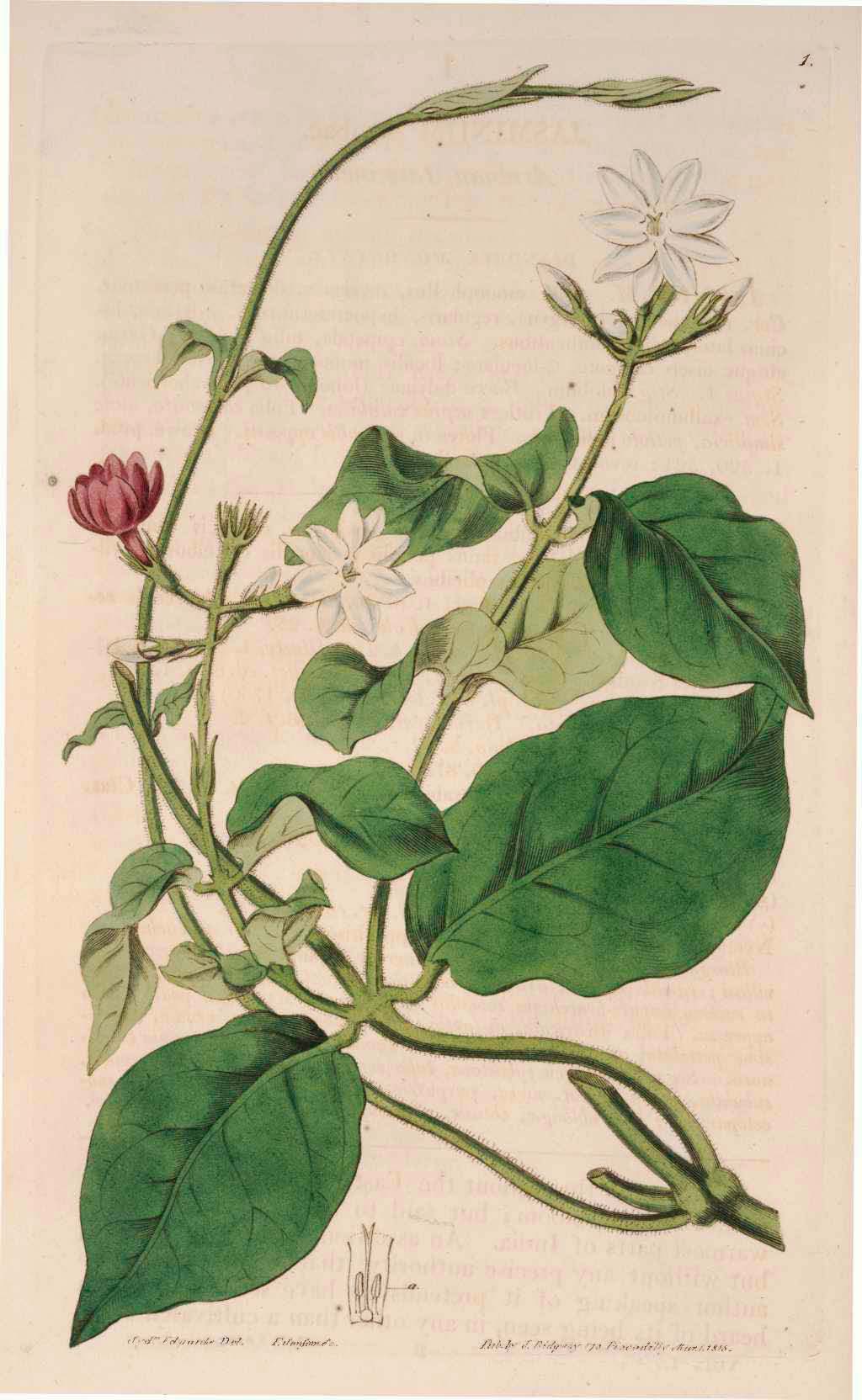
Taxonomy and nomenclature
In terms of classification, Jasminum sambac belongs to the genus Jasminum, tribe Jasmineae, in the olive family Oleaceae. Its common English name, "Arabian jasmine," comes from its widespread cultivation in the Arabian Peninsula. Early Chinese records suggest it originated in Southeast Asia. This species, along with nine others, was carried by humans into Arabia and Persia for garden cultivation, and from there introduced to Europe as ornamentals, where it was known as "sambac" in the 18th century.
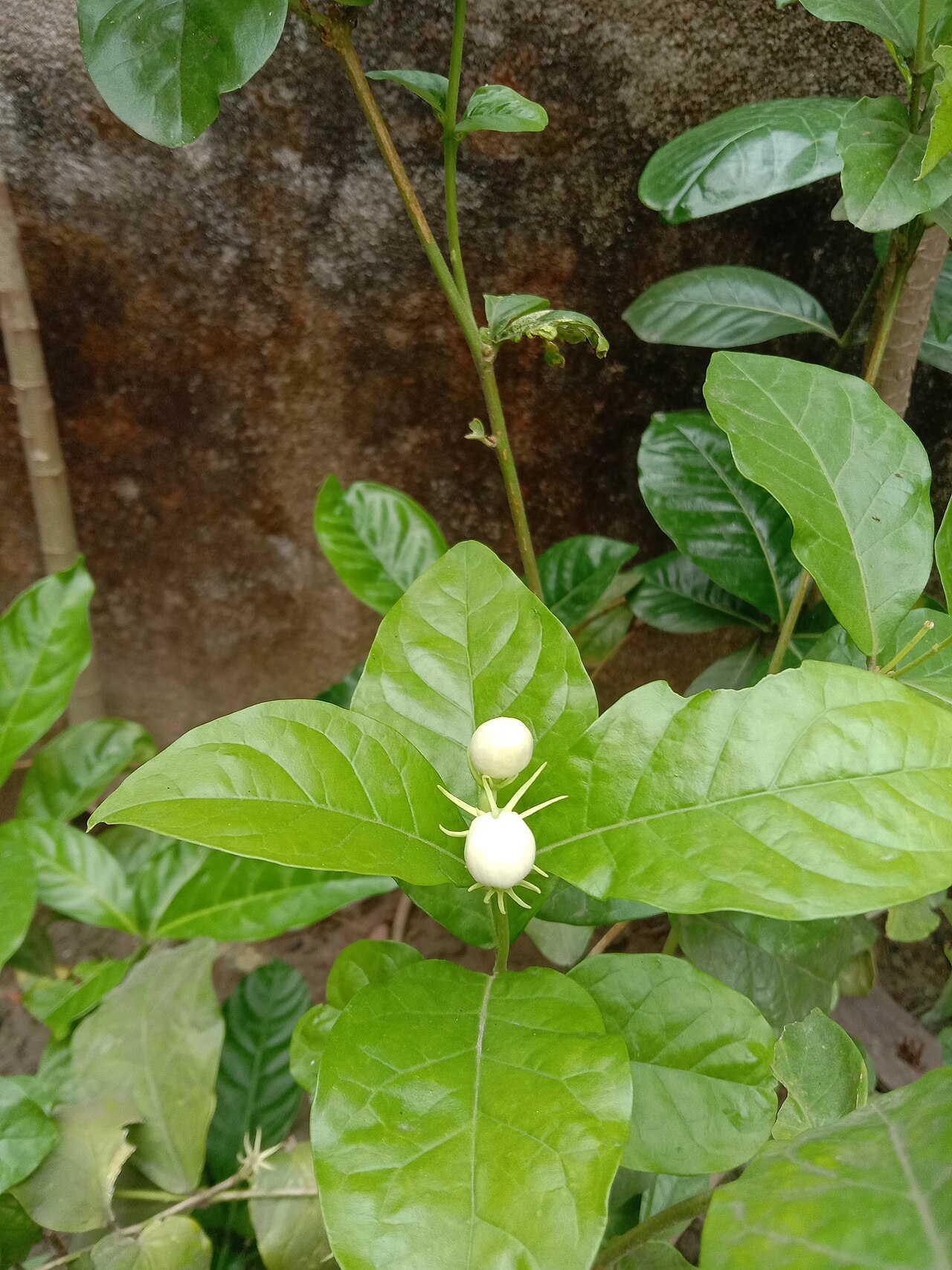
The Medieval Arabic word "zanbaq" referred to jasmine flower-oil from any jasmine species. That term entered late medieval Latin as "sambacus" and "zambacca" with the same meaning, and later post-medieval Latin plant taxonomy adopted "sambac" as the species label. J.
Scientific classification
- CladeTracheophytes
- CladeAngiosperms
- CladeEudicots
- CladeAsterids
- OrderLamiales
- FamilyOleaceae
- GenusJasminum
- SpeciesJasminum sambac
Named by (L.) Aiton
Close relatives
Other species of Jasminum with a Codexery entry.
- Jasminum officinale Jasminum officinale
Sources: Wikipedia taxobox: Jasminum sambac (CC BY-SA 4.0)
Where the jasminum sambac has been recorded
Each dot is a place where the species has been observed and reported (1,133 records, half-degree grid) — not a modelled range. 525 inland records left out (institution coordinates).
Map: drawn by Codexery. Data: GBIF occurrence search (records CC0 / CC BY) · Natural Earth basemap (public domain) · place coordinates: Wikipedia (CC BY-SA 4.0)
Quick Facts
- Species
- sambac
Facts from the source article.
Lore & Background
Jasminum sambac is an evergreen vine or shrub reaching up to 0.5 to 3 m tall. The species is highly variable, possibly due to spontaneous mutation, natural hybridization, and autopolyploidy. Cultivated plants generally do not bear seeds and are reproduced solely by cuttings, layering, marcotting, and other asexual methods.
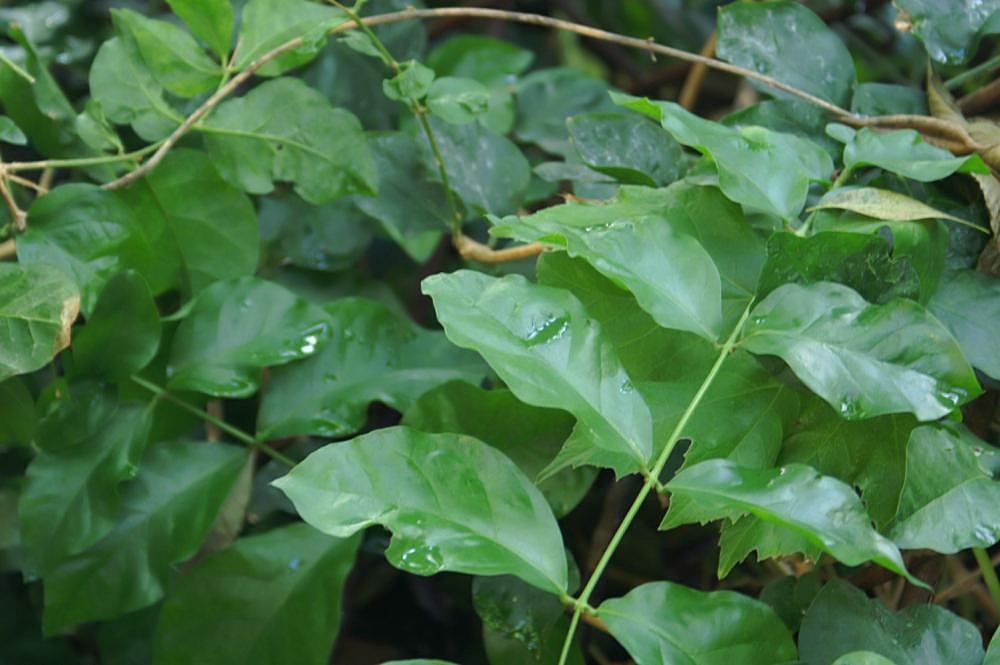
The leaves are ovate, smooth except for a few hairs at the base, and arranged opposite or in whorls of three. Flowers bloom year-round in clusters of 3 to 12, are strongly scented with a white corolla 2 to 3 cm in diameter with 5 to 9 lobes, and open at night (around 6 to 8 in the evening) closing in the morning after 12 to 20 hours. The fruit is a purple to black berry 1 cm in diameter.
Reader's Guide
Jasminum sambac is widely cultivated throughout the tropics from the Arabian Peninsula to Southeast Asia and the Pacific Islands as an ornamental plant and for its strongly scented flowers. Its sweet, heady fragrance is its distinct feature, and numerous cultivars exist, including 'Maid of Orleans', 'Belle of India', 'Grand Duke of Tuscany', 'Mysore Malli', and 'Arabian Nights'. The flowers are harvested as buds during early morning, based on color, and are used in perfumes and jasmine tea. In the Philippines, it is the national flower known as sampaguita, adopted on 1 February 1934, and is used in leis, corsages, and garlands for religious and ceremonial purposes.
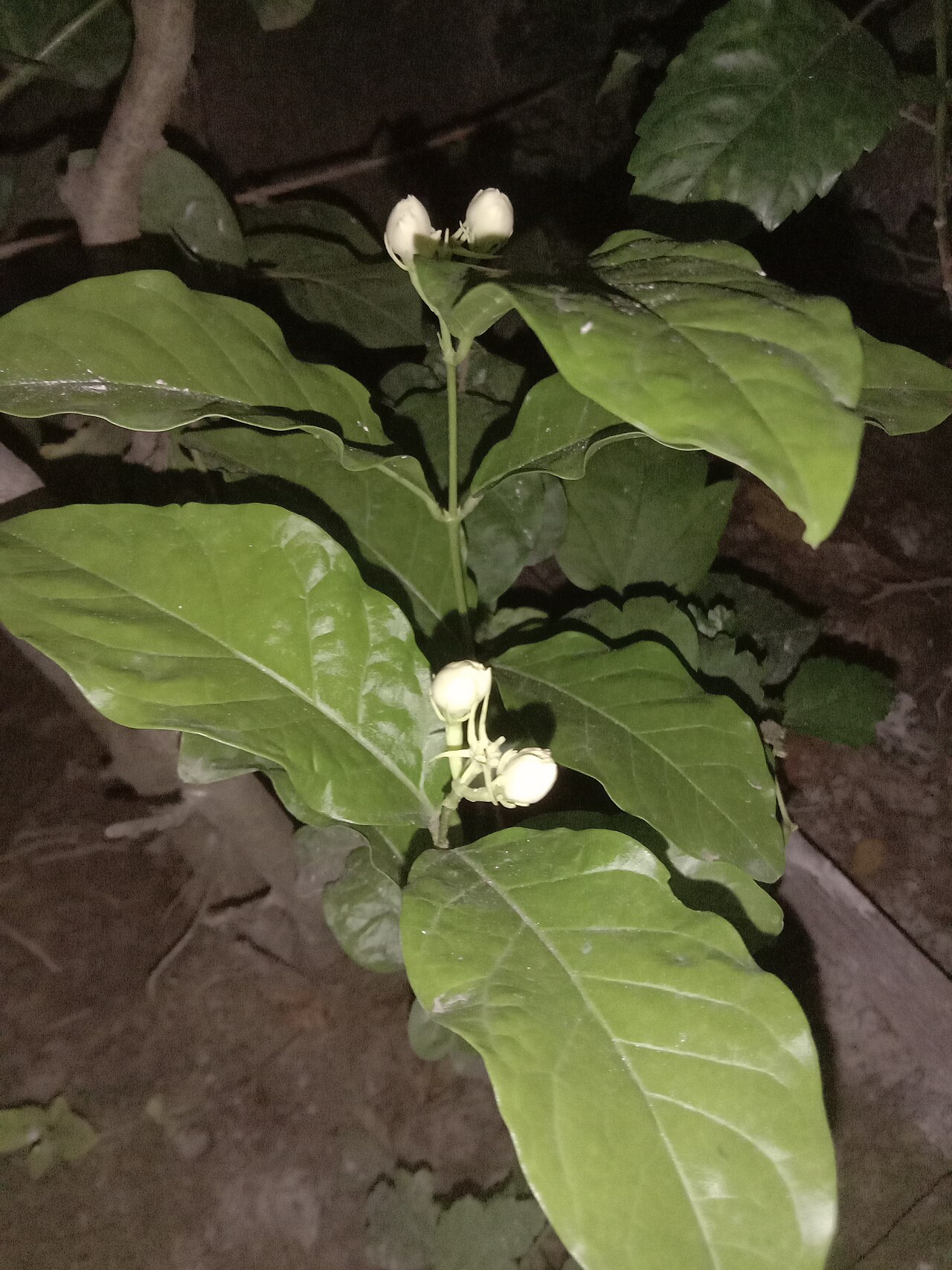
In Indonesia, it is one of three national flowers, known as melati putih, symbolizing purity and sacredness. The plant does not tolerate freezing and in temperate regions must be grown under glass. In the UK, it has gained the Royal Horticultural Society's Award of Garden Merit.
More in Herbs & Spices
Sources
Compiled from Wikipedia and the sources listed below. Text from Wikipedia is available under CC BY-SA 4.0; this entry is adapted from it.
- Wikipedia: Jasminum sambac (CC BY-SA 4.0).
- Occurrence records: GBIF (CC0 / CC BY). Basemap: Natural Earth (public domain).
- Word definitions: the Codexery glossary, each quoted from its Wikipedia article.
Spotted an error? Know more?
Reader corrections go straight into our review queue. Suggest an edit · How this site is sourced