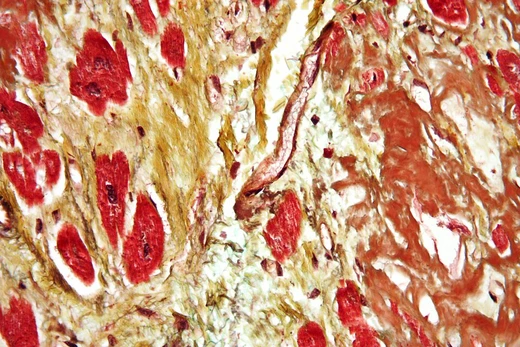
Coronary artery ectasia
Enlarged coronary artery often found incidentally, linked to inflammation and clotting risk.
Last updated
Coronary artery ectasia is a rare condition in which a coronary artery enlarges to at least 1.5 times its normal diameter, occurring in 0.3–4.9% of people in North America. It is often asymptomatic and discovered incidentally during testing for other heart conditions such as coronary artery disease or stable angina. The disease is four times more frequent in males and is associated with risk factors like smoking, and it can lead to chest pain, blood flow disruption, and potentially fatal aneurysms.
Quick Facts
- Specialty
- cardiology
Facts from the source article.
Pathology
Coronary artery ectasia frequently occurs alongside connective tissue diseases and heightened inflammatory responses, such as Marfan syndrome and Kawasaki Disease, and can appear transiently after stent placement due to vessel stretching. The condition involves increased wall stress and thinning of the arterial wall, leading to progressive dilation and remodeling, primarily driven by inflammation from disease, chemicals, or physical stress. This inflammatory response causes overexpression of matrix metalloproteinases, cysteine proteinases, and serine proteinases, which partially break down and weaken the vessel wall.
Inflammation also triggers platelet activation, and turbulent blood flow in the enlarged vessel further promotes clot formation. Elevated oxidative stress and depressed antioxidant activity damage cells and weaken vessels, while detectable increases in C-reactive protein, interleukin-6, tumor necrosis factor alpha, and cell adhesion molecules serve as diagnostic markers.
Diagnosis
Angiography is the most common method for detecting coronary artery ectasia, using contrast dye and X-ray to reveal the size, location, and number of affected vessels. Other diagnostic tools include intravascular ultrasound and magnetic resonance imaging. The disease most often involves the right coronary artery, followed by the left anterior descending artery, then the left anterior circumflex artery. Coronary artery ectasia is classified into four types: Type 1 (diffuse ectasia in 2–3 vessels), Type 2 (diffuse disease in one vessel and local disease in another), Type 3 (diffuse disease in one vessel), and Type 4 (localized or segmental ectasia).
Treatment
No cardiovascular society guidelines exist for treating coronary artery ectasia. Experts recommend anti-platelet therapy, such as aspirin, to reduce thrombus formation from turbulent blood flow, while dual anti-platelet therapy and full anticoagulation remain under investigation. Since atherosclerosis is the primary etiology in adults, statin therapy is advised, potentially reducing inflammation and matrix metalloproteinase activation to slow disease progression. Some studies suggest angiotensin converting enzyme inhibitors due to ACE gene polymorphisms implicated in progression, and risk factor modification—including tobacco cessation, blood pressure control, and avoidance of cocaine—is recommended.
More in Heart Diseases
Sources
Compiled from Wikipedia and the sources listed below. Text from Wikipedia is available under CC BY-SA 4.0; this entry is adapted from it.
- Wikipedia: Coronary artery ectasia (CC BY-SA 4.0).
- Word definitions: the , each quoted from its Wikipedia article.
Spotted an error? Know more?
Reader corrections go straight into our review queue. Suggest an edit · How this site is sourced