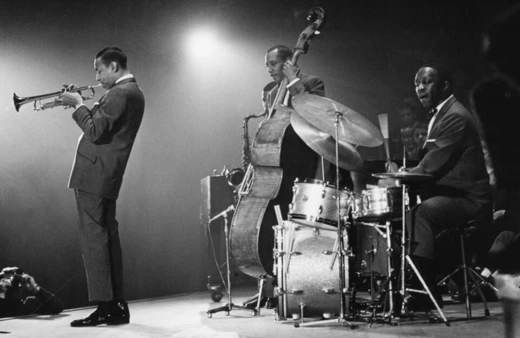
Randy Weston
America's African Musical Ambassador.
Last updated
Randolph Edward "Randy" Weston was an American jazz pianist and composer whose work was deeply shaped by his ancestral African connection. His piano style drew on influences including Duke Ellington, Thelonious Monk, Count Basie, Nat King Cole, and Earl Hines. Beginning in the 1950s, he frequently collaborated with trombonist and arranger Melba Liston.
Lore
In 1954, Weston formed his own trio and quartet and released his debut recording as a leader, Cole Porter in a Modern Mood. DownBeat's International Critics' Poll voted him New Star Pianist in 1955. His album Little Niles, dedicated to his children Niles and Pamela, featured all tunes in 3/4 time, with Melba Liston providing arrangements for a sextet playing Weston's compositions like the title track, "Earth Birth," "Babe's Blues," and "Pam's Waltz."
1960s–70s
In the 1960s, Weston's music prominently incorporated African elements, shown on the large-scale suite Uhuru Afrika (1960, with poet Langston Hughes) and Highlife (1963), recorded two years after his first trip to Africa as part of a U.S. cultural exchange to Lagos, Nigeria, with Hughes, Lionel Hampton, Ahmed Abdul-Malik, Nina Simone, and Brock Peters. In 1967, Weston traveled throughout Africa with a U.S. cultural delegation, settling in Morocco and running his African Rhythms Club in Tangier from 1967 to 1972.
He said in a 2015 interview: "We had everything in there from Chicago blues singers to singers from the Congo.... The whole idea was to trace African people wherever we are and what we do with music." In 1972, he produced Blue Moses for CTI Records, his only hit record, though he was unhappy with Creed Taylor's insistence on electric piano. In the summer of 1975, he played at the Festival of Tabarka in Tunisia, accompanied by his son Azzedin Weston on percussion, alongside Dizzy Gillespie.
Later career
In 1977, he participated in FESTAC in Lagos, Nigeria, with artists including Osibisa, Miriam Makeba, Stevie Wonder, and Sun Ra. Later, his 1991 recording The Spirits of Our Ancestors, arranged by Melba Liston, featured African musicians and guests Dizzy Gillespie and Pharoah Sanders, and has been described as "one of the most imaginative explorations of 'world jazz' ever recorded." His most popular compositions include "Hi-Fly" (inspired by his experience of being 6'8" and looking down at the ground), "Little Niles," "African Sunrise," "Blue Moses," "The Healers," and "Berkshire Blues."
A five-night celebration of his music took place at the Montreal Jazz Festival in 1995, featuring Gnawa musicians and a duet with saxophonist David Murray. In 2002, he performed with bassist James Lewis for the inauguration of the Bibliotheca Alexandrina in Egypt, and with Gnawa musicians at Canterbury Cathedral at the invitation of the Archbishop of Canterbury. He played at the Kamigamo Shrine in Japan in 2008. On June 21, 2009, he participated in a memorial at the Jazz Gallery in New York for Ghanaian drummer Kofi Ghanaba, whose composition "Love, the Mystery of..."
Weston used as his theme for some 40 years. In 2013, Sunnyside released The Roots of the Blues, a duo session with tenor saxophonist Billy Harper. On November 17, 2014, as part of the London Jazz Festival, they played a duo concert at the Queen Elizabeth Hall. In 2015, Weston was artist-in-residence at The New School in New York.
He celebrated his 90th birthday in 2016 with a concert at Carnegie Hall, and performed at the Gnawa Festival in Morocco in April 2016.
Biography
Randy Weston came into the world on April 6, 1926, the son of Vivian and Frank Weston, and grew up in Brooklyn, where his dad ran a restaurant. His mother hailed from Virginia, while his father, of Jamaican-Panamanian background, was a devoted Garveyite who taught his son to be self-reliant. As a child, Weston learned classical piano and took dance lessons. He attended Boys High School in Bedford-Stuyvesant, chosen by his father for its tough academic reputation.
His piano training shifted when Professor Atwell, unlike his earlier teacher Mrs. Lucy Chapman, let him explore music beyond the classical canon. During World War II, Weston was drafted into the U.S. Army, serving from 1944 for three years and rising to staff sergeant, with a year stationed in Okinawa, Japan. Back in Brooklyn, he took over his father's restaurant, which became a hangout for jazz musicians. Weston admired pianists like Count Basie, Nat King Cole, Art Tatum, Duke Ellington, and his cousin Wynton Kelly, but Thelonious Monk truly transformed him.
After hearing Monk with Coleman Hawkins, Weston spent roughly three years closely following Monk, saying Monk put the magic back into the music. In the late 1940s, he played with Bull Moose Jackson, Frank Culley, and Eddie "Cleanhead" Vinson. In 1951, wanting to get away from the drug-heavy New York jazz scene, he moved to Lenox, Massachusetts, in the Berkshires. At the Music Inn there, jazz historian Marshall Stearns introduced him to jazz's African roots.
He returned in later summers, composing "Berkshire Blues" and connecting with Geoffrey Holder, Babatunde Olatunji, Langston Hughes, and Willis James, drawing deep inspiration for African music from those experiences.
Autobiography
In October 2010, Duke University Press published African Rhythms: The Autobiography of Randy Weston, composed by Randy Weston and arranged by Willard Jenkins. The book was described as an important addition to jazz historiography and a long-anticipated read for fans. Reviewer Larry Reni Thomas called it a consciousness-raising, African-centered work that takes the reader on a journey from America to Africa and back.
Archives
In 2015–16, Weston's archives were acquired by the Jazz Research Initiative in collaboration with the Hutchins Center for African and African American Research, Loeb Music Library, the Harvard College Library, and the Dean of the Faculty of Arts and Sciences. The Randy Weston Collection includes hundreds of manuscripts, scores, videos, films, photographs, and more than 1,000 tape recordings. Highlights include correspondence with Langston Hughes and Alvin Ailey, photographs with Dizzy Gillespie, Pharoah Sanders, Muhammad Ali, and Cornel West, and records of Weston's African Rhythms Club in Tangier, Morocco, from 1967 to 1972.
Frequently Asked Questions
When and where was Randy Weston born?
Randy Weston was born on 6 April 1926 in Brooklyn, New York City, New York, U.S.
When did Randy Weston die?
Randy Weston died on 1 September 2018 in Brooklyn, New York City, U.S.
More in Hard Bop Pianists
Sources
Compiled from Wikipedia and the sources listed below. Text from Wikipedia is available under CC BY-SA 4.0; this entry is adapted from it.
- Wikipedia: Randy Weston (CC BY-SA 4.0).
Spotted an error? Know more?
Reader corrections go straight into our review queue. Suggest an edit · How this site is sourced