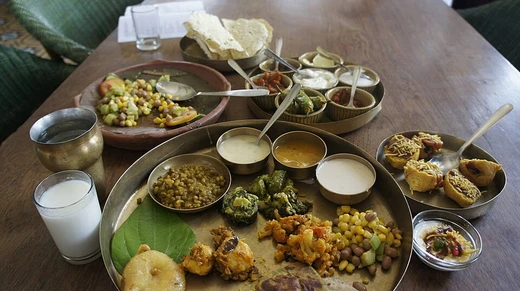
Toor dal
A staple pulse from the pigeon pea plant.
Toor dal comes from the pigeon pea, a perennial legume in the Fabaceae family. This pea is grown widely in tropical and semitropical areas and is a common food across the Indian Subcontinent, Southeast Asia, Africa, Latin America, and the Caribbean.
Quick Facts
- Scientific name
- Cajanus cajan
- Family
- Fabaceae
- World production
- 4.49 million tons
- India's share of production
- 63%
- Average yield
- 700 kg/ha
Facts from the source article.
Did You Know?
- Pigeon peas contain high levels of protein and the amino acids methionine, lysine, and tryptophan.
- The immature seeds contain significant vitamin C (39 mg per 100 g serving) and have a slightly higher fat content.
- The protein content of immature seeds is of a higher quality than that of mature seeds.
Etymology and other names
The scientific name Cajanus and cajan derive from the Malay word katjang (modern spelling: kacang) meaning legume. In English, pigeon pea originates from its historical use as pigeon fodder in Barbados. The terms Congo pea and Angola pea developed due to its cultivation in Africa and association with people of African descent. No-eye pea refers to the lack of a hilum blotch on most varieties, unlike the black-eyed pea, while red gram refers to the red color of most Indian varieties and gram meaning legume.
In India, names include arhar, tur, kandi, tuvarika, and adhaki. In Persian it is known as shakhul. In the Philippines it is called Kadios in Filipino and Kadyos in Tagalog. In Latin America, Spanish names include guandul or gandul, and Portuguese names feijão andu or gandu, all deriving from Kikongo wandu or Kimbundu oanda. In Suriname it is wandoe or gele pesi, the latter meaning yellow pea. In Hawaii it is pi pokoliko or pi nunu.
History and origin
The cultivated pigeon pea has three closest wild relatives: Cajanus cajanifolia, Cajanus scarabaeoides, and Cajanus kerstingii, which are native to India and West Africa. There is ongoing disagreement about where the species originated, with some pointing to the Nile River and West Africa and others to India. Both Africa and India are centers of genetic diversity, but India is generally seen as the primary origin, with West Africa as a secondary one.
Evidence of cultivation in peninsular India dates to at least 2800 BCE, where the wild relative Cajanus cajanifolia grows in tropical deciduous woodlands. Archaeological sites from around the 14th century BCE, such as Sanganakallu in Bellary, Tuljapur, Gopalpur, and other locations in South India, also show pigeon pea cultivation. From India, the crop likely reached Northeast Africa through Bronze Age trade routes. The earliest African evidence comes from Egyptian tombs around 2200 BCE.
Cultivation then spread west and south across the continent. During the Trans-Atlantic slave trade, pigeon peas reached the Americas around the 17th century. James Macrae introduced them to Hawaii in 1824, but they only became popular later, when Filipino and Puerto Rican workers arrived to work on sugarcane plantations in the early 1900s.
Cultivation
Pigeon peas can be perennial, lasting three to five years with seed yield dropping after the first two years, or annual, more suitable for seed production. World production is estimated at 4.49 million tons, with India accounting for 63%. The total area grown is estimated at 5.4 million hectares, with India accounting for 72% or 3.9 million hectares. Africa contributes about 21% of global production with 1.05 million tons, with major producers including Malawi, Tanzania, Kenya, Mozambique, and Uganda.
Malawi's Nandolo Farmers' Association is supported by international aid via Christian Aid. The crop is important in rainfed agriculture in semiarid tropics, with the Indian subcontinent, Africa, and Central America as the three main producing regions. It is cultivated in over 25 tropical and subtropical countries, either as a sole crop or intermixed with cereals like sorghum, pearl millet, or maize, or with other legumes like peanuts. As a legume capable of symbiosis with Rhizobia, it enriches soils through nitrogen fixation.
The crop is grown on marginal land by resource-poor farmers, traditionally using minimal inputs, with average yields of 700 kg/ha. Short-duration varieties of 3–4 months have been developed. Pigeon peas are very drought-resistant and can be grown in areas with less than 650 mm annual rainfall.
Uses
Pigeon peas can be eaten as dried peas, flour, or fresh green peas, and they also work as a forage or cover crop. Pairing them with cereals creates a nutritionally balanced meal. The dried peas can be sprouted briefly before cooking for a different taste. In Cape Verde, dried pigeon peas are used to make a soup called feijão Congo.
Across Kenya and the Swahili-speaking parts of East Africa, they appear in breakfast dishes like mbaazi na mahamri. In Nigeria’s Enugu state, the Igbo dish Ẹchịcha or Achịcha combines palm oil, cocoyam, and seasoning. Ethiopians cook and eat the pods, young shoots, and leaves. In India, pigeon pea is a hugely popular pulse and a key protein source in a largely vegetarian diet, often served as a staple alongside rice or roti; fresh young pods also go into dishes like sambar.
In the Philippines’ Western Visayas region, the soup KBL—short for Kadyos, Baboy, and Langka—features pigeon peas with smoked pork and jackfruit, giving it a violet color. On Colombia’s Caribbean coast, sopa de guandú con carne salada includes pigeon peas with yam, plantain, yuca, and spices.
More in Gujarati Cuisine
Spotted an error? Know more?
Reader corrections go straight into our review queue. Suggest an edit · How this site is sourced