Menelaion
Mycenaean hill complex and later hero-shrine to Menelaus and Helen.
Last updated
Where it is
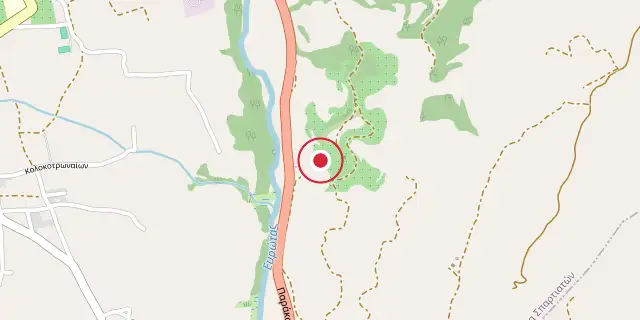
Coordinates: 37°03′54″N 22°27′11″E (37.0650, 22.4530) · Open in OpenStreetMap
Coordinates and connected clubs: the infobox of Wikipedia: Menelaion (CC BY-SA 4.0). Map: drawn by Codexery from OpenStreetMap tiles.
The Menelaion is an archaeological site on a ridge near Sparta, Greece, associated with the Mycenaean civilization. It is notable as a likely reference for Homer's description of the kingdom of Menelaus and Helen, and later became a hero-shrine dedicated to them.
Historical context
The site lies in the Eurotas valley, where mild climate and low hills shaped its geography. Middle Helladic finds are scarce on the Northern hill, but the Menelaion hill held a major Mycenaean settlement.
This 'proto-Sparta' participated in Mycenaean culture, with elites who wore gold and traded widely, contrasting with later Spartan austerity. After the Bronze Age collapse, early Spartans founded Sparta in the valley rather than rebuilding on the ridge. Around the 8th century BC, they built a hero-shrine over the ruins, dedicating it to Menelaus and Helen to legitimize their rule.
Excavations
Ludwig Ross recognized the Menelaion as a heroon and excavated in 1834, uncovering lead votive figurines of the Laconic type. In 1909, the British School at Athens, with John Percival Droop, M. S. Thompson, and Alan Wace, conducted the first systematic excavation, revealing a Late Mycenaean structure of raw brick with painted plaster on the eastern peak. Richard MacGillivray Dawkins, then director of the British School, led further excavations in 1910.
After a 60-year gap, Hector Catling returned to the site, attempting to establish a chronological sequence between Mycenaean remains and the later heroic cult. He identified three phases: Mansion 1, built around 1450 BCE with a central megaron, soon destroyed by a possible earthquake; Mansion 2, built about 10 meters away with a new orientation, abandoned during Late Helladic IIIA1; and Mansion 3, inhabited at the end of Late Helladic IIIA1. Catling interpreted these palaces as administrative centers ancestral to the large megaroid palaces of Pylos, Mycenae, and Tiryns.
Stratigraphy
The monument shows several stratigraphic and architectural phases. The first, late 8th or early 7th century BC, is represented only by scattered limestone blocks dated by associated votive strata.
The second phase, probably in the 6th century BC, involved a small limestone structure, though its materials are found out of context. This Ancient Menelaion stood until the 5th century BC, when it was demolished. The third, classical phase, from the 5th century BC, saw a new sanctuary built upon the earlier edifice, though some researchers argue the Ancient Menelaion was actually a warehouse during the 1909 excavations.
More in Greek Temples
Sources
Compiled from Wikipedia and the sources listed below. Text from Wikipedia is available under CC BY-SA 4.0; this entry is adapted from it.
- Wikipedia: Menelaion (CC BY-SA 4.0).
Spotted an error? Know more?
Reader corrections go straight into our review queue. Suggest an edit · How this site is sourced