Hockenheimring
German circuit hosting Grands Prix since 1970.
Last updated
Where it is
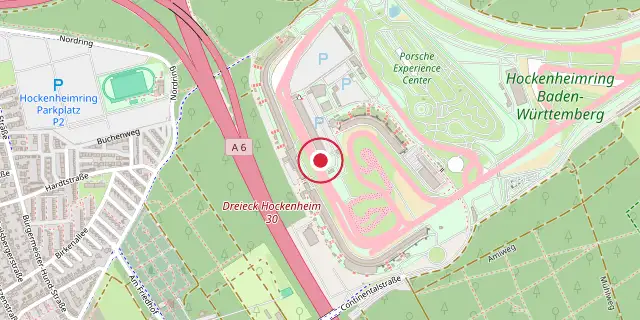
Coordinates: 49°19′41″N 8°33′58″E (49.3280, 8.5660) · Open in OpenStreetMap
Coordinates and connected clubs: the infobox of Wikipedia: Hockenheimring (CC BY-SA 4.0). Map: drawn by Codexery from OpenStreetMap tiles.
Nestled in the Rhine valley near Hockenheim, Germany, the Hockenheimring Baden-Württemberg sits along the Bertha Benz Memorial Route. This nearly flat circuit, holding an FIA Grade 1 licence, most recently staged the German Grand Prix in 2019.
History
The Hockenheimring was built in 1932, originally called "Dreieckskurs" (triangle course). Ernst Christ, a young timekeeper who wanted a racing track in his hometown, submitted plans that were approved on Christmas day 1931. The first layout was about twelve kilometres long, with a large triangle-like section, a hairpin in the city, and two connecting straights. In 1938 the circuit was shortened to just over seven and a half kilometres, the Ostkurve corner was introduced, and the track was renamed "Kurpfalzring".
Damaged by tanks during World War II, it was repaired afterward and renamed "Hockenheimring". Wilhelm Herz became manager in 1954 and promoted the track; Grand Prix motorcycle racing events were held, with the German motorcycle Grand Prix alternating between Hockenheimring and other tracks. This version had two long straights, the Ostkurve in the forest, and the original hairpin inside Hockenheim.
In 1965, after the Autobahn A 6 separated the village from the main part of the track, a new version was built with the "Motodrom" stadium section designed by John Hugenholtz. In 1982, after Patrick Depailler's death in 1980, a chicane was added at the Ostkurve and the first chicane was made slower. For the 1992 German Grand Prix, the Ostkurve was changed to a right-left-right chicane after Érik Comas crashed in 1991. The second chicane was renamed after Ayrton Senna following his death at the 1994 San Marino Grand Prix.
Formula One
The Hockenheimring first hosted the German Grand Prix in 1970 after F1 drivers boycotted the Nürburgring. The race returned to the Nürburgring the next year until 1976. From then, Hockenheimring hosted the German Grand Prix except in 1985 when the race was at the reconfigured Nürburgring. In July 2006, Bernie Ecclestone announced that from 2007 there would be only one Grand Prix per year in Germany; the Nürburgring and Hockenheimring alternated hosting the German Grand Prix, starting with the Nürburgring in 2007.
Deficits of up to 5.3 million Euro per race made extension unlikely after 2010, but in October 2009 the contract was extended to 2018 with FOA covering losses. Neither Hockenheim nor the Nürburgring hosted a Grand Prix in 2015 or 2017. 2019 was the last time the facility hosted the German Grand Prix, sponsored by Mercedes-Benz.
Drag racing (NitrolympX – Rico Anthes Quarter Mile)
The Hockenheimring’s start-finish straight hosted 1/8 mile drag races from 1986 to 1988. The following year, a dedicated drag strip was created by linking the Opel-Kurve to the first turn into the Motodrom. The finish line sat where the forest began, with a lengthy run-off continuing through the woods. Drivers had to go the wrong way around the entire circuit to get back to the paddock.
This strip is active only for two August events: the Public Race Days and the NitrolympX main event a week later. Originally called the Nitrolympics and featuring Top Fuel dragsters, it was later rebranded as NitrolympX. After the track was shortened in 2002, the drag strip was relocated closer to new tall Tower stands, which offer a unique view along the quarter-mile. Although the run-off area was cut in half, it remains among drag racing’s longest.
The NitrolympX typically hosts most European Drag Racing Championship rounds sanctioned by FIA or FIM, plus jet dragsters and other Saturday night entertainment that attracts 40,000 spectators. In 2008, the strip was named Rico Anthes Quarter Mile after the German Top Fuel driver and longtime NitrolympX organizer who retired in 2007. Because the drag strip can only be prepared after the circuit’s last major event—usually the Formula One race—grip is often poorer than at permanent strips like Santa Pod or Tierp Arena.
The best full quarter-mile time came in 2005: Brady Kalivoda (USA) ran 4.873 seconds at 458 km/h. In 2012, some Pro classes struggled for traction after Formula One required a new surface; later, organizers improved the track with help from Santa Pod personnel and equipment. In 2016, Hockenheim saw mainland Europe’s first 3-second Top Fuel pass at 1000 feet: Anita Mäkelä (FIN) recorded 3.939 seconds at 486.91 km/h. Garry Bowe (GB) set a European Super Street Bike record of 7.04 seconds at 340.69 km/h.
Did You Know?
- The rallycross track uses a section from turns 11 to 16 combined with a dirt section in front of the grandstands.
- The first ever World RX of Hockenheim was round 2 of the FIA World Rallycross Championship in 2015 as a supporting event of DTM.
- WRX also combined with the DTM for an event there in 2017.
Frequently Asked Questions
When did Hockenheimring open?
Hockenheimring opened on 29 May 1932.
What is the capacity of Hockenheimring?
Hockenheimring has a capacity of 70,000.
More in Grand Prix Motorcycle Circuits
Sources
Compiled from Wikipedia and the sources listed below. Text from Wikipedia is available under CC BY-SA 4.0; this entry is adapted from it.
- Wikipedia: Hockenheimring (CC BY-SA 4.0).
Spotted an error? Know more?
Reader corrections go straight into our review queue. Suggest an edit · How this site is sourced