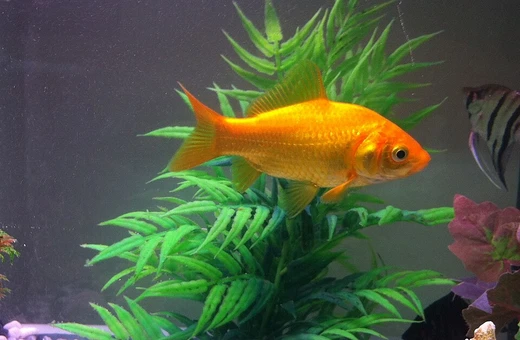
Celestial Eye
A fancy goldfish with upward-turned telescope eyes.
The Celestial Eye goldfish, also known as Choutengan, is a double-tailed fancy breed distinguished by telescope eyes whose pupils are permanently turned upward, as if gazing skyward. This unique orientation develops within six months after hatching, as the eyeballs gradually reposition from a normal lateral gaze to a near-vertical alignment. The breed's distinctive eye structure is entirely genetically determined, contrary to early myths that it resulted from confinement in narrow-necked jars.
Quick Facts
- Country
- China or Korea
Facts from the source article.
Origins
The Celestial arose as a direct mutation of the telescope goldfish during the 18th century, though whether this first occurred in Korea or China remains unclear. The earliest known record is a Chinese scroll from 1772 depicting a goldfish lacking a dorsal fin and having protuberant, upturned eyes. The breed reached the United States from Japan in the 1900s and 1910s and was included in the first edition of Goldfish Varieties and Tropical Aquarium Fishes (1917) by William T. Innes. American fanciers bred them and exported stock to Great Britain. A celestial appeared on a Chinese postage stamp issued in 1960.
Description and physical traits
The celestial has an elongate, egg-shaped body similar to the bubble-eye and lacks a dorsal fin. Its paired fins are of the fantail or ryukin type, and the caudal fin may be half as long as the body or equally long. Metallic scales in shades of orange, white, or red and white are most common; nacreous or shiny scales are rare. Despite their ocular differences and missing dorsal fin, celestials are as active and agile as any goldfish. However, their vertically focused field of vision puts them at a disadvantage when competing for food against more vigorous breeds, such as telescope-eye goldfish, so they are best kept alone or with bubble-eye breeds. Their large, vulnerable eyeballs require protection from sharp rocks, gravel, driftwood, or artificial plants with sharp edges; smooth-bottomed aquariums with silk plants are recommended. Live plants with soft foliage, such as Anubias, Bolbitis, Bucephalandra, or Leptochilus, can be attached to smooth rocks or non-jagged driftwood. Larger specimens of Cryptocoryne or Echinodorus may be safe from smaller goldfish but need a richer substrate. Celestials are somewhat sensitive to temperature fluctuations, preferring water in the lower to mid-70s °F (21–23.89 °C).
Variants
The original Celestial breed, over 240 years old, is still bred by Chinese and Japanese breeders and is commercially available, though less common than other varieties. This form is described in the American standard adopted by the American Goldfish Association and the Goldfish Society of America. British fanciers prefer deeper bodies and shorter fins, selectively breeding for these features per the British standard. Chinese breeders have crossed Celestials with Lionheads, Ranchus, and Pompoms, producing larger fish with short ranchu-like fins, deep blocky bodies, nasal bouquets, and rudimentary head growths. Some crosses are less animated swimmers, especially those with a short, downturned ranchu-like caudal peduncle and flared short caudal fins, and may be sedentary near the bottom. These hybrids display a wider color range, including chocolate, black, various bi-colors, and nacreous fish in bi-color, tri-color, and calico, but are generally not available commercially outside Asia except through specialist dealers. The Deme-ranchu is identical to the Celestial except for telescopic eyes that do not turn upward; many Celestial fry mature with such eyes. The Toadhead, or Hama-tou, has upward-turned eyes that are not protuberant, each with a small bubble-like sac beneath, and is believed ancestral to both the celestial eye and bubble eye goldfish.
More in Goldfish Breeds
Spotted an error? Know more?
Reader corrections go straight into our review queue. Suggest an edit · How this site is sourced