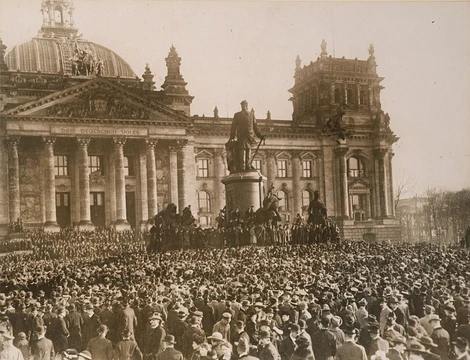
Proclamation of the republic in Germany
Two rival proclamations ended the German Empire on 9 November 1918.
The proclamation of the republic in Germany occurred twice on 9 November 1918 in Berlin. Philipp Scheidemann of the Majority Social Democratic Party of Germany (MSPD) first declared it at the Reichstag building, followed hours later by Karl Liebknecht of the Marxist Spartacus League at the Berlin Palace. This event marked the effective end of the German Empire and the birth of the Weimar Republic.
Quick Facts
- Date
- 9 November 1918
- Location
- Berlin
- First proclamation location
- Reichstag building
- First proclaimer
- Philipp Scheidemann (MSPD)
- Second proclamation location
- Berlin Palace
- Second proclaimer
- Karl Liebknecht (Spartacus League)
Facts from the source article.
Background
The MSPD leadership had seen its long-standing demands for democratization addressed by the October 1918 constitutional reforms, which turned the German Reich into a parliamentary monarchy. The MSPD was initially willing to preserve the monarchy, partly for continuity and to accommodate imperial elites, but soon pushed for Emperor Wilhelm II's abdication due to his responsibility for Germany's defeat in World War I. The Emperor, at the army's General Headquarters in Spa, Belgium since 29 October, kept postponing the decision. On the evening of 8 November, the MSPD leadership learned that the Independent Social Democratic Party (USPD) had called for meetings and mass demonstrations for the following day, expected to demand not only abdication but abolition of the monarchy. To forestall this, Prince Max von Baden, at MSPD chairman Friedrich Ebert's urging, announced Wilhelm II's abdication on the morning of 9 November before it had actually occurred. After learning of the announcement, the Emperor and his family fled into exile in the Netherlands, where he and Crown Prince Wilhelm signed the abdication document on 28 November 1918. At noon on 9 November, Max von Baden unilaterally transferred the office of Reich chancellor to Friedrich Ebert, who asked von Baden to act as imperial regent. Though von Baden refused, Ebert continued to assume he could save the monarchy.
Liebknecht's proclamation
At about 4 p.m. on 9 November 1918, Karl Liebknecht proclaimed the "Free Socialist Republic of Germany" in the Lustgarten in front of the Berlin Palace, standing on the roof of a vehicle. He declared that the day of revolution had come, peace was concluded, and the rule of the Hohenzollerns was over. He saluted Russian brothers who had been "shamefully chased away" four days earlier and said the new socialist freedom of workers and soldiers would enter through the gate. After troops surrounding the Palace abandoned their posts in the face of the growing crowd, Liebknecht spoke a second time from a large window of Portal IV directly above the gate. The Vossische Zeitung reproduced this speech, in which he recalled that seventy years earlier Frederick William IV had stood on the same spot and had to remove his cap before the procession of those who fell on the barricades for freedom. Liebknecht proclaimed the Free Socialist Republic of Germany, which would embrace all communities with no more servants and honest reward for honest labor, and declared the rule of capitalism broken. He called back Russian brothers, noting that they had said if Germany had not achieved in a month what they had achieved, they would turn their backs, but it had taken barely four days.
Aftermath
At first, the moderate MSPD managed to get the more radical USPD to join them in a temporary governing body called the Council of the People's Deputies. But by the end of December 1918, the three USPD members quit over political differences, and two more MSPD figures took their spots. The next month, the Spartacist uprising broke out, and the MSPD leadership called in right-wing Freikorps units to crush the leftist rebels. On January 19, elections were held for the Weimar National Assembly. That body wrote the Weimar Constitution, which took effect on August 11, 1919. Its very first article declared that the German Reich was a republic. Even though many Germans still wanted the monarchy back, and the Weimar Republic itself collapsed in 1933, no serious attempts were ever made to restore the empire. During the uprising, on January 15, 1919, Karl Liebknecht and Rosa Luxemburg were killed by soldiers from the Guard Cavalry Rifle Division, with Friedrich Ebert's approval. Philipp Scheidemann became a target of nationalist hatred; someone tried to assassinate him in 1922. When Hitler came to power in 1933, Scheidemann fled to Denmark. The Nazis put his name on their first expatriation list on August 25, 1933. He died in Copenhagen in 1939.
More in German Revolution of 1918–1919
Spotted an error? Know more?
Reader corrections go straight into our review queue. Suggest an edit · How this site is sourced