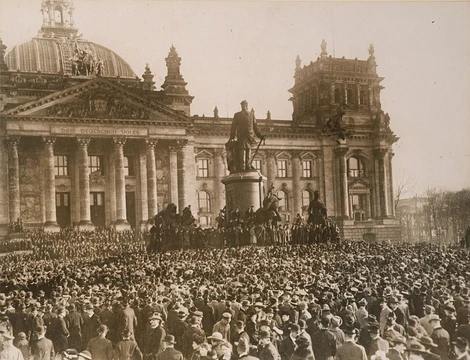
Scheidemann cabinet
Germany's first democratically elected national government.
The Scheidemann cabinet, led by Minister President Philipp Scheidemann of the Social Democratic Party (SPD), was Germany's first democratically elected national government. It took office on 13 February 1919, three months after the collapse of the German Empire, and is generally counted as the first government of the Weimar Republic. The cabinet resigned on 20 June 1919 over the terms of the Treaty of Versailles.
Quick Facts
- Cabinet name
- Cabinet of Philipp Scheidemann
- Cabinet number
- 1st
- Jurisdiction
- Weimar Germany
- Incumbent
- 13 February 1919 – 20 June 1919
- Date formed
- 13 February 1919
- Government head
- Philipp Scheidemann
- Deputy government head
- Eugen Schiffer (until 19 April 1919); Bernhard Dernburg
- State head
- Friedrich Ebert
Facts from the source article.
Did You Know?
- The cabinet's legal position was different from both its imperial predecessors and later cabinets, being provisional and improvised.
- On 3–4 June 1919, only Erzberger, David, Wissell, and Noske clearly favoured signing the Treaty of Versailles if the Allies refused significant changes.
Election and establishment
Following the collapse of the German Empire and the German Revolution of 1918–1919, elections for the Weimar National Assembly were held on 19 January 1919. The SPD received 38% of the vote, the USPD 7%, and the KPD boycotted. The National Assembly met in Weimar, passed a provisional constitution called the Law on Provisional Reich Power, and elected Friedrich Ebert as temporary president on 11 February. Ebert then asked Philipp Scheidemann to form the new government. Coalition negotiations among the SPD, DDP, and Centre Party had been ongoing. The SPD made cooperation conditional on acceptance of a republican form of state, a fiscal policy targeting wealth, and socialisation of suitable industries. The SPD approached the USPD, but Ebert reportedly conducted those talks only so the USPD would bear responsibility for their failure; the DDP would not have accepted a coalition with the USPD. Negotiations were difficult, with the presidency of the National Assembly hotly contested. It was finally agreed that Eduard David would resign as president and join the cabinet, allowing Constantin Fehrenbach to head the Assembly.
Internal and external security
The domestic security situation remained highly volatile in early 1919. The Berlin March Battles erupted shortly after the cabinet took office. Leftist workers' councils sought to establish a dictatorship of the councils, while separatist movements operated in several regions. The strong showing of the Weimar Coalition parties in the January elections further angered the radical left after the suppression of the Spartacist uprising. Between February and May 1919, numerous wild strikes, armed uprisings, and plant occupations occurred, especially in mining areas around Halle and the Ruhr. Workers demanded preservation of the council system, socialisation of key industries, democratisation of the military, higher wages, and better conditions. The government used paramilitary and regular troops to crush uprisings. In February, government forces occupied the North Sea ports, and Freikorps moved into central Germany, taking Gotha and Halle. In April, Magdeburg, Helmstadt, and Braunschweig were taken, followed by Leipzig and Eisenach in May and Erfurt in June. In Berlin, a general strike led to a state of emergency. On 9 March, Reichswehr Minister Gustav Noske authorised shooting anyone fighting government troops with arms; around 1,000 people died.
Economic policies
Economic policy was a major dispute within the cabinet. The SPD, still a socialist party based on the Erfurt Program of 1891, advocated socialisation of major industrial enterprises once the proletariat controlled the government. The party's approach was softened by revisionism, which focused on short-term reformist progress rather than revolutionary action. The DDP ministers and some from the Centre Party, especially Matthias Erzberger, favoured a liberal, market-oriented economy aimed at maximising productivity, which implied dismantling the wartime command economy and ending capital and currency controls and trade barriers. A third school of thought, dominant in the Ministry of Economic Affairs and associated with Walther Rathenau and Wichard von Moellendorff, combined private property rights with central planning and forced syndication of industries, with workers involved in administration and government control of foreign trade.
Foreign policy, armistice and Paris Peace Conference
Foreign policy in early 1919 focused on the armistice and peace treaty. Relations with the latter were influenced by German troops remaining in the Baltic states under Article XII of the Armistice. A permanent armistice commission led by Matthias Erzberger negotiated with the Allies on interpretations and prolongations of the armistice, which was extended on 13 December 1918, 16 January 1919, and 16 February 1919. On 16 February, the cabinet initially rejected conditions for the third extension, deeming unacceptable the bar on resisting Polish military action in Posen without an Allied guarantee of an end to Polish hostilities. Foreign Minister Brockdorff-Rantzau considered resigning. After intervention by coalition party leaders, the cabinet signed the third prolongation, which was indefinite, and handed a note of protest to the Allies; the final version included some requested changes to the line of control. The cabinet largely left negotiations over Posen to Erzberger's commission and was not closely involved in the Brussels Food Convention of 14 March 1919. It dealt at length with whether to move the Polish Blue Army from France to Poland by sea via Danzig, fearing it might seize Western Prussia; the troops were transported across Germany by land.
More in German Revolution of 1918–1919
Spotted an error? Know more?
Reader corrections go straight into our review queue. Suggest an edit · How this site is sourced