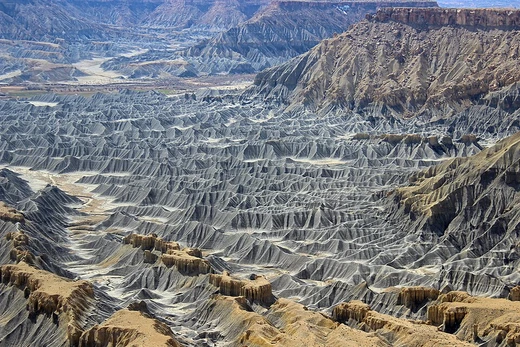
Rockslide
A rapid, en masse downslope movement of solid rock.
Last updated
A rockslide is a type of landslide where solid rock collapses en masse along a bedding plane, rather than as individual blocks.[1] A rockslide involves the transport of solid rock down a slope, unlike a landslide which moves loose sediment.[1]
Quick Facts
- Type
- Geologic mass-wasting event
- Subtype
- Translational slide
- Key agent
- Water as the most effective geologic agent
- Common location
- Over steepened canyons and drainages of Idaho, such as Salmon River Canyon
- Hazard level
- Most dangerous form of mass-wasting due to sudden, rapid release of bedrock
Facts from the source article.
Key facts and history
Water is the most effective geologic agent causing mass-wasting events, adding weight to material and decreasing its resistance to movement.[2] A majority of slides result from a combination of gravitational pressure and erosional influences, though large earthquakes can also trigger them.[3] The sudden release of large, heavy material gives rockslides potential for devastating effects on human life and infrastructure.[2] Rockslides are common in over-steepened canyons, such as Idaho's Salmon River Canyon where elevation differences exceed 5,000 feet.[2]
Excavating a hill, an anthropogenic activity, can alter stress states and lead to slope instability.[4] Because they involve a sudden, extremely rapid release of bedrock along a uniform plane of weakness, rockslides are considered the most hazardous form of mass-wasting.[5]
References
- Wikipedia, "Rockslide" (CC BY-SA 4.0), which cites: Whittow, "Dictionary of Physical Geography", Penguin, 1984; "Flows", California State University, Long Beach (we also read that source) en.wikipedia.org
- Wikipedia, "Rockslide" (CC BY-SA 4.0), which cites: "What is Mass Movement?", Idaho Museum of Natural History (original not read by us) en.wikipedia.org
- Wikipedia, "Rockslide" (CC BY-SA 4.0), which cites: "Types of Wasting: Slump, Rockslide, Debris Flow & Earthflow – Video & Lesson Transcript", Study.com (original not read by us) en.wikipedia.org
- Wikipedia, "Rockslide" (CC BY-SA 4.0), which cites: Tomás, "Preliminary analysis of the mechanisms, characteristics, and causes of a recent catastrophic structurally controlled rock planar slide in Esposende (northern Portugal)", Landslides, 1 August 2023, p. 1657–1665 (original not read by us) en.wikipedia.org
- Wikipedia, "Rockslide" (CC BY-SA 4.0), which cites: "Landslide Types and Processes", USGS, 18 August 2004; "Landslide Types and Processes", USGS, 18 August 2004 (original not read by us) en.wikipedia.org
Each numbered sentence above was checked against the source it cites before publication. Sentences citing Wikipedia adapt text from the English Wikipedia article Rockslide (contributors), used under CC BY-SA 4.0; this entry is available under the same licence. Other sources were used for facts only; no text or images are copied from them.
More in Geomorphology
Sources
Compiled from Wikipedia and the sources listed below. Text from Wikipedia is available under CC BY-SA 4.0; this entry is adapted from it.
- Wikipedia: Rockslide (CC BY-SA 4.0).
Spotted an error? Know more?
Reader corrections go straight into our review queue. Suggest an edit · How this site is sourced