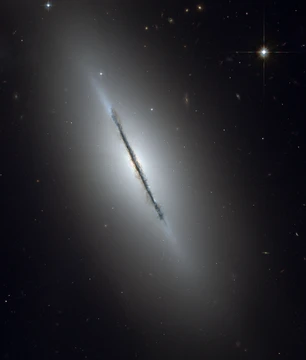
Peculiar galaxy
Galaxies of unusual size, shape, or composition.
Last updated

ESA/Hubble & NASA · via Wikipedia: Peculiar galaxy · CC BY 4.0
A peculiar galaxy is a galaxy that has some abnormality of shape, size, or content that sets it apart from normal ellipticals, spirals, and irregulars in the Hubble classification.[1] Peculiar galaxies make up an estimated 5% to 10% of all known galaxies.[2]
Quick Facts
- Category
- Galaxy type
- Percentage of known galaxies
- 5–10%
- Types
- Interacting galaxies and active galactic nuclei (AGN)
- Common cause
- Gravitational interactions or collisions
Facts from the source article.
Key facts and history
Halton Arp's 1966 catalogue is devoted to peculiar galaxies.[1] Peculiar galaxies are notated by an additional "p" or "pec" after the Hubble type.[3] Highly irregular shapes can result from the mutual gravitational pull when two galaxies approach each other.[4] Because gravitational interactions are the cause of most peculiar galaxies' shapes, the terms 'peculiar galaxy' and 'interacting galaxy' are now used interchangeably.[4]
The collision of two or more galaxies is thought by scientists to be the origin of many peculiar galaxies.[5] Compared to normal galaxies, peculiar galaxies more frequently contain active galactic nuclei, which are signs of supermassive black holes.[5] A slightly bluer color in peculiar galaxies results from both the elevated star formation and the luminosity from active galactic nuclei.[5]
What the research sources say
The Daviddarling.info account states that a ring galaxy is a galaxy with a ring-like appearance.[1] It is believed that such a system was an ordinary galaxy that recently suffered a head-on collision with another galaxy.[1] The same source notes that a satellite galaxy is a small galaxy in orbit around a much larger one.[1] The Daviddarling.info account also describes an active galaxy as any galaxy with an active galactic nucleus.[1]
References
- "peculiar galaxy", Daviddarling.info, 2007-02-01. facts only, no text reused. daviddarling.info
- Wikipedia, "Peculiar galaxy" (CC BY-SA 4.0), which cites: "peculiar galaxy", Daviddarling.info, 2007-02-01; Higdon, "The Encyclopedia of Astronomy and Astrophysics", 2001; "Peculiar Galaxies", www.cliffsnotes.com (we also read that source) en.wikipedia.org
- Wikipedia, "Peculiar galaxy" (CC BY-SA 4.0), which cites: Darling, "peculiar galaxy", www.daviddarling.info (original not read by us) en.wikipedia.org
- Wikipedia, "Peculiar galaxy" (CC BY-SA 4.0), which cites: Millis, "Peculiar Galaxies", space.about.com; Higdon, "The Encyclopedia of Astronomy and Astrophysics", 2001 (we also read that source) en.wikipedia.org
- Wikipedia, "Peculiar galaxy" (CC BY-SA 4.0), which cites: Millis, "Peculiar Galaxies", space.about.com; Higdon, "The Encyclopedia of Astronomy and Astrophysics", 2001; Millis, "Peculiar Galaxies", space.about.com; Higdon, "The Encyclopedia of Astronomy and Astrophysics", 2001; Higdon, "The Encyclopedia of Astronomy and Astrophysics", 2001 (we also read that source) en.wikipedia.org
Each numbered sentence above was checked against the source it cites before publication. Sentences citing Wikipedia adapt text from the English Wikipedia article Peculiar galaxy (contributors), used under CC BY-SA 4.0; this entry is available under the same licence. Other sources were used for facts only; no text or images are copied from them.
More in Galaxies And Their Properties
Sources
Compiled from Wikipedia and the sources listed below. Text from Wikipedia is available under CC BY-SA 4.0; this entry is adapted from it.
- Wikipedia: Peculiar galaxy (CC BY-SA 4.0).
- Word definitions: the Codexery glossary, each quoted from its Wikipedia article.
Spotted an error? Know more?
Reader corrections go straight into our review queue. Suggest an edit · How this site is sourced