Candida albicans
Opportunistic yeast causing candidiasis; model fungal pathogen.
Last updated

DataBase Center for Life Science (DBCLS) · CC BY 4.0
It can cause the infection candidiasis when it overgrows, especially in immunocompromised individuals.[1] The fungus is often used as a model organism for studying fungal pathogens.[2]
Scientific classification
- KingdomFungi
- ClassSaccharomycetes
- OrderSaccharomycetales
- FamilyDebaryomycetaceae
- GenusCandida
- SpeciesCandida albicans
Named by (C.-P. Robin) Berkhout (1923)
Close relatives
Other species of Candida with a Codexery entry.
- Candida parapsilosis Candida parapsilosis
- Candida tropicalis Candida tropicalis
- Candida auris Candida auris
- Candida dubliniensis Candida dubliniensis
- Candida oleophila
Sources: Wikipedia taxobox: Candida albicans (CC BY-SA 4.0)
Where the candida albicans has been recorded
Each dot is a place where the species has been observed and reported (1,496 records, half-degree grid) — not a modelled range. 130 inland records left out (institution coordinates).
Map: drawn by Codexery. Data: GBIF occurrence search (records CC0 / CC BY) · Natural Earth basemap (public domain)
Quick Facts
- Species
- albicans
Facts from the source article.
Biology and range
The genome is highly dynamic, with high heterozygosity caused by chromosomal rearrangements and changes.[3] An unusual feature is that the CUG codon, normally specifying leucine, specifies serine in C. albicans.[4] Healthy adults harbor C. albicans in their gastrointestinal tract and mouth at a prevalence rate of 40–60%.[1] This fungus is capable of surviving in environments external to the human body.[1]
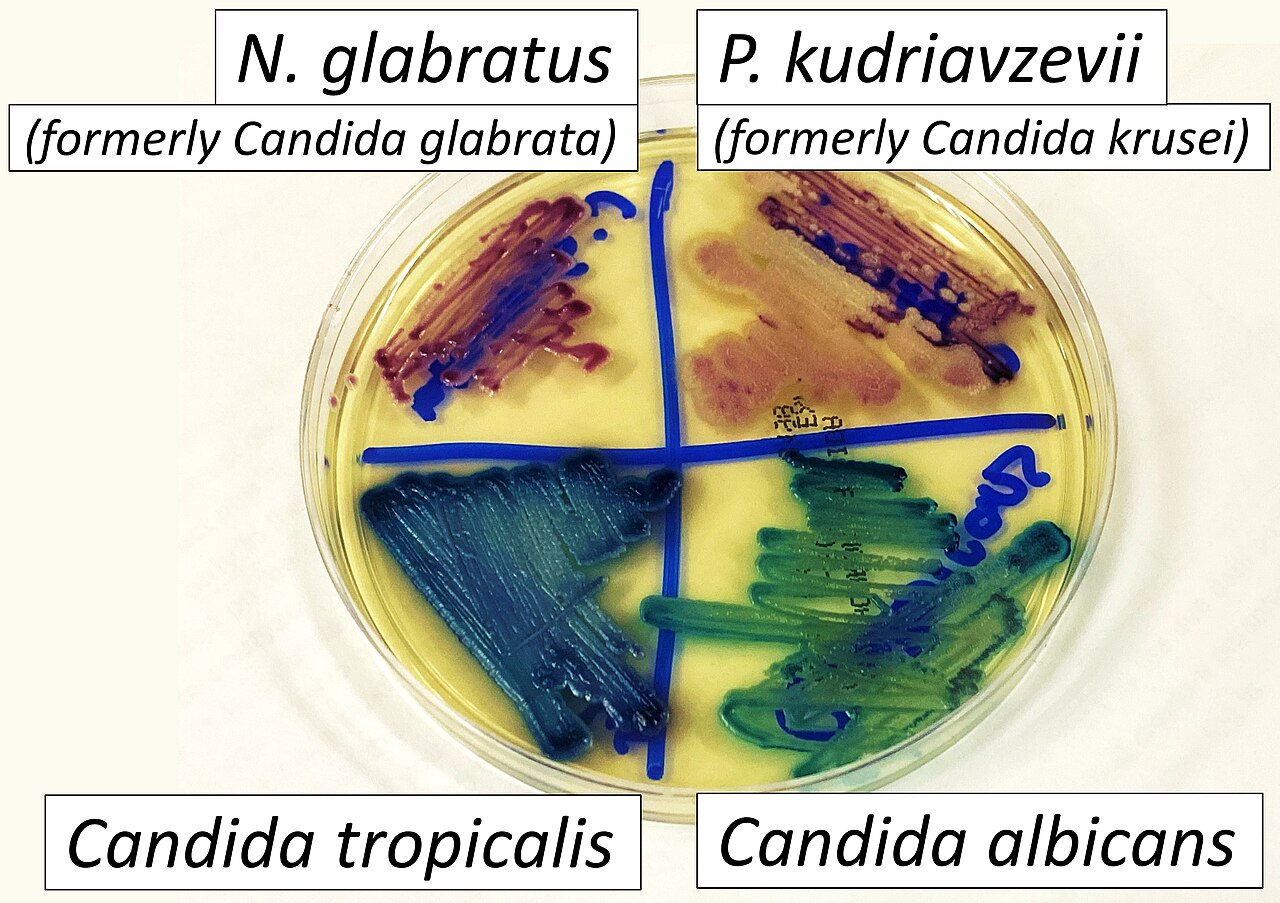
For many years, researchers believed C. albicans was an obligate diploid lacking a haploid stage, but that view has been overturned.[5][6] When diploid cells mate while in the opaque form, they can produce a tetraploid stage.[6] The yeast-form cells of C. albicans measure between 10 and 12 microns in diameter.[7][8]
What the specialist sources record
The "Microbiology and Immunology On-line" account states that C. albicans is an endogenous yeast-like fungus and the most common species in human infections.[7] That same source notes that C. albicans is "polymorphic," growing as budding yeast cells, pseudohyphae, and true hyphae.[7] It also reports that the yeast form is Gram-positive and grows overnight on most bacterial and fungal media.[7] The production of germ tubes and chlamydospores are important characters to identify C. albicans in the lab.[7]
The "Microbiology and Immunology On-line" account describes that prolonged antibiotic therapy destroys normal microbiota balance, allowing overgrowth of endogenous Candida.[7] The GBIF Backbone Taxonomy accepts Candida albicans as a species in kingdom Fungi, phylum Ascomycota, class Saccharomycetes, order Saccharomycetales, family Debaryomycetaceae.[9] GBIF holds 4,730 occurrence records for this taxon.[9]
References
- Wikipedia, "Candida albicans" (CC BY-SA 4.0), which cites: "Diverse Lineages of Candida albicans Live on Old Oaks", Genetics, January 2019, p. 277–288; "Candida and Candidosis: A Review and Bibliography", Bailliere Tindall, 1988; "Oral and maxillofacial surgery", Oxford University Press, 2010, p. 446, 447; "Small intestinal fungal overgrowth", Current Gastroenterology Reports, April 2015; "Small intestinal fungal overgrowth", Current Gastroenterology Reports, April 2015; "Candidiasis: predisposing factors, prevention, diagnosis and alternative treatment", Mycopathologia, June 2014, p. 223–240; en.wikipedia.org
- Wikipedia, "Candida albicans" (CC BY-SA 4.0), which cites: "Candida albicans: A Model Organism for Studying Fungal Pathogens", ISRN Microbiology, 2012 (original not read by us) en.wikipedia.org
- Wikipedia, "Candida albicans" (CC BY-SA 4.0), which cites: "Variations of Candida albicans electrophoretic karyotypes", Journal of Bacteriology, October 1991, p. 6586–6596; "Heterozygosity and functional allelic variation in the Candida albicans efflux pump genes CDR1 and CDR2", Molecular Microbiology, October 2006, p. 170–186; "The diploid genome sequence of Candida albicans", Proceedings of the National Academy of Sciences of the United States of America, May 2004, p. 7329–7334 (original not read by us) en.wikipedia.org
- Wikipedia, "Candida albicans" (CC BY-SA 4.0), which cites: "Non-universal decoding of the leucine codon CUG in several Candida species", Nucleic Acids Research, August 1993, p. 4039–4045; "CGD Help: Non-standard Genetic Codes", Candida Genome Database; Andrzej (Anjay) Elzanowski and Jim Ostell, "The Alternative Yeast Nuclear Code", The Genetic Codes, 7 July 2010; "Selective advantages created by codon ambiguity allowed for the evolution of an alternative genetic code in Candida spp", Molecular Microbiology, February 1999, p. 937–947 (we also read that source) en.wikipedia.org
- Wikipedia, "Candida albicans" (CC BY-SA 4.0), which cites: "Regulatory mechanisms controlling morphology and pathogenesis in Candida albicans", Current Opinion in Microbiology, December 2019, p. 27–34; "Fungal Physiology and Immunopathogenesis", 2019, p. 61–99 (original not read by us) en.wikipedia.org
- Wikipedia, "Candida albicans" (CC BY-SA 4.0), which cites: "The 'obligate diploid' Candida albicans forms mating-competent haploids", Nature, February 2013, p. 55–59; "Candida albicans SC5314 Genome Snapshot/Overview", www.candidagenome.org (original not read by us) en.wikipedia.org
- "Microbiology and Immunology On-line", 2018. facts only, no text reused. microbiologybook.org
- Wikipedia, "Candida albicans" (CC BY-SA 4.0), which cites: ""White-opaque transition": a second high-frequency switching system in Candida albicans", Journal of Bacteriology, January 1987, p. 189–197; "High-frequency switching of colony morphology in Candida albicans", Science, November 1985, p. 666–669; "High-frequency switching in Candida albicans", Clinical Microbiology Reviews, April 1992, p. 183–203; "Microbiology and Immunology On-line", 2018; "Candida albicans", 22 July 2013 (we also read that source) en.wikipedia.org
- GBIF Backbone Taxonomy and occurrence index, Candida albicans (taxon key 2599597). CC BY 4.0 (backbone); counts are facts. gbif.org
Each numbered sentence above was checked against the source it cites before publication. Sentences citing Wikipedia adapt text from the English Wikipedia article Candida albicans (contributors), used under CC BY-SA 4.0; this entry is available under the same licence. Other sources were used for facts only; no text or images are copied from them.
More in Fungi And Fungus-Like Organisms
Sources
Compiled from Wikipedia and the sources listed below. Text from Wikipedia is available under CC BY-SA 4.0; this entry is adapted from it.
- Wikipedia: Candida albicans (CC BY-SA 4.0).
- Occurrence records: GBIF (CC0 / CC BY). Basemap: Natural Earth (public domain).
- Word definitions: the , each quoted from its Wikipedia article.
Spotted an error? Know more?
Reader corrections go straight into our review queue. Suggest an edit · How this site is sourced