Chytridiomycota
Early-diverging fungi with flagellated zoospores, including amphibian pathogens.
Last updated

M. Piepenbring, correction: User:Selso · CC BY-SA 4.0
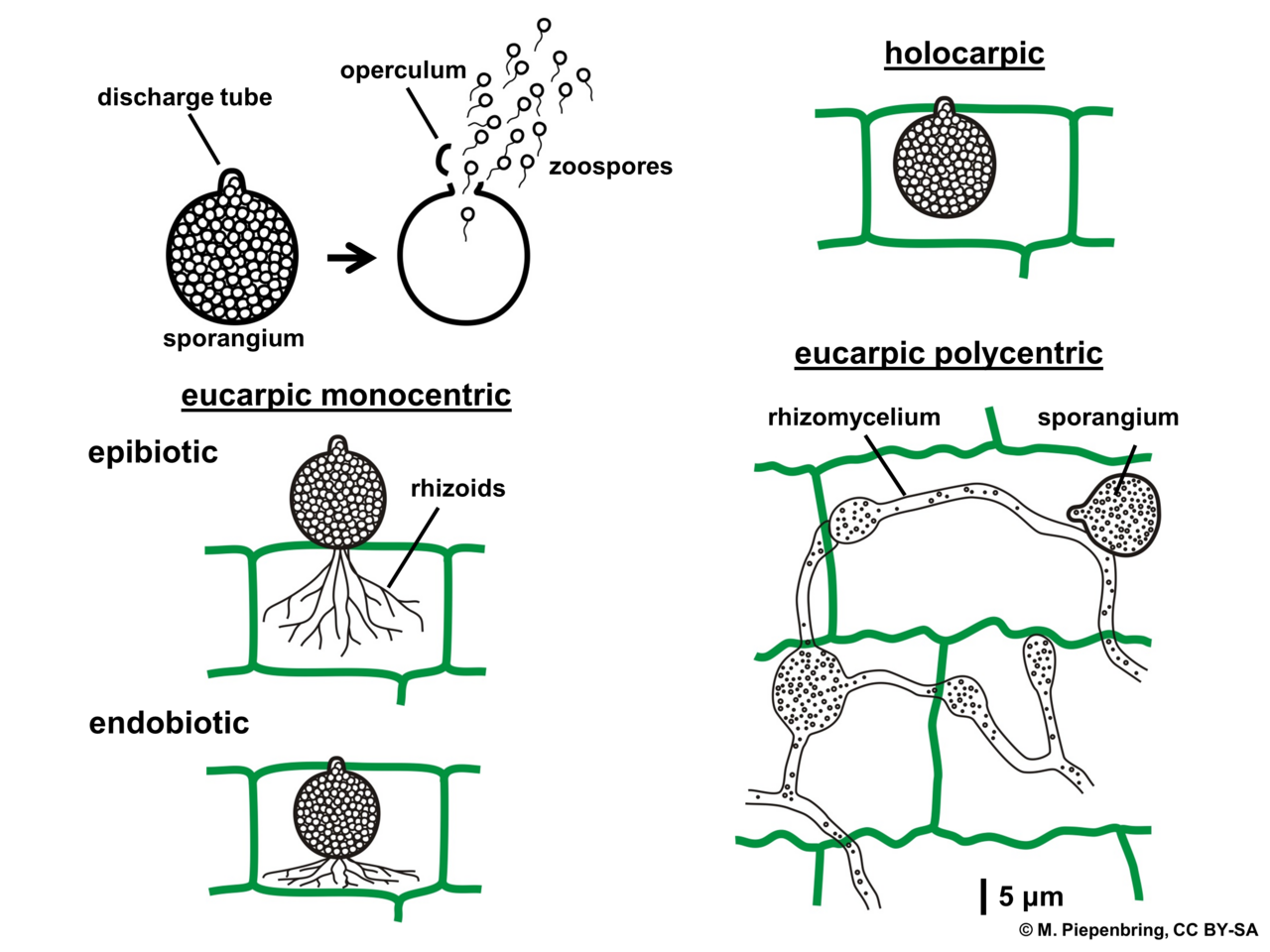
Chytrids are unique among all fungi in having motile stages in their life cycles.[1] Within the kingdom Fungi, the division Chytridiomycota comprises zoosporic organisms that are commonly called chytrids.[2] The term "chytrid" originates from the Ancient Greek word χυτρίδιον, which translates to "little pot" and refers to the structure that holds zoospores before their release.[2]
Quick Facts
- Classification
- Division of zoosporic organisms in kingdom Fungi
- Habitat
- Aquatic and terrestrial, including periglacial soils
- Key trait
- Reproduce with zoospores, unusual among Fungi
Facts from the source article.
Biology and range
Chytrids are one of the earliest diverging fungal lineages, with chitin cell walls and a posterior whiplash flagellum.[2] They reproduce with zoospores, which is unusual among the Fungi.[3] They have been isolated from aquatic habitats including peats, bogs, rivers, ponds, springs, and ditches.[4] Chytrids also occur in terrestrial habitats such as acidic soils, alkaline soils, temperate forest soils, rainforest soils, and Arctic and Antarctic soils.[4]
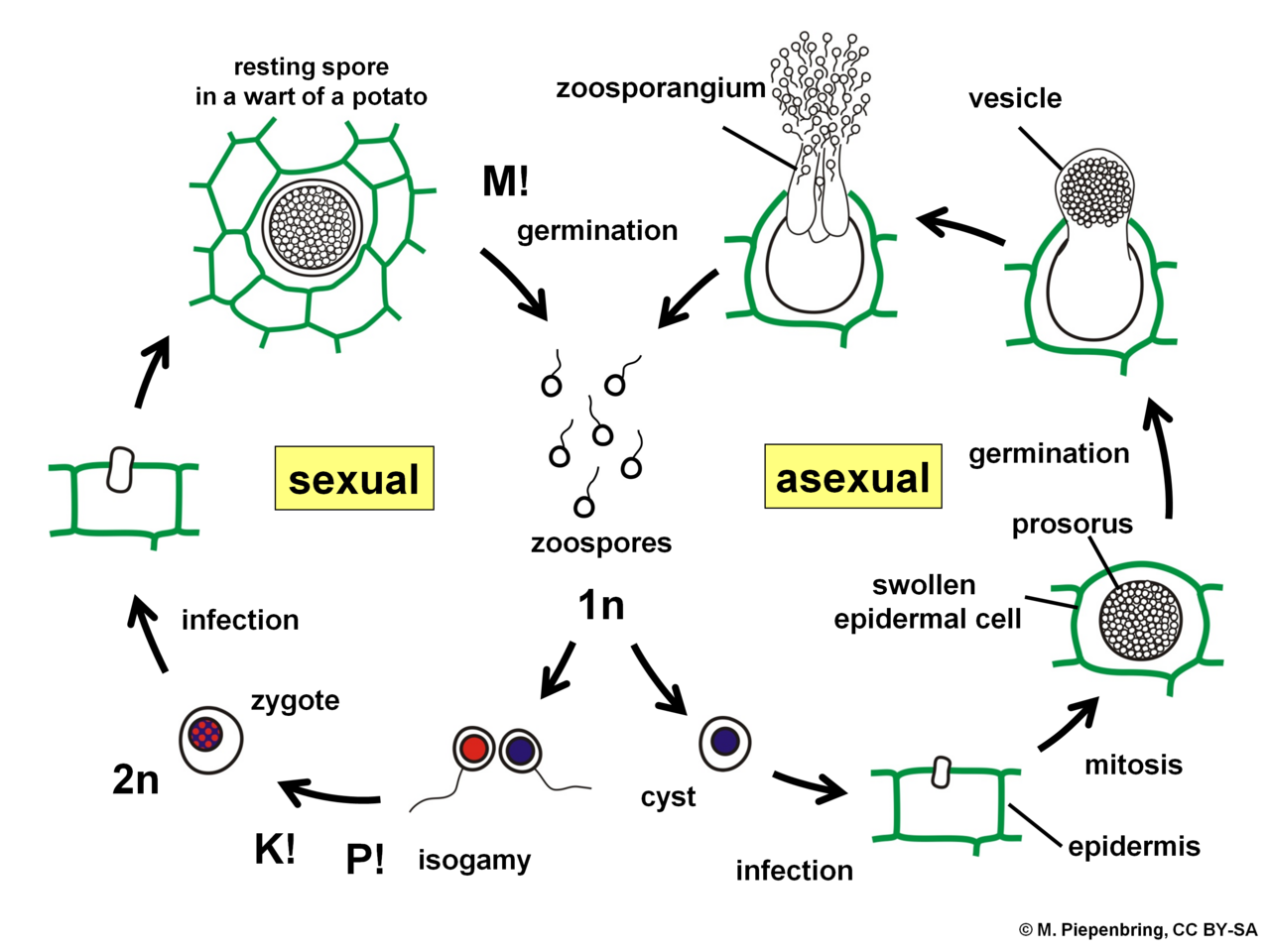
Zoospores, which are presumably produced through mitotic division, are released during asexual reproduction.[5] As saprobes, chytrids break down tough substances like chitin and keratin, and they can also function as parasites.[6] Periglacial soils represent an unexpected terrestrial habitat where chytrids are found.[7] The Scottish Rhynie chert, a Devonian-age lagerstätte, contains the oldest known chytrid fossils.[8]
What the specialist sources record
The GBIF Backbone Taxonomy accepts Chytridiomycota as a phylum within kingdom Fungi.[9] GBIF holds 539,382 occurrence records for this taxon as of 9 October 2026.[9] The "Chytridiomycota" account notes that during asexual reproduction the zoospores swim away in search of new pollen grains.[1]
References
- "The Chytridiomycota", nbm-mnb.ca. facts only, no text reused. website.nbm-mnb.ca
- Wikipedia, "Chytridiomycota" (CC BY-SA 4.0), which cites: "Introductory Mycology", John Wiley & Sons, 1996; Kendrick, Bryce, "The Fifth Kingdom", Focus Publishing, 2000 (original not read by us) en.wikipedia.org
- Wikipedia, "Chytridiomycota" (CC BY-SA 4.0), which cites: Sparrow, F.K., "Aquatic Phycomyete", The University of Michigan Press, 1960; Hibbett, "A higher-level phylogenetic classification of the Fungi", Mycologia, 2007, p. 509–547 (original not read by us) en.wikipedia.org
- Wikipedia, "Chytridiomycota" (CC BY-SA 4.0), which cites: Sparrow, F.K., "Aquatic Phycomyete", The University of Michigan Press, 1960; Sparrow, F.K., "Aquatic Phycomyete", The University of Michigan Press, 1960; Letcher, "Rhizophlyctidales – a new order in Chytridiomycota", Mycological Research, 2008, p. 1031–1048; Simmons, "Phylogeny of Powellomycetacea fam. nov. and description of Geranomyces variabilis gen. et comb. nov", Mycologia, 2011, p. 1411–1420; Sparrow, F.K., "Aquatic Phycomyete", The University of Michigan Press, 1960; "Temporal variation of the small eukaryotic community in two fr en.wikipedia.org
- Wikipedia, "Chytridiomycota" (CC BY-SA 4.0), which cites: Sparrow, F.K., "Aquatic Phycomyete", The University of Michigan Press, 1960 (original not read by us) en.wikipedia.org
- Wikipedia, "Chytridiomycota" (CC BY-SA 4.0), which cites: Sparrow, F.K., "Aquatic Phycomyete", The University of Michigan Press, 1960; Blackwell, "The Fungi: 1,2,3 … million species?", American Journal of Botany, 2011, p. 426–438; Longcore, "Batrachochytirum dendrobatidis gen. et sp. nov., a chytrid pathogenic to amphibians", Mycologia, 1999, p. 219–227 (original not read by us) en.wikipedia.org
- Wikipedia, "Chytridiomycota" (CC BY-SA 4.0), which cites: Freeman, "Evidence that chytrids dominate fungal communities in high-elevation soils", Proceedings of the National Academy of Sciences of the USA, 2009, p. 18315–18320 (original not read by us) en.wikipedia.org
- Wikipedia, "Chytridiomycota" (CC BY-SA 4.0), which cites: "Allomyces in the Devonian", Nature, 1994, p. 601 (original not read by us) en.wikipedia.org
- GBIF Backbone Taxonomy and occurrence index, Chytridiomycota (taxon key 94). CC BY 4.0 (backbone); counts are facts. gbif.org
Each numbered sentence above was checked against the source it cites before publication. Sentences citing Wikipedia adapt text from the English Wikipedia article Chytridiomycota (contributors), used under CC BY-SA 4.0; this entry is available under the same licence. Other sources were used for facts only; no text or images are copied from them.
More in Fungi And Fungus-Like Organisms
Sources
Compiled from Wikipedia and the sources listed below. Text from Wikipedia is available under CC BY-SA 4.0; this entry is adapted from it.
- Wikipedia: Chytridiomycota (CC BY-SA 4.0).
- Word definitions: the , each quoted from its Wikipedia article.
Spotted an error? Know more?
Reader corrections go straight into our review queue. Suggest an edit · How this site is sourced