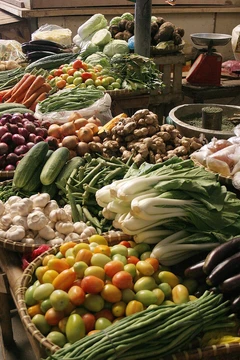
Gai lan
A leafy vegetable with thick stems and small florets.
Its flavor is noticeably stronger and slightly more bitter than broccoli.[1] The white blossoms of the flowering plant resemble those of hoary stock.[1] Gai lan, also known as Brassica oleracea var. alboglabra, is a leafy vegetable whose leaves are thick, flat, and glossy blue-green, with thick stems and florets that resemble broccoli's but are much smaller.[2]
Quick Facts
- Species
- Brassica oleracea
- Group
- Alboglabra Group
Facts from the source article.
Key facts and history
Gai lan is a cool season crop that grows best between 18 and 28 °C.[3] It withstands hotter summer temperatures better than other brassicas like broccoli or cabbage.[3] Market-sized gai lan is typically 15 to 20 cm tall, but a "baby" version is produced by crowding seedlings with generous fertilization.[3] In Chinese cuisine, common preparations include stir-frying with ginger and garlic, or boiling and serving with oyster sauce.[4]
Approximately 60 to 70 days after planting, before flowering begins, the crop is gathered.[3] If the plant bolts, its stems may turn woody and become tough.[3] In Americanized Chinese food, when gai lan was unavailable, Western broccoli often took its place.[5][6]
What the cited sources add
A 2008 university publication notes that the original Chinese dish "beef and broccoli" actually uses gai lan, a leafy vegetable different from Western broccoli.[6]
References
- Wikipedia, "Gai lan" (CC BY-SA 4.0), which cites: "Kai-lan – Cuisine of Myanmar (Burma)", Trek Zone (original not read by us) en.wikipedia.org
- Wikipedia, "Gai lan" (CC BY-SA 4.0), which cites: Patrick J. Cummings, "A Dictionary of Hong Kong English: Words from the Fragrant Harbor", Hong Kong University Press, 2011, p. 62; (we also read that source) en.wikipedia.org
- Wikipedia, "Gai lan" (CC BY-SA 4.0), which cites: Rana, "Vegetable Crop Science", CRC Press, 2018, p. 289–298; Hutton, "A Cook's Guide to Asian Vegetables", Periplus Editions, 2004, p. 42–43 (we also read that source) en.wikipedia.org
- Wikipedia, "Gai lan" (CC BY-SA 4.0), which cites: "Kai-lan – Cuisine of Myanmar (Burma)", Trek Zone; Hutton, "A Cook's Guide to Asian Vegetables", Periplus Editions, 2004, p. 42–43 (we also read that source) en.wikipedia.org
- Wikipedia, "Gai lan" (CC BY-SA 4.0), which cites: "History and Culture: Chinese Food New University UC Irvine", 2008-06-02; Hung, "When authenticity means a heaping plate of Tex-Mex", San Francisco Chronicle, 2019-10-31 (we also read that source) en.wikipedia.org
- "History and Culture: Chinese Food New University UC Irvine", 2008-06-02. facts only, no text reused. newuniversity.org
Each numbered sentence above was checked against the source it cites before publication. Sentences citing Wikipedia adapt text from the English Wikipedia article Gai lan (contributors), used under CC BY-SA 4.0; this entry is available under the same licence. Other sources were used for facts only; no text or images are copied from them.
More in Fruits & Vegetables
Spotted an error? Know more?
Reader corrections go straight into our review queue. Suggest an edit · How this site is sourced