Radway
Last updated
Where it is
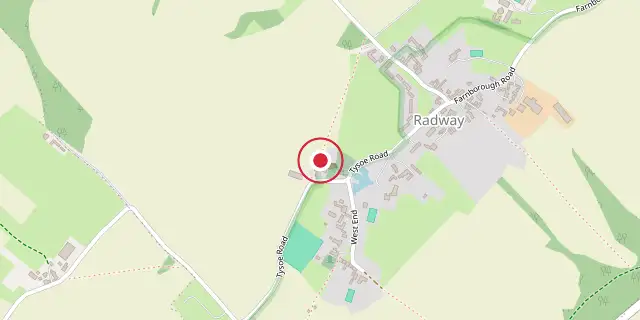
Coordinates: 52°07′48″N 1°27′50″W (52.1300, -1.4640) · Open in OpenStreetMap
Coordinates and connected clubs: the infobox of Wikipedia: Radway (CC BY-SA 4.0). Map: drawn by Codexery from OpenStreetMap tiles.
Radway is a village and civil parish in Warwickshire, England, located about 7 miles north-west of Banbury in Oxfordshire. It lies at the foot of Edge Hill and is notable as the site of the Battle of Edgehill, one of the early major engagements of the English Civil War. The population at the 2011 census was 238.
History
Radway first appears in the historical record in the Domesday Book of 1086. Its medieval lands were split between Arbury Priory and Stoneleigh Abbey. Following Henry VIII’s dissolution of the monasteries in the 1530s, these lands were given to members of his court, especially the Coke family, and the old manorial system dissolved as properties changed hands. The Battle of Edgehill, a key early clash of the English Civil War, took place in the fields around Radway and its neighboring parishes.
During and after the Commonwealth, Radway was a Puritan stronghold, and local Quakers faced persecution and imprisonment, prompting a small group to leave in the 1680s for a Quaker settlement in Gloucester County, West New Jersey; letters from that colony survive in the local record office. The village was enclosed in the 1750s and was the final home of Sir Steven Runciman. Radway also has a cricket club.
Architecture
The Grange began as an Elizabethan gentleman's house before Sanderson Miller gave it a major Gothic Revival makeover. Sitting below where the original Stoneleigh Abbey grange once stood, it remains a private home. Before becoming Commander in Chief on the Western Front during World War One, Douglas Haig lived there. Today, David Richards, who used to chair Aston Martin, owns the property.
On the ridge next to the hamlet of Edgehill stands the Octagonal Tower, a folly Miller designed as a scaled-down copy of a Warwick Castle tower. It has operated as a pub since it was built, first called the Inniskilling Dragoon in 1817 and now known as the Castle Inn. Some say it occupies the site of another grange complex, Ratley Grange, also belonging to Stoneleigh Abbey, but Miller’s own diaries record the Tower as standing opposite that grange.
The parish church of Saint Peter, built in 1866, was designed by Gothic Revival architect Charles Buckeridge. Traces of an earlier medieval church remain visible. Inside, memorials moved from the old church include a 15th-century priest’s effigy, an effigy of Captain Henry Kingsmill—who fought for Charles I and fell at the Battle of Edgehill—and one of Sanderson Miller, who died in Radway. The church has five bells, all cast by Robert Stainbank at the Whitechapel Bell Foundry in 1868.
In 2015, a permanent exhibition called ‘The People’s Struggle,’ funded by the Heritage Lottery, opened inside the church, focusing on the nearby Edgehill battlefield and its effect on local people. Two duplicate wind-up audio guides for visitors were also placed around the village.
More in Folly Castles in England
Sources
Compiled from Wikipedia and the sources listed below. Text from Wikipedia is available under CC BY-SA 4.0; this entry is adapted from it.
- Wikipedia: Radway (CC BY-SA 4.0).
Spotted an error? Know more?
Reader corrections go straight into our review queue. Suggest an edit · How this site is sourced