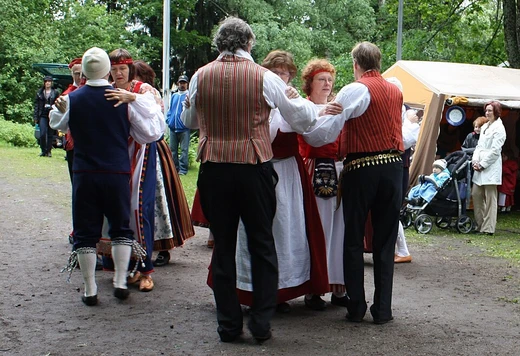
Folklore of Finland
Finnish folklore encompasses rural traditions, folk poetry, and regional variation.

Finland’s folklore covers the country’s traditional practices, beliefs, knowledge, technologies, attitudes, and habits. In a broad sense, it includes all of traditional Finnish folk culture, with a strong focus on rural customs. It is set apart from new, commercial, or foreign contemporary culture, as well as from so-called “high culture.” As folklorist Alan Dundes outlined, folklore includes oral stories and other verbal traditions, music, traditional objects and buildings, religious and belief systems, and culinary traditions.
Variation in Finnish folklore is significant, shaped by the country’s long and complex history. A major divide exists between east and west: eastern Finland, historically under Russian influence, features tales of bogatyrs and other Russian folk heroes, while western Finland, influenced by Sweden, shares stories of trolls, elves, and creatures from Scandinavian mythology. Another key contrast is between coastal and inland regions. Coastal areas, with centuries of contact from Vikings and the Hanseatic League, developed folklore rich in seafaring and trading tales. Inland, more isolated areas preserved traditions centered on farming, hunting, and fishing. Local geography, climate, and ethnic makeup further diversify these regional traditions, so there is no single “Finnish” folklore—only many distinct local variations.
Folk poetry collection began in the 19th century, funded by the Finnish Literature Society. These efforts produced the world’s largest folk poetry archive: a card index of about 2.2 million cards. The Society sponsored ten trips by Elias Lönnrot, who edited collected poems into the national epics *Kalevala* and *Kanteletar*, and also published collections of Finnish fairy tales and riddles.
A notable figure is Joulupukki, the Finnish Christmas character. The name literally means “Christmas goat” or “Yule Goat”; *pukki* comes from the Teutonic root *bock*, related to English “buck” and “Puck,” meaning “billy-goat.” Originating from an old Scandinavian custom, the figure eventually merged with Santa Claus.
Traditional Finnish foods often feature wholemeal products like rye, barley, and oats, along with berries such as blueberries, lingonberries, cloudberries, and sea buckthorn. Milk and its derivatives, like buttermilk, are common as food, drink, or ingredients.
- Field
- Folklore
- Nationality
- Finnish
- Known for
- Rich and varied folklore tradition with regional variation, including folk poetry, dances, foods, and sauna culture
Lore & Background
Finland's folklore tradition varies considerably by region, shaped by historical influences. Eastern Finnish folklore shows Russian influences, including tales about bogatyrs and other Russian folk heroes, while western Finnish folklore is more closely related to Swedish folklore, with tales about trolls, elves, and other Scandinavian creatures. Coastal regions, with a history of contact with Vikings and the Hanseatic League, developed folklore about seafaring and trading, whereas inland regions have more traditional folklore focused on farming, hunting, and fishing.
Reader's Guide
Folk poetry collection trips, starting from the 19th century and funded by the Finnish Literature Society, resulted in the world's largest folk poetry archive—a card index of about 2.2 million cards. These trips included ten by Elias Lönnrot, who edited collected poems into the national epic Kalevala and Kanteletar, and published collections of Finnish fairy tales and riddles. Notable figures include Joulupukki, a Finnish Christmas figure whose name means 'Christmas goat' or 'Yule Goat,' derived from the Teutonic root bock, and which became conflated with Santa Claus. Traditional Finnish foods often use wholemeal products and berries, with examples such as Karelian pies, bread cheese, mämmi, rice porridge, Karelian stew, fish soup, black sausage, meatballs, and pancake. Folk dances include humppa, jenkka, letkajenkka, polska, and Säkkijärven polkka. Living sauna culture retains ancient traditions, and the tradition of communal work, talkoo, remains strong. Oral tradition, including fairy tales, folk wisdom, proverbs, and poetry in Kalevala metre, has been passed down through generations.
Did You Know?
- The folk poetry archive contains about 2.2 million cards, making it the world's largest such archive.
- Joulupukki, the Finnish Christmas figure, originally meant 'Christmas goat' and became conflated with Santa Claus.
- Traditional Finnish saunas can reach temperatures of 80-100 °C.
Linguistic Roots and a Pan-European Family
The names for these water spirits stretch across an extraordinary web of languages, all tracing back to a Proto-Indo-European root meaning "to wash." From Old English nicor to Finnish näkki, from Danish nøkke to Icelandic nykur, from Dutch nikker to German Nixe, the family of terms is remarkably widespread. Scholars connect these forms to Common Germanic *nikwus or *nikwis(i), and further to Sanskrit nḗnēkti, Greek nízō and níptō, and Irish nigh—all sharing the sense of washing or being washed. The Old High German nihhus even carried the meaning "crocodile," while Old English nicor could denote both a water monster like those Beowulf encountered and a hippopotamus. Similar water-dwelling figures appear well beyond Germanic Europe: France's Melusine, Asturias's Xana, and the Slavic Rusalka all occupy a comparable mythological niche. The modern English word "nixie" itself arrived via German Nixe, the feminine counterpart of Nix, passing through Middle High German nixe and Old High German nicchessa, which meant "water-spirit, water-elf, crocodile."
The Finnish Näkki and the Music of the Waters
In Finnish and broader Nordic tradition, the näkki is a male water spirit whose defining act is playing enchanted music on instruments, drawing women and children toward the drowning depths of lakes and streams. The Finnish figure shares this role with the Swedish brunnsgubben, the "well man," and the Sami rávga, all of whom can drag people beneath the surface. Yet the picture is not uniformly sinister. Many tales describe the näkki as entirely harmless to his listeners, his sweet melodies attracting men as readily as women. In some stories, a human falls in love with the spirit, and the two agree to live together—though the union typically ends when the näkki returns to his home in a nearby waterfall or brook, for he grows despondent without free, regular contact with a water source. The powerful Norwegian Fossegrim and Swedish Strömkarlen represent a related tier of these figures: nature spirits of such musical mastery that, if properly approached, they could teach a human musician to play until trees danced and waterfalls halted at the sound.
Shapeshifters and the Brook Horse
Pinpointing the true appearance of the nix is nearly impossible, because shapeshifting was considered his most essential quality. Some scholars suggest he may not have possessed any fixed form at all. He might present himself as a man fiddling along a brook or waterfall—often imagined today as fair and naked, though older folklore more frequently described him in elegant clothing. Equally, he could manifest as glittering treasure, a collection of floating objects, or an animal, most commonly a "brook horse." The modern Scandinavian names derive from nykr, which literally means "river horse," strongly implying that the equine figure preceded the later personification of the nix as a man in the rapids. In southern Scandinavia, this horse-form takes the specific name Bäckahästen, the "brook horse," echoing the Scottish kelpie and the Welsh Ceffyl Dŵr. In Icelandic and Faroese tradition, the nykur is explicitly described as a horselike creature, preserving what may be the oldest layer of the myth.
Dangers, Defenses, and the Shadow of Faith
The nixie's music posed the gravest threat to women and children, particularly pregnant women and unbaptised infants. The spirit was thought most active on Midsummer's Night, Christmas Eve, and Thursdays—though many of these temporal restrictions likely crystallized only after the Christianization of the northern lands, paralleling the development of similar faerie beliefs elsewhere. When a malicious nixie attempted to carry someone off, villagers believed they could defeat it simply by calling its name, a spoken word that would cause the spirit's death. Conversely, a person who wished to learn the nixie's enchanting music could purchase the lesson by offering three drops of blood, a black animal, a splash of brännvin, or a pinch of snus dropped into the water. The nixie also served as an omen: a loon-like scream from a particular spot in a lake or river foretold a drowning fatality at that very place. Swimmers seeking protection against such a fate could throw a small piece of steel into the water.
Frequently Asked Questions
What exactly counts as Finnish folklore?
Finnish folklore refers to the traditional, community-rooted practices and beliefs passed down through generations in rural Finland. It encompasses everything from oral storytelling and folk poetry to sauna rituals, traditional cooking, and seasonal customs. It is deliberately distinguished from modern commercial culture or academic 'high culture.'
What are the main elements of Finnish folklore?
The tradition spans verbal arts like folk poetry and songs, as well as music, dance, and ritual practices. It also covers material culture such as traditional buildings, crafts, and food preparation methods. Religious beliefs and seasonal customs form another core layer of the tradition.
Why does Finnish folklore vary so much by region?
Finland's geography and historical settlement patterns meant that communities developed their own distinct customs, dialects, and ritual practices over centuries. A folk song or a sauna custom in Lapland can look quite different from those in the south. This regional diversity is considered a defining feature of the tradition rather than a flaw.
How is Finnish folklore different from just 'old stories'?
It goes far beyond narrative tales to include embodied practices like dance, cooking, building, and seasonal rituals. The tradition is living and community-based, sustained through participation rather than written texts alone. It covers the full spectrum of a community's inherited knowledge and creative expression.
Why do fans and scholars care about preserving Finnish folklore?
It represents a complete worldview of rural Finnish life that is increasingly at risk as modernization reshapes daily habits. The tradition carries unique knowledge about nature, craft, and social organization that isn't recorded anywhere else. Preserving it keeps alive a distinct cultural identity tied to specific landscapes and communities.
More in Finnish folklore 1-20
Spotted an error? Know more?
Reader corrections go straight into our review queue. Suggest an edit · How this site is sourced