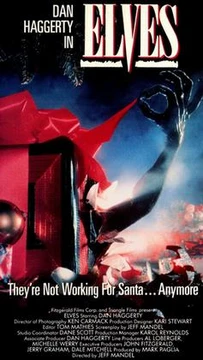
Elves (film)
A 1989 Christmas horror film with Nazi elves.

Elves is a 1989 American Christmas horror film directed by Jeffrey Mandel, with Dan Haggerty, Deanna Lund, and Ken Carpenter in the cast.
The story follows teenager Kirsten, who accidentally cuts her hand during a pagan "Anti-Christmas" ritual in the woods with her friends Brooke and Amy. Her blood awakens an ancient demonic Christmas elf, which becomes central to a modern Neo-Nazi scheme to create the master race. It turns out Hitler’s plan involved half-human, half-elf hybrids, and the Nazis secretly practiced an elf-based cult religion. Kirsten is the last pure-blooded Aryan virgin—her grandfather, a former Nazi who later reformed, is also her father, as inbreeding was considered essential to preserving the bloodline. Unaware of this, Kirsten sulks through the holiday season while working at a department store snack counter.
Mike McGavin, an ex-cop fired for alcoholism, is jobless, penniless, and facing eviction from his trailer. He gets a job as the store Santa after the previous Santa is killed by the elf. With nowhere to go, Mike sleeps in the storage room and eats leftover snacks. One night, he discovers Kirsten and her friends sneaking into the store for a party. Instead of their boyfriends, a Nazi group arrives to kidnap Kirsten and find the elf. Mike helps her escape, though her friends die. Fired for breaking in, Mike and Kirsten investigate. After visiting a college library and breaking into a professor’s home, Mike learns the plot. A final confrontation occurs at Kirsten’s home, ending in the woods where Kirsten destroys the elf using an "elfstone" from her grandfather’s study. The next morning, snow falls on a destroyed forest, and the film closes on an image of a fetus, hinting the plan may have succeeded despite the elf’s inability to mate with Kirsten.
The cast includes Dan Haggerty as Mike McGavin, Julie Austin as Kirsten, Deanna Lund as Kirsten’s mother, Borah Silver as her grandfather, Mansell Rivers-Bland as Rubinkraur, Christopher Graham as Willy, Laura Lichstein as Brooke, Stacey Dye as Amy, Winter Monk as Kurt, Jeff Austin as Emil, Allen Lee as Dr. Fitzgerald, Paul Rohrer as Prof. O’Conner, Ken Carpenter as Shaver, Michael Tatlock as Hugh Reed, Michael Herst as Sgt. DeSoto, Chris Hamner as Kevin, D.L. Walker as Dave, and James Albert as Mark.
The film had a limited theatrical release in 1989 with a PG-13 rating.
Quick Facts
- Director
- Jeffrey Mandel
- Producer
- Mark Paglia
- Starring
- Dan Haggerty / Deanna Lund / Ken Carpenter
- Music
- Vladimir Horunzhy
- Cinematography
- Kenny Carmack
- Editing
- Tom Matthies
- Studio
- Action International Pictures
- Distributor
- Action International Pictures / AIP Home Video
- Released
- 24 October 1989
- Runtime
- 89 minutes
- Country
- United States
- Language
- English
Facts from the source article.
Lore & Background
The plot follows teenager Kirsten, who accidentally cuts her hand during an 'Anti-Christmas' pagan ritual, awakening an ancient demonic Christmas elf. The elf is central to a modern-day Neo-Nazi plot to create a master race of half-human/half-elf hybrids, a secret Nazi religion involving elves. Kirsten is the last pure-blooded Aryan virgin, her grandfather being a former Nazi and also her father due to inbreeding. Ex-cop Mike McGavin, an alcoholic who lost his badge, becomes the store Santa after the previous Santa is murdered by the elf. He helps Kirsten escape from Nazis who plan to kidnap her and find the elf. After a climactic showdown, Kirsten destroys the elf using an 'elfstone' ritual. The film ends with a fetus image, suggesting the plot may have succeeded.
Reader's Guide
Elves is notable for its absurd and convoluted plot, mixing Christmas horror with Nazi occultism and incestuous bloodlines. Critics have panned it for being slow, mean-spirited, and unintentionally funny. Ryne Barber from HorrorNews.net called it 'so bad it’s funny' but not worth watching except for hardcore bad-movie fans. Charles Tatum from DVD Talk gave it 1/5 stars, calling it 'very ugly' and 'mean.' Brett Gallman from Oh, the Horror! criticized its absurd plot and dialogue as 'completely harmless.' Jeremy Wheeler from AllMovie described it as a 'horrendously strange low-budget opus' that delivers ridiculous entertainment. The film has never been released on DVD or Blu-ray as of 2025, remaining a VHS-era curiosity.
Did You Know?
- The film was given a PG-13 rating.
- It was released on VHS on December 19, 1994 by AIP Home Video and Hemdale Home Video.
- As of 2025, the film has no DVD or Blu-ray release.
- The plot involves a Neo-Nazi plan to create a master race of half-human/half-elf hybrids.
From Norse Roots to the Modern Fantasy Shelf
The familiar image of elves as pointy-eared humanoids with a deep affinity for nature and animals traces its lineage back to the álfar of Norse mythology. These semi-divine beings of human stature established the foundational template that later fantasy writers would expand and reshape. Notably, this popular conception diverges sharply from the elves encountered in medieval folklore and Victorian-era literature, revealing a complex evolution of the concept across centuries. The explicit bridge between those older traditions and the modern fantasy elf was first crossed in Lord Dunsany's 1924 novel The King of Elfland's Daughter, which introduced Norse-style elves into the speculative fiction tradition. From that moment forward, the elf became a recognizable species in modern fantasy, carrying an aura of ancient myth while being continuously reinterpreted to serve new narrative purposes. The result is a creature that feels simultaneously primordial and freshly invented, a defining hallmark of modern fantasy worldbuilding.
Tolkien's Living Mythology
In Tolkien's legendarium, elves function not merely as characters but as living repositories of an entire world's mythological history. Their biology is meticulously detailed: pregnancy spans roughly a year, infants can speak and dance by age one, and physical maturity is not reached until somewhere between the fiftieth and one hundredth year. They marry once, freely, and for love, with betrothal lasting at least a year and sealed by the exchange of rings. Sexual intimacy is treated as a sacred, intimate act leading to children, and married elves cannot be coerced. Their culture centers on smithwork, sculpture, music, and the arts, with males and females holding equal standing. Tolkien's deepest innovation, however, was linguistic: he created entire constructed languages—Quenya and Sindarin—before the stories themselves existed, and his elves are credited with devising the Tengwar and Cirth writing systems. Their immortality carries a cost; spirits of the slain go to the Halls of Mandos, and eventually the immortal spirit overwhelms the body, rendering elves invisible to mortal eyes at the world's end. They often sail from the Grey Havens toward Valinor, weary of Middle-earth.
The Tolkien Standard and Its Challengers
The enormous popularity of The Lord of the Rings in the 1950s cemented a particular vision of elves as the default template for modern fantasy. From the 1960s onward, Tolkien-like elves became standard non-human characters in high fantasy novels and role-playing games, their beauty, longevity, and alien craftsmanship serving as a benchmark. Yet other authors pushed back or reimagined the concept. Poul Anderson's 1954 The Broken Sword offered grim, Norse-style elves of human size, a deliberate departure from Tolkien's ethereal figures. Guy Gavriel Kay's Fionavar Tapestry series, beginning with The Summer Tree in 1984, split the concept into lios alfar (light elves) and swart alfar (dark elves), drawing on original Norse and Icelandic terminology to create a duality that maps onto Tolkien's elves and goblins. Philip Mazza's 2014 post-apocalyptic The Harrow recontextualized elves as part of the En' Edan, a broader category of good and righteous races alongside dwarves and northern humans. Even Luc Besson's Arthur and the Minimoys franchise reimagined elves as tiny, two-millimeter-tall beings of African descent, blending modern and medieval aesthetics. Each of these works demonstrates that the elf, while shaped by Tolkien, remains a malleable mythic figure.
Elves in Play and Popular Culture
In the Dungeons & Dragons role-playing game, elves occupy a central position as one of the primary playable races, appearing prominently in the narratives of numerous setting worlds. They are celebrated for their grace, their mastery of both magic and martial arts—particularly the bow and sword—and their extraordinary longevity, capable of living well beyond five hundred years while retaining youthful physical appearance. Physical maturity arrives at around age twenty-five, with emotional maturity not fully achieved until approximately one hundred and twenty-five years. Their innate beauty and poise make them objects of wonder within the game's fictional worlds. This treatment reflects and reinforces the post-Tolkien consensus: elves as long-lived, beautiful, wise, and possessing sharper senses than humans, with abilities that border on the magical. The D&D framework also codified the idea that elves may originate from an age preceding other races, making them living relics of a setting's mythology and the primary source of its lore. This positioning elevates them from mere characters to foundational world-elements, a role that echoes Tolkien's own use of elves as the wellspring of Middle-earth's history and language.
Frequently Asked Questions
What is Elves (1989)?
Elves is a 1989 American Christmas horror film helmed by director Jeffrey Mandel. It blends holiday-season tropes with Nazi mythology and occult horror in a single narrative.
What is the plot of Elves?
A teenage girl accidentally cuts her hand during a pagan Anti-Christmas ritual in the woods, which stirs an ancient demonic elf to life. That awakening becomes entangled with a modern Neo-Nazi conspiracy built on Hitler's secret plan to breed half-human, half-elf hybrid warriors.
Who stars in Elves and who directed it?
The principal cast includes Dan Haggerty, Deanna Lund, and Ken Carpenter, while Jeffrey Mandel sits in the director's chair. The film was produced in the United States.
What genre and rating does Elves carry?
It is classified as a Christmas horror film and carries a PG-13 rating. It was released in 1989.
Why is Elves considered notable among holiday horror fans?
The film stands out for fusing Nazi occult mythology with traditional elf folklore inside a Christmas-horror framework, a combination rarely seen in the subgenre. It has since developed a cult following among viewers who seek out obscure holiday horror titles.
More in Films about elves 1-19
Spotted an error? Know more?
Reader corrections go straight into our review queue. Suggest an edit · How this site is sourced